Showing posts with label Ypres. Show all posts

Friday, January 14, 2011

Day Thirteen: 13 November 2010

Today was a 'travel day': my last day in Belgium, in Ypres, and on the European continent.   It was time to go back to the UK, to spend the last five days of my unforgettable journey.

It started with another awesome breakfast at Erna's B&B.   It was hard to bid her farewell, and say adequate 'thanks' for such a wonderful stay.   She and I had several wonderful chats during my stay.   She showed me so many photos, old postcards, and videos of Ypres, and I think she was pleased with the interest I showed!

Around 8 or so, the doorbell rang: it was my friend Steve Douglas, come to take me to the Ypres train station.   I asked him to go to the upstairs landing, to bring my bag down; it was a bit heavy, and I didn't trust my footing on the slight spiral staircase.   I hugged Erna goodbye, and Steve and I went out into the rainy morning, for the short drive to the station.    We pulled up out front, and Steve got my bag out of the van.   I hugged him good-bye, and thanked him for everything he'd done for me on my visit--and also for the memorable visits in France, at Vimy RidgeNeuville-Saint-Vaast, and Ecoivres; and at Tyne Cot Cemetery in Belgium.   I think I embarrassed him a little with the hug.  Especially after all the intial grief I caused him the day of my arrival!

Not sure who this fellow's supposed to be!
Ypres, Belgium, train station.
Off he went to his bookshop in Ypres, and I went inside the station to buy my train ticket.  And I didn't have long to wait, as the train to Lille was arriving shortly.   Then it was onto the platform, and onto the train, pulling the bag up behind me.   I had assistance (again) bringing that monster thing aboard....

The same route as on Wednesday was retraced: Courtrai, Tourcoing, and then Lille.   In Courtrai, I discovered my train would appear on the opposite platform from where I was standing, so I had to shlep the bag down a flight of stairs (the escalator doesn't operate on Saturdays, I noticed!), one step at a time.  I flagged down a man wearing a fluorescent vest (I assumed he worked at the train station), and asked if he'd help me carry it up more stairs, and he did.   I suppose I was taking a chance asking a total stranger like that.   But the bag was so darned heavy.

The train to Lille was arriving, just as I emerged from the underground passage.  I ran (as fast as the bag would allow) and was pulled aboard quickly.   This time, however, the train did not stop in Tourcoing; it went straight on to Lille.   It was nice not having to get onto yet another train.   And I could now see the outside scenery, which was impossible in Wednesday's darkness.

On the journey from Ypres to Courtrai, I got my last look at the water-logged "Flanders fields", and gave a thought to all those First World War soldiers who died in that sticky, gooey mess....

The rain let up a little bit when we crossed the France-Belgium border, and the train finally pulled into Gare de Lille-Flandres station (photo left).   There were many people going to and fro in the station on this Saturday, but not quite the huge crowds I encountered the previous Wednesday.   A steady, but lighter, rain fell as I left Lille-Flandres to cross the plaza to Gare de Lille-Europe station (photo below right), and the Eurostar back to London's St Pancras International station.

I was not quite halfway across the plaza, however, when I found an easier way to go.   I left the plaza, and walked along a city street, and entered the station at street level.

My Eurostar train to London St Pancras International wouldn't be arriving until early afternoon, so I had a chance to catch my breath after all the train-chasing (and train-catching) from Belgium.  I changed my remaining euros back to British pounds, but kept 25euros to show my family and friends in the US some examples of this rather colorful 'funny money'.    It's actually quite attractive-looking currency, as compared to US paper dollars.

I also stopped at a small cafe in the station to get an authentic French croissant.  It was another opportunity to use my basic French, which was, I think, appreciated by the staff!

When I finished my croissant, I left the cafe to sit and wait close to the Eurostar gate.   While there, I chatted with a father and daughter from Northern Ireland, who were heading back to the UK on an earlier Eurostar train.  

And, I was also amused by the antics of one of the station's feathered residents (left).  These pigeons live in the rafters of Lille Europe station, and come in through open windows near the rooftop.   I had nothing in my hands to feed them with, but the fat feathered buggers kept staring at me to give them treats.   Eventually, they figured out I wasn't a feeding station, and walked away, or flew off.

Very soon, it was time to go to the Eurostar.   After going through the UK Border Control station and presenting my ticket, I headed off to the Security area, where we all madly took off our coats, carry-on bags, camera bags, etc., and threw our main suitcases onto the conveyor belt to be x-rayed.   I would describe it as 'controlled chaos', just like in an airline terminal.

I came through Security just fine, and followed my fellow passengers into a large waiting lounge.   I discovered I needed to visit the "ladies' loo", so I got into a rather long line.   There was one semi-panicky moment, when I thought I had lost my ticket: I couldn't feel it in the security bag hanging from my neck!  I got out of the line, and dashed into the Security area briefly, thinking it had fallen out of my pocket.  But it wasn't there.   Eventually, however, I discovered it was in the waiting lounge, hiding beneath my coat.   I could breathe safely again....!

That panic-moment, however, meant that I'd given up my chance to visit the 'loo'.   It would have to wait until I returned to London.   I just hoped my bladder could wait until then!

Very soon, the train number was called, and it was time to go.  But instead of joining the crowd on the escalator to the platform, I took an elevator instead to the platform, where I joined my fellow passengers in waiting.   Shortly, the Eurostar pulled into Gare de Lille Europe.  I found the right carriage to enter, and put my big bag in the baggage compartment near the carriage entrance.  Finding my window seat, I sat down and waited until the Eurostar began pulling out of the station.  I sat back and mentally said 'au revoir' to the French countryside, as we zipped by.   Soon, the Eurostar entered the Channel Tunnel.   And before I knew it, we were back in the UK: I noticed the scenery change immediately.  And best of all: it was DRY.   Not a drop of rain to be seen!

We passed the Folkestone White Horse carving (left) outside Folkestone, Kent, and we were on our way to London St Pancras.   I mused again about the smooth ride of the Eurostar, and wondered why our US trains couldn't be like this.   Rail travel in both Europe and the UK are far superior, in my opinion.   The USA has a long way to go in that respect.

The Eurostar pulled into London St Pancras around 3 pm, and I joined my fellow departing passengers out into the main terminal: out the same door near where I waited for Sir Martin Gilbert the previous Tuesday.  I decided to not take another train to my hotel, but instead left St Pancras to get a taxi.   It was more expensive, to be sure.   But I didn't feel like dragging my bag over one more train platform!   I flagged one down at the taxi stand and got in--and immediately we were stuck in a Saturday mini-traffic jam between the British Library and St Pancras.   But we got moving eventually, and thus began a rather rapid trip through London streets crowded with Saturday shoppers and walkers.   

I'm not sure of the exact route we took--but I do remember sweeping past Trafalgar Square to The Mall, and turning past Buckingham Palace into Buckingham Gate.   While on The Mall, I did glimpse a troop of mounted Life Guards trotting away from the Palace.   Was it a Changing of the Guard?

In the event, we arrived at last back at the Crowne Plaza St James Hotel; a place I now considered my "London home away from home".   The cabbie parked, and got out to look for the doorman; when the latter arrived, he took my bag for me, and I paid the cabbie (and gave him a good tip for the fast ride!).  I checked in at the front desk, where the job was done by a lovely Spanish girl called Patricia--only she pronounced the last syllable of her name as 'thee-ah', instead of 'sha'.   And my bag was taken to my room by a young man from the Galapagos Islands!   How in the world did he end up working in London???

I followed the young man through a confusing maze of corridors from the reception area: one turn this way, another turn that way.   We finally stopped at the lift near the health spa, and it was a VERY tiny lift indeed!   Somehow we squeezed ourselves in with the bag, and we went to the 8th floor, where my room was located in a tiny private hallway.   He let me in and deposited my bag, and I tipped him very generously for his help.

My new room felt so much bigger than the one during my earlier stay at the Crowne Plaza St James (although that first one was quite comfortable).  The bed was wider, and the bathroom was all shiny marble in different colors.   It also overlooked the hotel's Inner Courtyard.   I took a few moments to settle in, and then called my friend Nick in Worcester, to say I was back safely in the UK.  I also shared a little about my Europe adventures, and my breakfast meeting with Sir Martin.   He and his Pat had been, as he put it, 'puttering' round the house all day.

When I finished my chat with Nick, it was nearly dusk.   But I decided to take a walk to Westminster Abbey, to see the "Field of Remembrance", organized by the Royal British Legion Poppy Factory, as part of its annual "Poppy Appeal".   The green space next to the Abbey, and in front of nearby St Margaret's Church was covered with 340 plots of poppy crosses (and one of poppy Stars of David) in the names of British military organizations and associations.

The "Field of Remembrance" had been started in 1928 by Major George Howson MC, the founder of the Royal British Legion Poppy Factory.  Major Howson and several disabled ex-Servicemen from the Poppy Factory grouped together around a battlefield cross, familiar to those who had served in Flanders and on the Western Front; with trays of poppies, they invited passers-by to plant a poppy in the vicinity of the cross.   Since 1928, the Field of Remembrance has evolved to include a wide range of military interests.  Ex-Servicemen and women, both young and old, turn out for the opening ceremony to pay their respects to their colleagues.

For 2010, the Field was ceremonially opened on 12 November by HRH The Duke of Edinburgh, husband of Queen Elizabeth II.

This evening, I joined the crowds of people silently pausing by each of the plots, trying to read what was on the poppy crosses in the fading daylight.   Directly in front of the Abbey (behind the fence) was a small Pro-Life demonstration, with people carrying signs, Catholic banners and crosses.   Prayers were said quietly by the participants: no shouting was heard, and no noisy bullhorns were used.   Some people outside the Abbey gate stopped to watch, but most were heading into the Abbey Gift Shop, or over to the Field of Remembrance.  It was too dark to take good photos, but I knew I'd be back the following day--Remembrance Sunday--to attend the service at the Abbey, and get photos of the Field.   So I stopped in the Gift Shop to buy a few things, and went back to the hotel for the night.

I was really surprised at the number of people out walking on Victoria Street, when I left the Abbey.  It was comforting to know I wouldn't be walking alone in the dark!   I reached Buckingham Gate and entered the hotel through the Courtyard--and proceeded to get lost!   I stopped in a hotel bar entrance to ask for directions, and a staff member kindly led me to the right door.   I thanked her profusely, and took the lift to my room.

It was really nice to be able to finally unpack, and hang clothes in the closet for a change.   I was so used to staying in one place for just one or two nights at most, and living out of the suitcase: this time, I could really relax.   I ordered supper in, and settled in to watch a BBC tradition: the yearly "Festival of Remembrance", from the Royal Albert Hall in London.

The Festival of Remembrance is put on by the Royal British Legion, which was founded in 1921 to serve as a voice for former British Armed Services personnel as the "British Legion".   It was granted a Royal charter in 1971, on its 50th anniversary: hence its current title.   It supports former and currently-serving British military personnel and their dependents, through activities such as the yearly Poppy Appeal, where thousands of poppy pins are sold (for any size donation).   I bought several of these pins myself.   And I saw many ordinary Brits wearing them during my visit.

The Festival itself is held in the Royal Albert Hall, on the Saturday before Remembrance Sunday.   It consists of military displays by current Service personnel, musical performances, and an Anglican prayer service.   There are also videos on two huge screens, showing the work sponsored by the Royal British Legion, in rehabilitating wounded soldiers from Iraq and Afghanistan, as well as interviews with family members of deceased soldiers.   The latter are among the most poignant moments in the Festival.

The Festival is run twice on this Saturday: the first is open to the general public in the afternoon.   The evening performance is by ticket only to members of the Legion and their families, and is attended by senior members of the Royal Family (the Queen, the Duke of Edinburgh, the Prince of Wales, the Duke of York and the Earl of Wessex).   It is televised live on BBC One.

Here are some YouTube clips from the Festival:

The entrance of HM Queen Elizabeth II, and 
members of the Royal Family into the Royal Albert Hall.
I really enjoy the precision marching of the British military bands.   Here is an example from the Festival:

The Band of HM Royal Marines Portsmouth.
In the above video, the band is performing an original march, composed in honor of the town of Wootton Bassett, in Wiltshire.   Whenever a deceased UK soldier returns from Afghanistan at the nearby RAF base at Lyneham, the citizens of Wootton Bassett come out and line the High Street, and solemnly stand in tribute, as the cortege carrying the body comes through the town.   As church bells toll, the cortege stops briefly, so the soldier's family can place flowers on the hearse.   This is a wonderful tribute to Wootton Bassett.

As an update: in March 2011, the town of Wootton Bassett was given the honor of changing its name to 'Royal Wootton Bassett', in recognition of its dignified, and moving, tributes to fallen UK soldiers.

A young choir-girl named Isabel sings a poignant song, "You Are Not Alone".

This was a particularly moving moment.   Immediately preceding the song, there was an interview with the widow of a UK officer killed in action in Afghanistan.   Her grief was still palpable.   This night, while Isabel sang this song, this widow was escorted by one of her husband's colleagues; they led a small group of other family members of deceased UK soldiers from Afghanistan onto the stage, as honored guests.  

Young Isabel did a tremendous job singing, considering she was doing this before Her Majesty the Queen, and a UK-wide audience, via television and radio.

British singer Hayley Westerna sings an arrangement of
First World War poet Laurence Binyon's verse"For the Fallen",
before the Remembrance Service begins.


Ms. Westerna did a nice job with this song.

The placing of drums on a dais represents an 'altar in the field', where a Book of Remembrance is placed.   The precision with which this was done was very impressive!  The Book was brought to London by a Serviceman who led a race across the UK, in tribute to British service personnel killed in Afghanistan.   And the Book contained the names of those personnel.


The Soldiers and singer Hywel Dowsell,
singing "I Will Carry You".

I really liked this song a lot!   And The Soldiers aren't bad-looking, either, dressed in their best uniforms!

Before the Service portion began, there was a 'mustering-in' of representatives from the Armed Services. They assembled on the center floor of the Royal Albert Hall, and consisted of members of the Army, Royal Navy, Royal Air Force, Royal Marines, the Nursing Corps, the Territorials, the Gurkhas, veterans of the Merchant Marine, and Reservists.   There was also a tribute to "The Few": the surviving members of the Royal Air Force who fought against Hitler and the Luftwaffe during the Battle of Britain in 1940.

The Remembrance Service itself was conducted by the Bishop of Manchester, the Rt. Rev. Nigel McCulloch.   It consisted of prayers offered by serving Service chaplains.   The London Gospel Choir also sang--quite robustly, I might add!   Three hymns were sung by the combined choirs and the audience: O Lord of the Year, How Great Thou Art--and Abide With Me.    I wasn't familiar with the first hymn.   But the second and third hymns are amongst my personal favorites.

During How Great Thou Art, the camera panned sections of the audience, including the Royals--and Prime Minister David Cameron and his Deputy PM, Nick Clegg.   Mr. Cameron, in particular, seemed deeply moved by this hymn, and by the overall event. I thought I saw him wiping tears from his eyes.   And Mr. Clegg, who claims he is an agnostic, was also seen singing the hymn!

Here is that robust version of "Abide With Me", 
followed by a lone bagpiper playing the lament, "Flowers of the Forest".


The most moving highlight of the Festival was the conclusion of the Service, with the reading of a verse from Laurence Binyon's poem 'For the Fallen', and the Silence, accompanied by the raining-down of a million poppy petals from the ceiling.  The falling petals symbolize the deceased Service personnel:

This video is from the 2009 Festival of Remembrance.
The Silence that accompanies the poppy petal-dropping is absolutely stunning.   None of the military personnel move a muscle, even with petals covering their heads and shoulders.   There's not even a cough heard throughout the Royal Albert Hall!   A powerful and moving moment, indeed.
The Silence is ended by four trumpeters from the Royal Household, and followed by the singing of God Save the Queen--and a Loyal 'Three Cheers' from the Services.
This clip is from the 2009 Festival of Remembrance.

The Silence was broken by four Royal  Household trumpeters, followed by the leading of Three Cheers for The Queen, by members of her Armed Services:

 Three Cheers for Her Majesty, by members of her Armed Forces!


I must say that, as an American, I was deeply moved by watching the Festival of Remembrance, live on the BBC.   I've never seen anything like this done in the US.   The British take the Season of Remembrance very seriously--unlike certain sectors of US society, which use 11 November only as an excuse to hold a retail sale.

I felt so blessed to be able to visit the UK at this time.

Next I will describe my unforgettable Remembrance Sunday.

Friday, January 7, 2011

Day Twelve: 12 November 2010, Part One

Before I begin: a thousand apologies for the gap in blogging.  The Christmas-New Year holidays were a bit wearying, and I just wanted to procrastinate.   But I am back now, to resume my travels in Belgium and France....

The rain that fell on 11 November finally stopped this morning, but it was windy and cold and still overcast.   After another awesome breakfast at Erna's B&B, I decided to walk to Steve Douglas' bookshop in Ypres; I was going on a First World War battlefields tour with him.   The walk took around 20 minutes--and this time, I kept my eye out for local landmarks, in case I had to walk back to Erna's that evening.  I arrived at the shop just in time: Steve was just ushering into his van the only other tour group member: a delightful young Canadian woman named Kate.   When he saw me, he motioned 'hurry up!', so I clambered into the van, and introduced myself to Kate as Steve slammed the door behind me.

Kate was in her early 20s, I imagined; she was from Victoria, British Columbia, and was working as an au pair in Amersfoort, the Netherlands, for an American couple's three children.   She had decided, however, to return to Canada for Christmas.   We were on our way to France, to visit the Vimy Ridge battlefield: Kate said she'd learned about the battle in school, but her brother back in Canada was much more knowledgeable about it than she.

So--off we went: Kate and I were the only people on this tour with Steve.   Which was rather nice, I thought; then Steve could take time to explain the various sights to us in detail.   And we were in for a great day.

On the drive to our first stop, Steve gave us a little background of what was happening in the Ypres vicinity during the First World War.   He would point here and there, to indicate where the Allied and German forces were situated on the ground.   The terrain was generally flat, but there were small hills here and there--and those hills and ridges were bitterly fought over between 1914 and 1918 by both sides.   There was a decisive British victory won in this area in October 1917: the Battle of Messines.

Our first stop was in the village of Wijtschate, and the Church of Sint-Niklaas (St Nicholas).

Inside, we found a lovely little Catholic church (photo left).   Steve took us down into the church crypt, and told us a bit about its First World War history: it was used as a German field hospital.   And one of the wounded soldiers being treated there was none other than....Adolf Hitler!   Hitler was a young corporal during the war, and was primarily a messenger between units in the trenches.   By all accounts, he was a brave one, too.   He was even cited for saving the life of one of his commanding officers, who happened to be Jewish!!

In the rear of the crypt, there was a war memorial, with both a Catholic crucifix, and what looked like a Jewish menorah, or seven-branched candleabra (photo right).   It wasn't difficult to close one's eyes and imagine what it was like in here during the war: wounded and dying men; the stench of blood and death; the cries of the wounded.  And the overwhelmed medical staff, dealing with all of the chaos.

There was also a medieval tomb in this crypt as well: (photo left) Steve told us it was the final resting place of William the Conqueror's mother-in-law: one Adela of France, Countess of Flanders.   Her daughter Matilda was William the Conqueror's wife.   According to what I've found on Wikipedia, Adela became a nun after the death of her husband, Baldwin V, Count of Flanders, and was instrumental in establishing various Catholic colleges (as in 'communities', not educational insitutions) in the region.   She died in September of 1079.   How she ended up in this relatively tiny village church is a mystery!

Unfortunately, it's an empty grave today.   Steve thinks the Germans removed Adela's bones and took them back to Germany, where they might still be today.   And where that might be, no one knows.

Poor Adela: she can't Rest In Peace, after over 900 years.....her son-in-law The Conqueror can't be too pleased about that!

The church, like most every building standing in this part of West Flanders, was destroyed during the First World War.  But you'd never know by looking at it today.

We left the church, and made a brief stop in the nearby village of Ploegsteert.  During the First World War, British soldiers called it "Plug Street"!   We stopped in front of the Town Hall, where there was a plaque on the wall dedicated to Winston Churchill (photo left).   From 1914 to 1915, Churchill was First Lord of the British Admiralty.   But in 1915, Churchill was forced to resign his post, because of the failure of the Dardanelles, or Gallipoli, campaign in Turkey (which was aimed at knocking Turkey out of the war on the German side), and he became a front-line officer in the British Army, stationed near Ploegsteert.

The plaque had been unveiled by his late grandson and namesake, Winston S. Churchill MP, and also shows a portrait of his grandfather.   Steve told Kate and me that he once led a battlefields tour for Churchill's great-grandson Randolph!

Leaving Ploegsteert, we drove over a small ridge, to the town of Messines, site of a First World War British victory--and where several huge mines were set off, as the battle began.   We passed one roadside farmhouse, and Steve told us there was a huge unexploded mine buried beneath this very house!   God forbid the owners decide to dig under it anytime: the explosion could be catastrophic!

Very soon, we got on a busy expressway, leaving Belgium behind and entering France.   The surrounding landscape was still pretty flat--but the villages all looked the same: red pointed roofs on the houses, and a church with a tall steeple in the center.   Traffic was busy, but it moved fairly steadily, as we headed toward the city of Lens.

Soon, we noticed a wooded hill looming ahead, with two 'towers' just above the treeline.  This was Vimy Ridge, and the 'towers' were the Canadian National Vimy Memorial (to give it its formal name), marking the site of Canada's great victory at Vimy Ridge, in April 1917, in the First World War.

We turned onto a narrow road, to enter the Park.   There were wooded areas on both sides of the road.  But we also noticed grassed-over mounds of various sizes: these were made by artillery shells (photo left) fired in the runup to the battle itself.   These woods were marked-off with warning signs: there is still a lot of unexploded shells and other ordinance buried in the ground, and the Park staff doesn't want souvenir-hunters going beyond the ropes and blowing themselves up!

Kate and I both noticed how neatly trimmed the grass around the shell craters was.  Well, Steve told us the reason for that: one, the Park staff use specialized lawn-mowers that don't press down heavily on the ground.  And two: they also employ SHEEP (photo right)!   Vimy Ridge has its own shepherd on staff to care for the sheep--and nary a sheep has been lost to a shell or mine.

Steve told us a very funny story about Vimy Ridge's sheep: when the Memorial was being restored and refurbished beginning in 2001, the annual Remembrance service in April was moved to the small Givenchy Road Canadian Cemetery in the Park.   As the service started, the attendees heard the sound of hoofbeats: the whole sheep herd came over to see what was going on!   As the service progressed, the sheep got bored and wandered off.   But as it ended, the sheep galloped back in force to gawk!

Soon, we approached the parking lot near the Memorial.   The three of us climbed out, and Kate (photo left)  and I asked Steve to take our photos, .   It was definitely windy and cold at Vimy Ridge; the wind blew right in our faces.   Good thing I had my heavier red sweater on, and I brought my hat and gloves.   I'd need them up on the ridge summit itself!

A little background about the site is in order here.  Vimy Ridge was in German hands starting in October 1914, and there were several French attempts to retake it in 1915 and 1916, but with little to no success.  The ridge itself overlooks the Plains of Douai, and rises here to 200 feet: you can see the whole plain stretched out in front of you, as we were to see for ourselves (see right photo).

In February 1916, the British XVII Corps took over the sector from the French.   They were based at the foot of the ridge, and the Germans attacked them in May 1916, attempting to force the British from their position.  They captured several British-built tunnels and mine craters, before deciding to stop and entrench their position.   In October 1916, the Canadian Corps relieved the British IV Corps stationed along Vimy Ridge's western slopes.   It was also the first time in the war that the entire Canadian Corps fought together in the same battle.

On 9 April 1917, Easter Monday, the Canadian Corps under British General Sir Julian Byng (supported by the British 5th Infantry Division, the 24th British Division to the north, and the British XVII Corps to the south) began its attack.   Three out of the four Divisions achieved their objectives easily, but the 4th Division had much more difficulty; the Third Division had to come to their assistance, holding up the overall advance.   By nightfall on the first day, the Canadians achieved their initial objectives.   On 10 April, Byng brought in fresh Canadian reserves to renew the advance.  These fresh units leapfrogged Canadians already in place, and captured their third objective line, including Hill 135 and the town of Thelus.  By 2 pm, the 1st and 2nd Canadian Divisions reported capturing their final objectives.

 By now, a heavily-defended knoll known as "The Pimple" was the only remaining major objective.   On 12 April, the 10th Canadian Division attacked "The Pimple", and overcame the German defenders.   By nightfall, Vimy Ridge was firmly in Canadian hands.

The Canadians had achieved what the French and British could not do: capture Vimy Ridge.   Since then, Vimy Ridge has become a symbol of Canada coming of age as a nation, separate from Great Britain.   But it also came at a great cost: almost 3600 Canadian soldiers were killed, and just over 7000 were wounded.

After the war, General Byng was appointed Governor-General of Canada (the viceregal representative of the Canadian monarch--in this case, King George V) in 1921 by British Prime Minister David Lloyd George.   Byng traveled the length and breadth of Canada, meeting Canadian citizens.   He also immersed himself in Canadian culture, and was especially fond of Canada's national sport, ice hockey.   He and his wife, Evelyn, never missed an Ottawa Senators game.  

Ironically enough, Lady Byng donated the trophy that bears her name--the Lady Byng Trophy--to the National Hockey League in 1925, which is given to the player who exhibits 'gentlemanly play and good sportsmanship.'

In 1920, the Canadian Government announced that the Imperial War Graves Commission (now the Commonwealth War Graves Commission) had awarded Canada eight sites--five in France, and three in Belgium--on which to build war memorials.  In September 1920, the Canadian Battlefields Memorial Commission was formed, and it opened a competition for Canadian architects and designers to build appropriate memorials.  In 1921, Toronto sculptor Walter Seymour Allward's design was the one chosen.  When Vimy Ridge was chosen as the site to place Allward's design, the Canadian Government started to negotiate with France, to obtain more battlefield land, and ended up with 250 acres at Vimy Ridge; in turn, the French stipulated that it be used to create a memorial and battlefield park.   

Construction on the Memorial (photo left) began in 1925, and took eleven years to complete.   It was dedicated on 28 July 1926 by King Edward VIII, in his capacity as King of Canada.   It was also one of the few official duties he performed before his abdication later that year.  Over 50,000 Canadian, British and French war veterans and their families attended the ceremony, which was also attended by senior Canadian, British and European leaders, including French President Albert Lebrun.

On our walk from the parking lot to the Memorial, Steve gave us a little background on the Memorial itself: it is faced with limestone taken from an old Roman quarry in what's now Croatia.   The two 'pylons' represent Canada and France, and have maple leafs and fleur-de-lys sculptures, respectively, on them.   There are also several massive human-figure sculptures in place as well.   The base of the Memorial is inscribed with the names of 11,285 Canadian soldiers killed in France, who have no known grave.

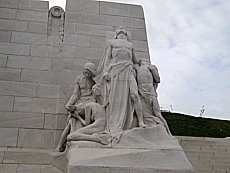
There are a number of representative human figures on the Vimy Memorial.   The two photos immediately below are the Mourning Parents, representing the mothers and fathers of the Canadian soldiers who died in the First World War.   Their possible inspiration is that of the four Michelangelo statues on the Medici Tomb in Florence, Italy.


The sculpture Sympathy of Canadians for the Helpless depicts (photo below)  a man standing above three bowed figures representing famine, disease and oppression.   It symbolizes Canada's defense of civilians affected personally by war and oppression.


The Spirit of Sacrifice (photo left) depicts a dying soldier in a crucifixion-like pose, holding a torch aloft to a comrade standing above and behind him.  It's a veiled reference to a portion of the poem In Flanders Fieldswritten by Canadian Army doctor John McCrae, which says:
"To you from failing hands we throw
the torch; be yours to hold it high".

The Spirit of Sacrifice is such a moving sculpture.   I then asked Steve to take a photo of me standing in front of it:


But to me, the most moving and beautiful sculpture on the Vimy Memorial is known as "Mother Canada"Her formal name is "Canada Bereft".   But to most visitors, she is simply called "Mother Canada".   She is a mourning woman holding what looks like an an olive branch, and she looks mournfully down on a sarcophagus below, which represents Canada's war dead:


In the photo of Mother Canada below, my Canadian friend Steve Douglas patiently waits for Kate and I to finish our walking tour around the Memorial:


The rather stormy-looking photo below is my favorite personal photo of the Vimy Memorial:


We eventually climbed down (and it IS a climb, especially for me!) the steps of the Memorial to the base, to see some of the floral tributes left on Armistice Day.   They were left by the Royal Canadian Legion's Europe branch, the Canadian Space Agency (I honestly didn't know Canada has a Space Agency!) and representatives from Canadian political parties.

Oddly enough, one of the memorial wreaths was left by  Gilles Duceppe , the leader of the separatist Bloc Quebecoiswho wants to take Quebec out of the Canadian Confederation!


I wonder if the 'fallen' maple leaves were purposely left scattered round the Canadian wreaths?

And even stranger, but a wonderful gesture nevertheless--there was a wreath left by the American Battle Monuments Commission, (photo below) which oversees the care of US battle monuments and cemeteries scattered throughout Europe, from both World Wars:


It was very difficult to leave the Vimy Memorial; as you can see, it is a very moving site indeed.  But Steve asked Kate and me if we wanted to go on a "tunnel tour" in the Park: a guided walking tour through one of the restored Canadian-built battlefield tunnels.   We both said "Yes!": however, the tour wouldn't begin until 2 pm--and it was now just short of lunchtime.   So, to use the time well, he took us to visit German and French war cemeteries near the village of Neuville-Saint-Vaast.

And by the looks of it, this post is quite long!  So I will continue with "Day Twelve, Part Two"!

Monday, December 27, 2010

Day Eleven: 11 November 2010: Part Two

I am back!   To continue with a memorable Armistice Day in Ypres, Belgium....

As I left the "In Flanders Fields" Museum, I decided to do some exploring in Ypres itself.   It was a very cold and wet day, with strong winds buffeting visitors in the Grand'Place.   It was now around 12 noon, and I was feeling both cold and hungry.   I spotted a small restaurant just off the Grand'Place, and decided to try it.   I went in through the bar area, which was surprisingly smoke-filled.   Don't know if the public smoking ban in Belgium had yet to be extended to drinking areas!   But I was led through to a non-smoking main dining area, which was a relief.   And it sure was busy!

The room was filled with chattering diners (some had come straight from the Menin Gate ceremony, as they all wore the poppy pin), as I was shown my table.   I ordered a dish of chicken and rice with mushroom sauce, and a lemonade.   While waiting for my meal, I watched the wait staff rushing to and fro with orders, and listened to the lively conversation of diners.

When lunch came, it was really delicious: the sauce came separate from the rice and chicken, and it was very flavorful.   My lemonade came in a slender bottle, and was tart instead of sweet (the way I like it).   The chicken was the surprise of the meal: it was incredibly tender and juicy, and it just fell off the bone!   I enjoyed it very much, and made sure to tell the wait staff so.

Soon, it was time to head back out into the cold and wet (I hated leaving the restaurant's warmth!).  But I sallied forth, and walked out of the Grand'Place, by the Cloth Hall.   And I found a most interesting monument (photo left).   It is called "Ypres Fury", and is dedicated to the memory of the citizens of Ypres who were killed in both World Wars.

This memorial was dedicated in June 1926, and is in memory of Ypres civilians killed in the First World War (and after 1945, to Ypres civilians killed in the Second World War).  

It's a rather flamboyant memorial, with a dramatic center sculpture (photo right).   It looks like a dead civilian (or is it a soldier?), mourned by women and angels (I am wondering if the angel in the background is the Archangel Michael, with upraised sword?).   The "Lion of Flanders" roars in anguish in front.   This is the same lion sculpture one sees atop the Menin Gate, come to think of it.

There were numerous floral wreaths laid before it.   That was probably done before the main ceremony at the Menin Gate.   The one here on the left is from someone affiliated with the Royal British Legion.

From the memorial, I made my way to St Martin's Cathedral.   Like the Cloth Hall and the rest of Ypres, the cathedral was also totally destroyed by the Germans in 1914.   Looking at it today, one could never tell it has been completely restored.

St Martin's Cathedral (photo right) was constructed between 1230 and 1370, and once served as the 'official' cathedral for the diocese of Ypres between 1561 and 1861, when Ypres was incorporated into the diocese of Ghent, Belgium.   It does not serve in that capacity today, but is still referred to as a cathedral.   Buried in the Cathedral crypt are Cornelius Jansen, the founder of the Jansenism theological movement, and Count Robert III, known as "The Lion of Flanders".

As I approached the Cathedral, I saw a closed door, and a very long line of people waiting to be admitted inside.   I assumed it was for a tour of some sort.   It was quite cold during the wait: the wind was blowing fiercely, and I had to stand with the wind to keep my coat hood on!   The line grew, and the door remained closed, so I decided to get out of the line, cross the street, and get some photos of the Cathedral (above right and below right).  After I took the photos, I saw that the Cathedral door was opening, so I got back into line.

When I finally entered the Cathedral, I realized the wait was NOT for a guided tour: it was for a special Armistice Day concert, called "The Great War Remembered".   It was sponsored by The Last Post Association, which was founded in 1928, and is responsible for, among other things, the continuance of the nightly "Last Post" ceremony at the Menin Gate.   

The concert was being performed several times this day, and I believe I was there for the final performance.   I did not have a ticket (not knowing it had to be purchased beforehand), so I was asked to wait until the ticket-holders were admitted and seated--and then, perhaps, I'd be allowed to attend.   Two people waiting with me decided not to wait, and left.  But I am SO glad I stayed; about ten minutes before it began, I was allowed to stay, and I paid my admission.

While I waited, I got this spectacular interior photo of the Cathedral ( below left).   I was so surprised the photo came out so well.  The blue lights aren't there every day.   But they did create a wonderful ambiance for the concert to come.

I was shown a seat on the right side of the nave (in the left photo), which had a view of the organ loft in front, and above.   The organ was playing softly, as the vast crowd settled in.  The swirling blue light on the ceiling had the effect of white clouds in a blue sky.   I thought it was quite magical.

In the Sanctuary, there was seated an orchestra: the Royal Harmony Ypriana, consisting of 80 local musicians who perform at various ceremonies in Ypres, including this one for 11 November.  There were also huge HD television screens set up in the Sanctuary, and around the nave, so those in the back, or in places with poor sight-lines, could see and hear what was happening 'onstage'.

Also appearing with Ypriana  was the Loretto Senior School Chamber Choir from Scotland (Loretto was founded in 1827 as an independent boarding school and currently has just over 600 students); the buglers of the Last Post Association; the Beauvarlet Koksijde choir from Ypres; the Roeselaars Kamerkoor, a 20-member chamber choir from Ypres; the choir of Holy Trinity Church, Dartford, Kent, UK--and UK tenor soloist Sean Ruane.

The concert began with a Fanfare by Ypriana, followed by a short Welcome from Benoit Mottrie, chairman of the Last Post Association, which was read in both English and Dutch.  Ypriana then played the latter part of Rossini's William Tell Overture, followed by another instrumental, Between the Two Rivers (depicting the peace of summer 1914, just before the First World War broke out).   Then came a reading called Start World War I, read by a young woman named Ann Sophie Senesael.   She sometimes spoke softly, which made it difficult to understand.   But the pictures on the HD screens told the story of the start of the war.

Ypriana was then joined by the Loretto Senior School Chamber Choir, the Dartford choir, and Beauvarlet koor and Roselaars Kamerkoor for a rousing rendition of George Frederic Handel's coronation anthem, Zadok the Priest, with lyrics taken from the Old Testament, describing King Solomon's anointing and crowning.   It's one of the four Coronation Anthems composed by Handel for the coronation of King George II of England in 1727, and it's been sung at every British Coronation since then.

When the applause for this anthem died down, Ypriana, along with the Fire & Rescue Service Bands and the Dartford Choir, performed the Overture to the HBO Second World War series Band of Brothers.   It is such a moving, and popular, composition; the music is also used in a song called Requiem For a Soldier, sung by the British soprano Katherine Jenkins.   This Overture always makes me cry.   It's perfect for an occasion like this concert!

Then Sean Ruane appeared with Ypriana, to sing "Nessun Dorma" from the opera Turandot, by Giacomo Puccini.  What a beautiful voice Mr. Ruane has!   This aria was made popular by the late Italian tenor Luciano Pavarotti.  But on this day, Sean Ruane made it his own!

When the applause died down, Ann Sophie Senesael reappeared, to read a verse entitled "Gas Attack 1915".  The poem was accompanied on the TV screens by horrific images of battle in the First World War, as if to signal that the war was only going to get worse.   When the poem was finished, Ann Sophie left the stage, and Ypriana performed the Overture to Carl Maria von Weber's opera Der Frieschutz: a very dramatic piece, that was considered too daring after its premiere in 1821 in Berlin.

The mood abruptly changed with the next piece: Pie Jesu.   The program I received didn't say who the composer of this version was; the words are derived from the last couplet of the Dies Irae of the Roman Catholic Requiem Mass.  The most well-known Pie Jesu is found in French composer Gabriel Faure's Requiem.  This version was sung by the Loretto Senior School Chamber Choir--and the girl-soloist had the most angelic voice I'd ever heard!   She gave me goosebumps, and I'm sure the rest of the audience felt the same way.   She received sustained applause when she finished, and looked a bit embarrassed by all the attention!

Another poem, 1916-1917, was next, read by Ann Sophie, followed by a very moving rendition of the well-known hymn Amazing Grace, performed by the Combined Fire & Rescue Service Bands, tenor Sean Ruane, and Holy Trinity Dartford Choir.   I wanted so much to sing along; I wonder if any other audience members wanted to as well?   Then followed an instrumental piece by Ypriana, Supreme Sacrifice.   I don't know who the composer of Supreme Sacrifice was.

Next was a prayer, For the Fallen, read by the Rt Rev Brian Llewellyn in English, and by E.H. Deken Roland Hemeryck in Dutch.   It went as follows in English:

Remembrance
We remember before Thee with gratitude, O Lord our God, who gave their lives for the cause of freedom.  Grant unto all of us for whom they died that their devotion may bear fruit in us in more abundant love for others, through Jesus Christ our Lord.

For those who suffer as a result of war
O Lord, our heavenly Father, we commend to Thy mercy all who suffer as the result of war; the maimed, those who are afflicted in mind; those who mourn.  Have pity upon the homeless and friendless, and upon those who no longer have a country of their own.   Fill us with compassion for them, prosper all who seek to minister to their needs, and hasten the coming of Thy Kingdom of justice and peace, through Christ our Lord.  AMEN.

This prayer was followed by the sounding of "Last Post", by the Buglers of the Last Post Association.  I never tire of hearing this bugle call: to me, it is even more moving than our Taps!   It reverberated around the Cathedral walls, and then died away.   The audience was deeply moved.   It was then followed by the singing of one of my favorite hymns: Abide With Me, by Henry Francis Lyte.  It was a favorite hymn of such diverse people as Britain's King George V, and Mahatma Gandhi (!), and sung at the weddings of King George VI, and his daughter Princess (now Queen) Elizabeth.   It is also sung at ANZAC Day services in Australia and New Zealand, in April.  Today, it was sung by the Beauvarlet Koor and Roselaars Kamerkoor.   Another solemn lament followed, Roses of Kelvingrove, performed by the Combined Fire & Rescue Bands.

But the music performed in this concert wasn't totally solemn: and the following songs would testify to that!

Next came a medley of "Soldier Songs" from the Great War, performed by Ypriana and the four choirs: Mademoiselle From Armentieres, Pack Up Your Troubles In Your Old Kit Bag, Keep the Home Fires Burning, and It's a Long Way to Tipperary.   And the audience was encouraged to sing along with the choruses!   The version of Mademoiselle we sang was one of the 'cleaner' renditions; some of the more racy versions talk about 'washing soldiers' underwear' (and probably other stuff too!) and such.   I wasn't familiar with the verses themselves, but I certainly knew the choruses!  

It was SO much fun to sing along with the choirs and the orchestra: I couldn't get Mademoiselle and Tipperary out of my mind for days afterwards!!   Still can't, now that I think about it.....  The Loretto Choir also sang a beautiful version of Danny Boy; the young girl who sang solo for Pie Jesu did the same thing here, and was appreciated with more sustained applause.

These songs were followed by a song performed by the Fire & Rescue Service Bands, World In Union.   The program notes say this is played during the Rugby World Cup, and attempts to capture the spirit of international friendship found in 'rugby union culture'.   Sean Ruane, the four choirs, and Ypriana then followed with a beautiful version of an Irish poem, The Last Rose of Summer; then these same performers stayed around for a rousing version of British poet William Blake's Jerusalem, with music by Hubert Hastings Parry.   This hymn has become an 'unofficial' English national anthem, and is sung at international soccer matches.   The audience sang along, of course.

Jerusalem was then followed by one of the most beautiful and moving bagpipe songs I've ever heard: Highland Cathedral, played by the Combined Fire & Rescue Bands, with a bagpipe soloist.   It was composed in 1982 for the Highland Games in Scotland, and is being proposed as Scotland's own official national anthem.   I can't see why not: it has the most glorious melody, evoking the beauty of Scotland!


Here is a YouTube video of "Highland Cathedral",
performed by the Royal Scots Dragoon Guards
in Dunblane Cathedral in Scotland.
When this song was finished, there was a storm of applause ringing throughout St Martin's Cathedral.  I do hope the Scots adopt this as their national anthem!!

When the applause faded away, we all stood for the national anthems of Great Britain and Belgium: God Save the Queen, and The Brabanconne, respectively.   Even though I am not a British subject, I still sang along to the UK anthem.   On this trip, I am British at heart (although my Irish ancestors might take exception to that)!    The concert concluded with the Fire & Rescue Bands playing Auld Lang Syne, before we filed out of the Cathedral, into the waiting evening.  

All I can say is: what an incredible concert!!

When the crowd came back outside, the rain had finally stopped, but it was still windy and cold in the Grand'Place.   It was around 6 pm or so, and time to head back to the Menin Gate for the evening "Last Post" ceremony.  The street was surrounded by metal barricades, as the bands that played at the concert were to make their way back towards the Gate.

I did stop in at "The British Grenadier" to say hello to Steve, and tell him a little about the concert, but I didn't stay long.   I went back out and moved closer to the Gate, joining the throngs of Belgians, Brits, Canadians--and whomever else!--lining the street.  I chatted with a Belgian lady, and also attempted to make friends with an Italian Greyhound and a nervous black-and-white King Charles Spaniel, who were straining at the lead to sniff each other.  The Greyhound (photo above left) wore a little sweater, and was called "Gawa": the owners said it was a Sikh word that meant "Good Luck"!

 I did get a few photos of the various bands marching from the 'GrandPlace to the Menin Gate for the "Last Post" ceremony.  There were also a number of soldiers marching in the 'parade': mainly from Belgium, but there could have been British ones too.   They all marched smartly along, and the crowds lined up on both sides of the street (and behind the police barricades) applauded them enthusiastically.

I tried to get good photos of the bands (right and below), but they were initially a bit blurry, because of the motion.   Thank heaven for a photo-sharpening software!

The spectators in the street, and those within the Menin Gate, fell silent as 8 pm approached, and the members of the Ypres Fire Brigade sounded the "Last Post".   The middle verse of Laurence Binyon's poem For the Fallen, was also read, and the crowd repeated the last line: "We will remember them".   I couldn't see from my vantage point, but there was yet another wreath-laying ceremony that evening, although not as large as at the morning service.   But it was moving, all the same.

After the ceremony was over, and the crowds dispersed, I lingered for a short while within the Menin Gate, and looked again at the piles of wreaths from the morning, and the new ones laid that evening.   I also chatted with a couple from Yorkshire named Carl and Jo, and we shared our various feelings about the day, and the evening ceremony.    They were also looking for a specific name inscribed on the inner walls of the Gate.   I think they did find it.

By now, it was getting late, and I thought I had better get back to Erna's house.   The streets were virtually deserted on the other side of the Menin Gate, but there were a few stragglers from the ceremony, as I quickly walked.   Stupidly, I didn't keep track of any landmarks when Erna brought me to the Gate earlier that morning, so I wasn't sure where I was.   I found my way into one neighborhood, but all the houses looked the same in the dark and narrow streets; I asked one couple where Erna's street was, and they gave it to me in broken English.   But I only ended up going completely in circles!

At this point, I was totally confused, and decided to go back into the walled part of Ypres, and find Steve.   After futilely asking directions from a Middle Eastern liquor-store owner, I went back through the Menin Gate--only to discover that Steve's shop was closed for the night!   

I didn't panic, surprisingly; I kept my wits about me and thought about calling a taxi, so I went to a nearby pizzeria: "Poppy Pizzeria", if you can believe that!   There were few customers inside--but two, thankfully, were British!  They told me they were from Liverpool, and I told them about my day in Ypres, and my current dilemma.   They asked the young manager for help--and when I showed him Erna's address, he told me he knew her!!!!    The young man's name was Trevor, and is originally from The Netherlands.   His dad owns "Poppy Pizzeria", and he came to Belgium to be with his then-girlfriend (he told me they had since broken up)--and they would stay at Erna's house.   And to make it all the more incredible: Trevor told me they stayed in the very room I was currently occupying!!!

As Trevor drove me back to Erna's, we cracked up about this amazing coincidence.   He was so kind--as was the British couple--and I thanked them both for all their help.   I let myself in the front door (Erna had given me a key for just such an event), and saw Erna and told her about meeting Trevor.   She thought it was very funny.

By this time, it was quite late, so I wished Erna good night, and toddled upstairs to bed.   It was the end of another awesome and spectacular day.   And I had one more to go in Belgium!