Showing posts with label Houses of Parliament. Show all posts

Friday, February 25, 2011

Day Seventeen: Wednesday 17 November 2010, Part Two

To continue on my last full day in London: a visit to the Tower of London.

When I completed my tour of the Churchill War Rooms, I handed back my 'mobile guide', and stopped at the Gift Shop to buy a DVD of Churchill's State Funeral in 1965.   I then left the Museum, and walked up the Clive Steps to King Charles Street, and then into Whitehall to take the Tube to the Tower.   I wrongly thought I was a "Tube Veteran" by now, finding my way to the correct train.   But I almost went west instead of east!   Thankfully, I discovered my error in time, and found the right one, and climbed aboard.  I used my Oyster Card, which saved me buying an individual ticket.   It's a godsend!

The trip didn't take long to do.   But there sure was an awful lot of stair-climbing and path-walking out of the station; it's some way to get some exercise!!   This particular station looked fairly new: a long paved walk up and down, just to see where to get an entrance ticket to the Tower.  I paid my fee, and headed towards the Tower entrance.   Nearby, I noticed a lot of construction, or restoration work, going on next to the Tower's walls.   Not sure exactly what was going on.

Before I entered the Tower proper, I took a glance at its surroundings; nearby is The City, which is London's financial district, and the oldest part of London itself.  It's home to many bank headquarters and related businesses.

And some of the newer high-rise buildings have some freaky architecture: one of the most notable, at 30 St Mary Axe, is shaped like a pickle: hence, most Londoners  call it "The Gherkin".   To me, it does look something like a pickle.   Or perhaps a blimp sitting on its tail, or a rocket....(photo left)
I entered the Tower at the Byward Tower, (photo right) via a bridge over the old moat.   The path was made of cobblestones, so I had to walk a bit gingerly.   There was a tour about to start that would take visitors on a walk atop the walls, but I decided against it, because of all the stair-climbing.   I contented myself with snapping photos of the various towers: the Wakefield Tower, and the infamous "Bloody Tower": so-called because it is the traditional site of the murder of the "Princes in the Tower": young Edward V and his brother Richard, Duke of York.


I also stopped at "Traitors' Gate": the former water gate entrance (photo left) used for such famous prisoners as Queen Anne Boleyn, Queen Katherine Howard, Sir Thomas More, and Princess Elizabeth (the future Queen Elizabeth I).   It was dry beneath the Gate now; visitors toss coins onto the ground below, and they are collected and used for charitable purposes.   Today, a man was there collecting for the Royal British Legion's "Poppy Appeal", to aid UK soldiers and their families.

The Tower of London is not a 'tower' in the usual sense of the word: a single structure.   It's actually a large complex of buildings, with different purposes used for each.   It was once a prison, of course.   But it was also a royal palace, an armory, home to the Royal Mint, a public records office, and home to the Crown Jewels of the United Kingdom.   The oldest part of the Tower is in its center: the White Tower.

The White Tower (photo right) was begun by William the Conqueror, in 1078.   The irony is, the White Tower was built not only to protect London from outside invaders: it also protected the Norman invaders from the people of the City of London!   It was built of Caen stone, imported from Normandy, in France.   Its construction was completed in 1087, during the reigns of William's sons William Rufus and Henry I.

During my visit, I noticed that part of the White Tower was covered by scaffolding and plastic sheeting: it was undergoing a major restoration project, so I couldn't get full photos of the White Tower without getting the modern structures too.  I decided not to take a tour inside the White Tower.  Instead, I just walked round the exterior.

 Near the walls I saw several huge enclosures built for the famous "Tower ravens": huge, black birds indeed (photo left)!   There were hordes of schoolchildren visiting the Tower this day, and they were clamoring to get photos, or just to look, at these big birds.   There were three hanging about their enclosures: six in all live within the Tower precincts.

Not far from the White Tower is the Waterloo Barracks: the home of the British Crown Jewels--and the most secure room in the whole UK!   I definitely wanted to see the Crown Jewels for myself, so I made my way inside.

First, the visitor enters a huge room on the Barracks' ground floor, where a film on the history of the Crown Jewels plays daily.  Included were clips of the coronations of both King George VI and his daughter, Queen Elizabeth II, and explanations of the usages of the Royal regalia.   Visitors were encouraged to keep moving by plainclothes security staff.   Some were dressed as Yeoman Warders, or "Beefeaters": the guards within the Tower precincts.

Next, I followed the crowd into the room where the Crown Jewels are kept, behind unbreakable glass.  The Crown Jewels have been kept in the Waterloo Barracks (photo right) since 1994; before that, they were kept in the basement of the Barracks beginning in 1967.

One interesting innovation is in this room: two very slow-moving 'sidewalks'--like the ones you use in major airport terminals--glide on either side of the displays.   They keep visitors from lingering too long in front of the Crown Jewels!

I am including a few Web-based photos of some of the Crown Jewels, for illustrative purposes only.  Visitors are not allowed to take their own photos of the Crown Jewels, for security reasons.

I saw the Imperial State Crown, (photo left) which is mainly used now by The Queen at the State Opening of Parliament.  It is also worn at the conclusion of the Coronation ceremony.   It contains such famous stones as 'The Black Prince's Ruby' (not a real ruby, but either a spinel or balas); the 'Stuart Sapphire'; the 'Cullinan II' or 'Second Star of Africa' diamond; four earrings that once belonged to Queen Elizabeth I; and 'St Edward's Sapphire', originally set in a ring that belonged to St Edward the Confessor.

Other crowns I saw included St Edward's Crown; this is only used at the moment of Coronation.  There was also a crown made for King George IV; Queen Victoria's Crown; the Crown of George, Prince of Wales; the Crown of Frederick, Prince of Wales; the Queen Consort Crowns of Queens Mary (wife of George V), Adelaide (wife of King William IV), Mary of Modena (wife of King James II), Queen Alexandra (wife of King Edward VII), and the Crown of Queen Elizabeth the Queen Mother (wife of King George VI).

Other State Crowns I saw were those for King George IQueen Victoria's Small Diamond Crown (photo left); Victoria wore this tiny crown with a veil, after the death of her husband, Albert the Prince Consort   The Imperial Crown of India  was created for King George V when he and Queen Mary visited India in December 1911, for the Delhi Durbar.  The Crown Jewels are not allowed to leave the UK, so this crown had to be made for this occasion.

Besides the various crowns on display, I also saw several gorgeous rings, including 'The Sovereign's Ring', made for William IV's Coronation, made of rubies forming the Cross of St George on a blue sapphire;  the 'Queen Consort's Ring', made for Queen Adelaide, with a huge ruby surrounded by diamonds; and 'Queen Victoria's Ring': a smaller version of William IV's coronation ring.   This particular ring caused a bit of pain for Queen Victoria at her Coronation: it was made too small for her finger, and was forced on by the Archbishop of Canterbury!

Queen Victoria inherited all three of these rings, and bequeathed them to the Crown on her death.  The Sovereign's Ring has been used in every Coronation since 1902, and the Queen Consort's Ring has also been worn by Queen Consorts since that date.

There was also a magnificent display of Orbs and Sceptres.   The 'Sovereign's Orb' (photo right) is from 1661, and symbolizes the Christian world with a cross mounted on a globe, and its bands of jewels and pearls dividing it up to represent the three continents known in medieval Europe.  The Monarch receives it in the right hand at the Coronation, before it's placed on the High Altar.

There is also 'Queen Mary's Orb', made for the joint Coronation of William III and Mary II in 1689; Mary was the daughter of the exiled King James II.   The Sceptres included 'The Sovereign's Sceptre With Cross', 'The Sovereign's Sceptre With Dove', 'The Queen Consort's Sceptre With Cross', 'The Queen Consort's Ivory Rod With Dove', and 'Queen Mary's Sceptre With Dove'.
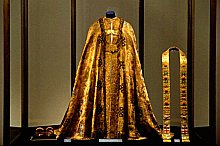
Not far from the Crowns was a large display case containing a beautiful gold ensemble: the Coronation Robes (photo left).   They were last worn by Queen Elizabeth II at her Coronation in 1953.

The outer robes are based on ancient Imperial vestments, and are woven from silk thread wound round with gold.  Over the monarch's linen shift is worn the Supertunica, a long coat made of cloth of gold, that was made for George V's Coronation in 1911.

Next comes the Stole, which is worn round the neck; the one in the display was made in 1953, and it bears both the emblems of the British Isles and symbolic plants of the Commonwealth.

Lastly, there's the Imperial Mantle, made in 1821 for King George IV's Coronation, and used by Queen Elizabeth II in 1953 for her Coronation.  It is covered with emblems of the-then newly created United Kingdom, along with imperial eagles.   All that stuff must weigh a ton when worn!

Lastly, there was a room filled with items used in the Coronation ceremony, the Coronation Feasts, and for Royal Christenings.   For the Coronation ceremony, there were several huge Altar Dishes, Communion Patens and Chalices: they are displayed on the High Altar at Westminster Abbey during the Coronation.   The biggest one of the lot was 'The Last Supper Altar Dish", made in 1664, showing a representation of The Last Supper in the center, and it weighs nearly 29 lbs.!

Among the more interesting (and rather bizarre!) items was the massive 'Wine Cistern', or cooler, made for King George IV's Coronation in 1821 (photo left): it's a riot of Rococo decoration, and can hold 144 bottles of wine inside.  It was later used as a vessel for hot punch, so it's also known as the 'Grand Punch Bowl'.

On one side is a carving of a Unicorn; the other has a Lion wearing a crown.   It weighs around 548 lbs.; how does one get this thing moved from place to place?   I bet more than a few Coronation Banquet guests were tottering about, after indulging in wine cooled in here!!

King George IV was the last British Sovereign to hold a Coronation Banquet.   Probably a good thing: the man ran up an awful lot of debts during his life--not to mention he had an overly-hearty appetite!

One can read all one wants about the Crown Jewels, and see photos of them in books.   But nothing beats seeing them in person, in all their sparkling, glowing splendor!!   I could not help but think of Prince William and Kate Middleton.   When William becomes King William V, he will wear the Imperial State Crown.  And when Kate becomes "Queen Kate", she'll wear the Queen Consort's Crown!  Awesome....!!!


If that wasn't enough to dazzle the mind: I also saw a big display case containing beautiful ornamental Maces; these are used by the Sergeants at Arms, or the Royal Bodyguard (photo right).   It is also used in the Houses of Parliament, as the symbol of Royal authority: there are three for the House of Lords, and one for the House of Commons.

The Mace precedes the arrival and departure of the Speaker of the House of Commons, and neither House can lawfully meet without the Mace being present.   I've seen it numerous times during 'Prime Minister's Questions' in the Commons.

Nothing beats seeing the British Crown Jewels in person.   One can see them in dozens of photo books, or travel guides.   But those mere photos pale in comparison to seeing the 'real thing'!

SO--after picking my jaw up off the floor, I found my way out of the Waterloo Barracks, and walked to the nearby Chapel Royal of St Peter-ad-Vincula (photo left).   It is the Tower of London's church, and contains the bodies of many of the famous executed prisoners of the Tower: among those buried in the church's vault are Queens Anne Boleyn and Katherine Howard, Sir Thomas More (photo below right) (minus his head!), the 'Nine Days' Queen' Lady Jane Grey and her husband Lord Guildford Dudley, George Boleyn, Viscount Rochford (Anne's brother) and his wife Jane, Lady Rochford, John Fisher, Bishop of Rochester-- just to name a few.

No photography was allowed in the church, and visitors were strongly encouraged to remain quiet.   I thought that was good: St Peter-ad-Vincula is a place for quiet reflection and prayer, to remember those who are buried in the crypt below.  It is a very intimate setting for Anglican services too.   What sad history has been witnessed by this little church....

Not far from the church is Tower Green: the site of many executions of prisoners from the Tower.   Only the most prominent of them were executed here; most met their deaths on Tower Hill, outside the walls.

In place of the scaffold stands a modern Plexiglass sculpture (photo left) , shaped like an open flower: in the center sits what looks like a pillow (perhaps one where a severed head landed?).   Engraved round the 'flower' were the names and execution dates of those who died here: I saw names such as Anne Boleyn, Katherine Howard, and Sir Thomas More.   An interesting sculpture, I thought: not bad for a modern work of art.

Across Tower Green were stucco-and-wood-fronted buildings. I believe this was the site of the 'Queen's Quarters', when the Tower was used as a Royal residence.  They are now the homes of Tower staff (photo right).

I think the Governor of the Tower lives here; I saw a bearskin hat-wearing Guard on duty outside his door.  The Governor is usually a retired high-ranking military member; one past Governor was Field Marshal Alexander, also known as Earl Alexander of Tunis, from the Second World War).   I wonder what these quarters look like inside?

Also near Tower Green lurked three of the Tower Ravens, strutting about on the grass .   The schoolchildren were attempting to feed them with French fries from one of the nearby restaurants within the Tower (more like cafes, actually).   When the ravens got close to the kids, the latter squealed with fright and backed away.

One of the really big ravens had ruffled feathers (photo left), and looked a bit grumpy to boot.  If you looked close enough (or dared to!), you could see where the wings were clipped.  There is an old legend that says if the ravens leave the Tower, the kingdom will fall.   So, to make sure that doesn't happen, all the ravens' wings are clipped.

It was really cool seeing these huge birds in person.   Seeing them made me want to quote the famous line from Edgar Allan Poe's poem The Raven: 'Quoth the Raven: NEVERMORE!"


By now, my poor feet were starting to throb, even though I had sat down for a few minutes in St Peter-ad-Vincula.   My final stop within the Tower precincts was the 'Bloody Tower'.

I could have taken the spiral staircase up into the tower itself, but decided instead to get a look at the workings of the tower's Portcullis: a nasty-looking spiked gate held in place by heavy rope, round a wooden spool.   A crank was used to lower the Portcullis in case of threats of attack.   Across from that was a large furnished room with a fireplace (photo above right).   This room was used by Sir Walter Raleigh, when he was a prisoner in the Tower.

Raleigh's family was allowed to join him here, oddly enough.   But in the end, Sir Walter still lost his head on Tower Green.

As I left the Tower precincts proper, I snapped a few more photos of the Thames-side view of Traitor's Gate (photo left), and St Thomas' Tower above the Gate, before calling it a day.

It's really incredible, visiting a site that has so much tragic history.  The phrase 'to the Tower!' sparked a lot of fear, for many centuries.   Even as a museum, the Tower is a spooky place.   And it has more than its share of wandering ghosts--so I am told!
Once outside the Tower itself, I walked slowly to the River Thames side of the Tower, and took several photos of the nearby Tower Bridge (photo right).   It's another of London's iconic sights, and is sometimes confused with the even more famous London Bridge.   It's called 'Tower Bridge' because of its proximity to the Tower of London, and was opened in June 1894 by Edward Prince of Wales, and his wife Alexandra, Princess of Wales: the future King Edward VII and Queen Alexandra.
Upstream from Tower Bridge, moored on the south side of the River Thames is HMS Belfast(photo left) a Second World War light cruiser that's been turned into a museum operated by the Imperial War Museum.   She was built in 1939, and participated in the Arctic supply convoys to the Soviet Union and in Operation Overlord on D-Day, 6 June 1944.   She also saw action during the Korean War.   


HMS Belfast was saved from the scrap heap in 1971, and was restored and opened to the public in July 1971.   In 1978, she became a branch of the Imperial War Museum.

While walking along Tower Wharf and taking photos, I noticed how cold it was: the wind was whipping off the gray Thames, under equally gray skies.   After taking a few more photos of the exterior Tower walls, I walked back to the Visitor Center and stopped at a fish-and-chips restaurant for lunch, and to change a little money.

After lunch, I stopped at the Gift Shop to buy some last-minute presents.  I bought a "Winston Bulldog" stuffed toy, drink coasters with portraits of Henry VIII's Six Wives--and a collection of scented bar soap, in boxes showing portraits of both King Henry (photo left) and all his wives.   I bought the last-named gift for my sister Joanne at home.   And all of these gifts were placed in a Tower of London canvas bag!

I paid for my gifts and left the Shop.  Of course, as I was buying more stuff, I didn't even take into consideration how I was going to pack it all!

Before leaving the Tower of London for the last time, I took a couple more photos, including one of "The Gherkin", standing above the more historic buildings in London (photo below right).

I also made one more call on my UK mobile phone to my friend  Sir Martin Gilbert , in hopes of chatting with him before I left for the US.  I only got his voice-mail, so I left a message, and then retraced my steps  back to the Tower Hill Tube station.

As a footnote to that call, Sir Martin and I weren't able to make telephone connections before I left London.   But we did make email connection after my return to the States.

Before too long, an eastbound train showed up, and I got on for the short ride back to Westminster.  I got off the Tube at Westminster Bridge station, and discovered I was just across from Big Ben, and the Houses of Parliament.   I decided to go back down Whitehall, and say 'farewell' to the horses at Horse Guards, and to The Cenotaph.   I did take one last look at the wreaths laid on Remembrance Sunday round The Cenotaph.   But I never made it to Horse Guards.

Across Whitehall, I noticed a small crowd forming near the fence at Downing Street, so I crossed over to see what was going on.  And I noticed a large group of well-dressed people waiting to be admitted through the gate at Downing Street.   I asked a woman in line what was up, and she told me that a group of school headmasters were invited to meet with Prime Minister David Cameron at No. 10 Downing Street, to discuss Education in difficult economic times.   She told me her husband was one of those being admitted.

But as we stood there, I heard loud whistles and banging drums coming closer up Whitehall, and towards Downing Street.  As the sounds got closer, I noticed a number of colorful banners being held above the crowd: they were from the London Fire Brigade.   And the marchers were protesting upcoming Government budget cuts.   Many of the Brigade members wore their 'working' uniforms (photo left).

The marchers slowed down as they got close to Downing Street, and they continued banging their drums, and they also started chanting.   They began to spill over onto the sidewalks--and I then figured it was time to get out of the way, before got caught up in the demonstration!   While it was a peaceful protest, one never knew if it might get out of hand--so I made my way along the sidewalk to King Charles Street, and down the Clive Steps--into the peace of St James Park.

The noise from the Fire Brigades' demonstration faded as I walked through the Park, and headed for my hotel; I did stop briefly for a few last photos of the bird life in the Park--including a scene that looked like Alfred Hitchcock's film The Birds: when a visitor threw bread onto the grass near the water, a huge flock of seagulls and ducks swarmed over the stuff, squawking and flapping like mad (photo left).  It was fun to watch.

When I returned to the hotel, I stopped long enough to drop my stuff off and clean up a bit.  For supper, I thought about going to an 'authentic' British pub: the 'Prince Albert', on the corner of Buckingham Gate and Victoria Street, just a few steps from my hotel.   It's a very historic pub, and one frequented by MPs and other politicians, since it's a couple of blocks from the Houses of Parliament and Whitehall.

When I did go in, the bar area was crowded with people, but I went upstairs to the main Dining Room--and discovered it didn't open until 5 pm!   Flushed with embarrassment, I scampered downstairs and out the door--and decided instead to order supper from Pret A Manger across the road.  It was just as well: Pret's food was awesome.   And it was a bargain for the money!

I saved the most onerous task of the night for last: PACKING UP.   It took three attempts to get most of my stuff inside the suitcase!   I ended up stuffing my backpack with small gifts, and carrying my Tower of London bag with my gifts from there.   So I definitely had my hands full, getting ready to leave for the USA the next day.

I went to bed with a mind full of all the things I did, the places I saw, and the people I met, during my stay in the UK and in Belgium.   I sure didn't want to leave....


Saturday, February 12, 2011

Day Sixteen: Tuesday, 16 November 2010

I woke to a very cold November morning: my next-to-last day in London.   The sun was shining, which made the cold much easier to bear.   This day, I was off to visit one of London's most interesting sights: the Imperial War Museum.

After I showered and dressed, I stopped at a nearby Pret A Manger shop (not the large one near Victoria Station--but a smaller one closer to the hotel) for breakfast, before joining the morning throng heading to Westminster.
I decided to make a stop again at Westminster Abbey's 'Field of Remembrance', to take some more photos of the memorials, such as the one for The Queen's Royal Lancers(photo left).   Workers on their way to the Houses of Parliament or Whitehall also stopped to look at the memorials.

This morning, I decided to take a scenic route, through Victoria Tower Gardens, on the west side of the Houses of Parliament.   There were still leaves on the trees, and several walkers and joggers were out and about too.   The walkers were taking lots of photos across the River Thames.  The light was perfect for 'atmospheric' photos!

The River Thames was covered in fog, caused by the warmer water and cold air above.   It really made for some wonderful photo opportunities.   Everything looked so mystical, almost like one of Turner's water scape paintings.   The buildings seemed to literally float out of the fog: Lambeth Palace, the London residence of the Archbishop of Canterbury, the leader of the worldwide Anglican Communion, looked like it had stepped out of a medieval picture (photo right).

The London Eye, further downstream, looked like a toy wheel climbing above the fog.

During the early stages of my walk, I came upon a very interesting sculpture--and a very famous one at that: French sculptor Auguste Rodin's The Burghers of Calais (photo below left).   It depicts an incident in 1347 in Calais, France, during the Hundred Years' War .  

Calais had been under siege by the English king, Edward III, for over a year.   After Edward's victory over the French at the Battle of Crecy in 1346, he laid siege to Calais, but the French King, Philip IV, ordered the town held at all costs.   But Philip could not lift the siege, and starvation started to take its toll of the inhabitants, and eventually it was decided to surrender the town.

King Edward offered to spare the town, if any six of its leading inhabitants would surrender themselves to him, presumably to be executed.   He demanded these six men walk out of Calais almost naked, wearing nooses around their necks, and carrying the keys to the town.   Led by Eustache de Saint Pierre, one of Calais' wealthiest citizens, he and the five other emaciated men stripped to their breeches, and walked to the city gates.

At that moment, Edward's Queen, Philippa of Hainault, intervened and persuaded her husband not to execute these men, as she felt their deaths would become a bad omen for their unborn child.   So Edward showed mercy, and the men's lives were spared.

Rodin completed his original of the sculpture in 1889, and it can be seen today in Calais' town square.   The sculptor only made twelve copies of his work, and they are displayed in Paris, New York City, Washington DC, Copenhagen, Philadelphia, Tokyo, Stanford University in California, Belgium, Switzerland, Seoul--and here in Victoria Tower Gardens, London.  This particular copy was cast in 1908, and placed in the Gardens in 1911.

It's a pretty awesome sculpture; I've always been fond of Rodin's work, such as The Thinker and The Kiss.


Leaving Victoria Tower Gardens, I walked up a flight of stairs onto Lambeth Bridge, and started my journey to the Imperial War Museum.   I passed by commuters walking to their jobs in central London.

I also stopped along the way, to take a couple of photos of the Houses of Parliament, enshrouded in the river fog (photo left).   Without boasting, I think they came out rather well.

At the south end of Lambeth Bridge sits the London residence of the Archbishop of Canterbury: Lambeth Palace.   It was situated behind a high wall, so I couldn't see much of it.   I did, however, glance through a couple of open gates, to glimpse its gardens, and several of its outer buildings.   I'm not certain if the general public has access to the gardens.

The Imperial War Museum is located on Lambeth's main thoroughfare: Lambeth Road.   It is both a residential neighborhood, and also hosted a few small businesses, like restaurants.   Some of the residences were post-war high-rises called 'council estates' (so called because the local town council runs them; I think they're sort of like public housing in the US).   The ones I saw looked neat, if not very picturesque.   A couple of smaller hotels could also be found here.

After about a half-hour's walk, I finally came upon the Imperial War Museum, which sits in a large park (photo left).   The Museum was founded in 1917, during the First World War, to document the war effort of Great Britain and her Empire..   It was first housed in the Crystal Palace at Sydenham Hill, and was opened to the public in 1920.

In 1924, the Museum moved to the Imperial Institute in South Kensington, and eventually acquired its present home in 1936.   It occupies the site of the former Bethlem Royal Hospital in Southwark--which had become a notorious mental institution.   It's where the world bedlam comes from: a corruption of the name Bethlem.


Royal Navy guns, taken from two ships: the battleship HMS Ramillies and the monitor HMS Roberts.   

I tried taking a photo of the guns from the front, but the rising sun behind it made that difficult; so I had to take the photo from the backside (photo right).

I arrived around 9 am, but the Museum didn't open until 10, so I wandered around the park in the rather frigid air.   The grass glistened with frosted dew, as I watched a couple of people play with their dogs.   I chatted with one lady who was tossing a big toy to her very frisky dog.   The dog was definitely getting a lot of exercise, just racing about.

The Museum also has its own chunk of the infamous Berlin Wall on the grounds (photo left).   So many different places have pieces of this once-deadly Wall in their possession: the West Point Museum at the United States Military Academy in New York state, and even a Western New York office building--just to name a couple!

I also found an interesting monument (photo right) on the grounds.   It was dedicated to the memory of the 20 million citizens of the then-Soviet Union who died in the Second World War (the monument was erected before the collapse of the Soviet Union in 1990).   The inscription was in both English and Russian, and the monument was decorated with flowers, and a red-white-and-blue Russian flag made of flowers.   They must have been laid the day before: Remembrance Sunday.

Very soon, the Museum opened its doors, and in I went.   It's quite a compact place inside, for such a massive building outside: its ground-floor exhibit space was full of military artefacts.

The first room I entered centered on the recent discovery of a mass burial ground containing Australian and British soldiers near the town of Fromelles, in France: scene of a really horrific First World War battle on 19-20 July 1916.  It was the first full-scale battle fought by the First Australian Imperial Force; it's estimated that 5500 Australian, and 2000 British, troops were killed and wounded.   The Australian losses in this one battle were equivalent to the total Aussie losses in the Boer War, Korean and Vietnam Wars combined.

This room described the efforts being made to identify the dead here as much as possible, and give them a proper burial in the new Commonwealth War Graves Commission cemetery being created near their original burial site, at Pheasant Wood.   I saw artefacts that were found in the grave: some personal items, utensils--things like that.

A few of the dead have been identified, thanks to DNA.   But I don't know how many more will be; the efforts will be ongoing for the next few years.  But at least these men will not be forgotten.

In the main ground-floor exhibit area, I saw some really awesome stuff.   Above my head, I could see several First and Second World War aircraft: a Royal Flying Corps (predecessor to the Royal Air Force) Sopwith Camel (photo left), an RAF Spitfire fighter, a German Heinkel fighter, and a US 8th Air Force P-51 Mustang fighter.  

And standing on the floor and towering above me was a WW2 German V-2 rocket, with its side open and showing the inner workings of this deadly weapon, which rained destruction on London in 1944 (photo right).   Hitler thought this 'wonder-weapon' would be the thing that would win the war for Germany.   But it was implemented too late to affect the war's eventual outcome.

And nearby was a more recent reminder of war: the remnants of a car from Baghdad, Iraq, after a homicide bomb had gone off in it.   The 'car'--or what was left of it--was totally flattened and mashed down, with just the frame showing.   I wonder how many innocent Iraqis had gotten killed standing or walking nearby.

In the back of the room, I saw a US Jeep, a British 'Churchill' and US 'Sherman' tank from the Second World War--and the personal Western Desert campaign tank (it is a Grant tank) of British Field Marshal Bernard Law Montgomery himself.  

The top entrance of the tank had a sign with the name 'MONTY' in fancy script--with a photo of the man himself surveying the ground from that very entrance during the Second World War (photo left).

Montgomery is a person one either admires or loathes: from what I have read about him, he was much admired by his men in the British Eighth Army in North Africa--and he was a real handful for US generals like Dwight D. Eisenhower and George S. Patton.  No way one can be neutral about Montgomery....

Upon leaving the main exhibit area, I had to make a decision, as to which major war to explore.   Would it be the First World War, or the Second?   It wasn't a hard decision this time: I chose the First World War, since this UK and Europe trip had a special concentration on that conflict, after visiting Ypres, Vimy Ridge, and Tyne Cot Cemetery in Belgium.   Not to mention the fact that my mother's family was living in Germany between 1914 and 1918.   And my mother herself was born in 1917, and she and her family endured much suffering with the rest of the German civilian population.   I felt that I needed to learn more about the First World War, to honor her memory, and that of her German family.

So--off I went to explore the First World War exhibit.   I found lots of things to look at: uniforms  of the various Allied (photo right) and Central Powers armies; military equipment, flags, weapons, diaries and other writings.   I found painted portraits of famous figures, such as the German Field Marshal Paul von Hindenburg (photo left).

Some of the displays were very poignant: there was one describing the story of the British nurse Edith Cavell (photo below right).   She was born near Norwich, England, a daughter of the local vicar, and received nurses' training in London before being recruited as the matron of a new nursing school in Brussels, Belgium.  She was visiting her mother in Norwich when the First World War broke out, and she decided to return to Brussels, and her nursing school.

When the Germans occupied Brussels in late 1914, Nurse Cavell began sheltering British soldiers and helping them to escape to neutral Holland; in late 1914, she became part of an underground resistance network which helped over 200 Allied soldiers to escape--which was in violation of German military law.  

Nurse Cavell was arrested in August 1915, and charged with harboring British soldiers.   She was imprisoned and court-martialed for aiding British and French soldiers, as well as young Belgian men, to get out of Belgium and go to Britain.

Nurse Cavell was condemned to death, and shot by a German firing squad on 12 October 1915.   She was buried near St Gilles Prison, where she had been kept, but after the war her body was brought back to Britain.   After a memorial service in Westminster Abbey, Nurse Edith Cavell was buried in Norwich, at Life's Green.   Her death was used by the Allies in their propaganda campaign against the Germans, as an example of their cruelty towards women and children.

Edith Cavell's strong Anglican beliefs compelled her to aid both German and Allied wounded during the war.   Among the many memorials to her is a statue adjacent to Trafalgar Square in London, near the church of St Martin-In-the-Fields.   Engraved on the monument's base is part of a quote attributed to Nurse Cavell: "Patriotism is Not Enough; I must have no bitterness nor hatred towards anyone".   She said this to an Anglican chaplain, who had been allowed to visit her in prison, and give her Communion before her death.

In the display case, there was a photo of Nurse Cavell with her two dogs.   One of them, named "Jack", is shown stuffed and mounted in the display case (photo left).   After his mistress' death, Jack was brought to England and adopted by Mary the Princess Royal, daughter of King George V.  

Also in the display was the cap worn by Nurse Cavell while she was in prison, along with some lace.

Nearby was a very interesting display of trench signs made by Allied soldiers--to keep themselves, and their comrades, from getting lost on the battlefield.   Some were cynically amusing, like "Suicide Corner"or "Tattenham Corner"; others pointed towards various towns near the battlefield.   These signs covered one big wall (photo left).

 Nearby, I also saw a display that included a small square of painted wood, which was a tiny remnant from the destroyed medieval Cloth Hall in Ypres: the very same restored Cloth Hall I'd seen the week before.  One can make out the Lion of Flanders symbol in the photo (right).

Some of the displays were amusing: there was one with a collection of "Toby mugs": collectible porcelain mugs portraying famous people in the war (photo left).   I could make out Kaiser Wilhelm II, Austro-Hungarian Emperor Franz Josef, British Field Marshal Sir Douglas Haig--and possibly British Secretary of State for War Lord Kitchener.   They were a cross between true portraits, and caricature.

And to top it all off, I also discovered the amusing side of the First World War section: within a display describing the effects of the war on the British civilian population, there was this sign (photo left)!   Today, we might see it as a form of class snobbery; during the war, however, it was really serious business.

When I came out of this section, I decided to head three floors up, to visit a special exhibit on the Nazi Holocaust.   There was a sign at the doorway stating that it was not suitable for very young children to see, as it was rather graphic in spots.   And no photography was allowed in this exhibit.

Even though I have seen and read a lot about the Holocaust--and visited the Yad Vashem Holocaust Memorial in Jerusalem, Israel, and the Dachau concentration camp in Germany--I wanted to visit this exhibit.   I heard recordings of speeches by Adolf Hitler and other Nazi leaders, and watched videotapes of survivors' accounts telling the stories of their families' fates.   On display were many letters and documents, and horrific things like instruments of torture used by the Nazis, and parts of a railroad cattle car used to transport Jewish people to the death camps.   There was even a full-scale replica of the death camp of Auschwitz-Birkenau: right down to the crematorium and the rail tracks leading to the gas chambers.

This exhibit also covered the history of anti-Semitism dating back to the end of the Roman Empire, when the Roman church created the first Jewish ghettoes in Italy, other forms of discrimination against Jews in European society, and the terrible massacres inflicted on the Jewish people by so-called 'christians' (small 'c' used purposely).   I also saw some very graphic photos of some of the atrocities committed by the Nazis on Jewish people: mass graves with hundreds of bodies, remnants of the dead in the crematoria after the Nazis fled.

No wonder the Museum did not recommend a visit here by young children.   And there were a lot of school groups in the Museum at the time; I heard their shouting and running about, while in the First World War display.   But there was none of that coming from this Exhibit.

As I was leaving the Holocaust exhibit, I noticed a list of names that formed an Advisory Board which created and supervised the exhibit.   On that list was my friend Sir Martin Gilbert, who is a leading historian on the Holocaust.   He and his fellow Board members did an excellent job on this exhibit.

By this time, it was around lunchtime--and I was in great need of a rest room.   Plus, my feet were really killing me, after walking on concrete floors for a couple of hours.   I did find a W.C. (the British call them "Water Closets"), and was able to get off my feet for a few minutes.   That felt great, I can tell you!

When I emerged from the W.C., I stopped by the Museum's Gift Shop and bought a few things: several fridge magnets, a First World War music CD, and a tiny bear wearing a pilot's suit.

I dodged the schoolkids flying round the shop, and decided it was time to head back to central London.  I had a marvelous time at the Imperial War Museum!   If one is really into military history, this is the place to go in London.

I took my time retracing my steps along Lambeth Road, and across Lambeth Bridge.   I walked along Millbank Street, and stopped in a park next to Westminster Abbey, where I sat down and pulled off my shoes to rub my aching feet.   I watched the traffic roar by for a little bit, and took a couple more photos of Westminster Hall across the road.

 Eventually I got up and headed for the Abbey, where I bought a muffin and some lemonade from a stand outside the Abbey precincts.  It was around 2 pm, and I was ravenous with hunger.   I'd not eaten since breakfast!   While sitting under a nearby tree to eat, one or two pigeons flew down to look for crumbs.  I tossed a few bits to one-and soon I was surrounded by a flock of the creatures, flying round my head (I could swear I felt a wing brush past my face!)!!!   They were a bit too close for comfort, and I finished my food quickly--and demanded the pigeons "GO AWAY!"


My hunger pangs now assuaged, I got up from my seat and walked back down Whitehall, to the Horse Guards Museum, where another group of tourists gathered to get photos of the beautiful black horses, and their riders, in their guardposts.   I got a few more photos of the horses, for good measure (left and right).   The Blues and Royals were on duty today, wearing their bright red cloaks.

I then retraced my steps back towards the Houses of Parliament--but turned onto King Charles Street, to go to the Churchill War Rooms.   When I'd had breakfast with Sir Martin Gilbert the previous week, we had made plans to meet at the Churchill War Rooms, where he would take me on a personal tour.  It was going to take place around 4 pm, so we arranged to meet near the entrance of the museum.  I got there a bit early, so I sat near a memorial to the victims of a terror bombing in Bali in October 2002, to wait for Sir Martin.   There were a lot of Government staff members out and about, so I felt safe.

I also noticed pelicans sitting on an island (photo left) in nearby St James's Park.   What the heck were pelicans doing in chilly London, in November?  And where did they go, when winter would inevitably arrive?

Four o'clock came and went.   And no sign of Sir Martin.   When I think about it now, I wonder why I didn't call his number on my mobile phone.   But I didn't.   I didn't find out until after my return to the US what had happened: he had been held up with work on the Iraq War Inquiry, and had misplaced my mobile number.   He emailed me to say he wouldn't be able to come--but since I had no email access, I never got the message until well after the fact.   He felt badly about being unable to guide me on the Churchill War Rooms tour.   And so did I.

I waited as long as I dared, as it was getting dark, and eventually gave up.   I decided then to attend Choral Evensong at Westminster Abbey.   And I'm glad I did!  The service didn't start until 5 pm, so I had a little time to visit the Abbey's Bookshop again, where I bought more stuff--including a collection of magnets containing Shakespearean curses!   It was hard not to bust out laughing at some of them ("Thou cream-faced loon!" has to be one of my favorites).   And what were Shakespearean curses doing in a church bookshop??

I then stuffed my purchases in my backpack, and left the Bookshop to enter the Abbey at the West Door.   There was already a good-sized group waiting to go inside.   And also out on the street facing the Abbey were several engines of the London Fire Brigade!   I did see a couple of Fire Brigade members enter the Abbey in full kit.   But no smoke or (heaven forbid) fire was found.  Maybe it was a false alarm?   Eventually the All-Clear was given, and we went into the Abbey for Evensong.

I followed the crowd through the Nave (giving a tiny wave to the Tomb of the Unknown Warrior) and then into the Choir, where we were seated in the stalls.   I was directed to the top row and sat in the Commonwealth High Commissioner's stall; another person near me sat in the Canadian High Commissioner's stall.   I figured there were around 100 people in all in attendance; some were seated in chairs situated below the High Altar.

At 4:45, the organist in his high perch above the Choir softly played a selection to get us into the proper frame of mind.   My own mind was taken up with glancing around the Choir, and up to the ceiling.

Then, about ten small boys dressed in red robes, white surplices, and ruffs round their necks entered the Choir silently, and took their places in stalls opposite me.   Suddenly, I heard male voices in song coming from the vicinity of the West Door: the men and boys of the Abbey Choir, processing in to take their places for Evensong.   They began with an Introit, sung in German, by Johannes Brahms.   It was followed by Versicles and Responses composed by an Elizabethan composer named Thomas Morley; an arrangement of Psalm 37--and a Magnificat and Nunc Dimittis arranged by one of my favorite English church composers, Thomas Tallis.   The Choir sang this a cappella, and it was absolutely heavenly!

An Anthem followed, sung in Latin by the Choir, by the Elizabethan-era composer John Taverner; it included a prayer for Queen Elizabeth I.   This was followed by a spoken prayer, for which the congregation knelt; those of us in the stalls had to pull out narrow kneelers situated in front of us--and do so without making a lot of unnecessary noise.   Not an easy thing to do.   And the kneelers were narrow; I had to make what is laughingly called 'the Anglican crouch': half-sitting, half-kneeling.

The Prayer was followed by a response version of Psalm 39: the boys would chant one verse, and the men would respond with the next.   No instrument was played.   It made me think back to when there were monks present at Westminster Abbey: this is how they would sing the Liturgy of the Hours together: morning, noon and night.   The congregation stood at the end for the "Glory be to the Father, and to the Son, and to the Holy Ghost..." prayer.   This was followed by a final Hymn, and then the choir filed out silently.   The congregation sat for a few moments of reflection, before filing out of the Abbey.

Strange thing is: the congregation didn't sing at all in this service.   But who needed to, when there was this magnificent Abbey Choir in full voice?   I felt literally enveloped in their singing, accompanied by a powerful sense of peace; I also felt I was participating in a service going back hundreds of years, when there were monks here in the Abbey.  

 It was an incredible and moving experience for me.   And I am so glad I attended Choral Evensong at Westminster Abbey.

As I followed the participants out the West Door, I inconspicuously threw a kiss to the Unknown Warrior and wished him "Good Night", and I shook hands with one of the participating clergy and thanked him for the service.  I then went out into the London night, for the walk back to my hotel.   I was jarred back into the modern world with the car and foot traffic.   But that sense of peace didn't leave me the rest of the evening.  I got some dinner, and turned in for the night.

All in all: it was another great day.   I knew the following day would be my last on this visit, and I faced it with mixed emotions.   But that's for another blog post.

One thing I have forgotten to write about: when I returned to my room and turned the TV on, the BBC News started off with some very happy news: Prince William and his longtime girlfriend Kate Middleton finally announced their engagement this day!!   I was absolutely floored by this news; I threw my arms in the air and said "Hurrah--ABOUT TIME!"   What a way to end the day!