To continue with my description of 7 June 2012: the day of the reception at The Morgan Library & Museum for Churchill: The Power of Words.
I had a really good nap in the early afternoon, and my alarm woke me close to 4:30 pm. After showering and washing my hair, I carefully got dressed in a black shift-dress, with a frilled bolero-style jacket. For this special occasion, I had decided to get my ears pierced--in my late fifties! Surprisingly, it only took one attempt to get a pair of 'dress earrings' on, to match the necklace and ring I wore. The challenging part was getting used to the inch-high dress shoes I bought. Most of the time, I wear flats on my feet, or just socks!
So--dressed and made-up to the nines, I left the hotel around 5:30, for the short walk to The Morgan. I noticed it had rained while I napped: the sidewalks and streets were damp, and it was a bit humid. As a precaution, I brought along my 'Flanders Poppy' umbrella I'd bought in Ypres, Belgium, in November 2010. I walked slowly south along Park Avenue, trying to get used to the 'high' heels, and turned left on 37th Street to Madison Avenue, and entered the Museum.
After 'signing in' at a registration table, I checked my umbrella in at the coat-check desk and walked into the large room behind the lobby, where several tables and chairs were set up. Nearby was an improvised bar, with various varieties of drinks. I ordered a glass of sparkling water and moved to one of the tables and sat down to watch the other guests arrive. For some time, there were only a handful of people in the room, along with the catering staff (a couple of tables for snacks like crackers, cheese and fruit were also on hand), so it was a bit quiet. But not for long.
Just after 6 pm, the room began to fill up, and the noise level increased too. I mostly sat and observed; I didn't know anyone else in attendance except my friend Allen Packwood from the Churchill Archives Centre--and he would have been busy chatting with the 'real' V.I.P.'s who were arriving. No one else sat at my table for some time, until an older couple and a woman and her young son came over. They asked if I was saving the seats for anyone, and I said 'Be my guest'. The four of them appeared to know each other, so they chatted amongst themselves while I merely listened. I'm not much for small-talk and schmoozing.
In the course of the conversation, I learned the young man's name was Jeremiah, and he was a student at Oberlin College in Ohio, majoring in US History and Political Science. He was a well-spoken and well-mannered young man. I did introduce myself to him and his mother--and I discovered that Jeremiah was studying about the American Civil War. His mother had some connections with the University of Cambridge, the Churchill Archives Centre, and Allen. Unfortunately, I did not catch her name. But she was very friendly.
The older couple, it turned out, also knew Allen and the University of Cambridge. But the really bizarre thing about them was....they were from Syracuse, New York. When I told them I live near Syracuse, they were just as amazed; what were the chances of our meeting, amongst 300-odd other guests at this reception?? The husband, whose name was David, was a retired Director of the E.S. Bird Library at Syracuse University. His wife was a university professor and historical researcher. They split their time between New York City and Syracuse, but the wife said they'd recently sold their NYC townhouse, and would now live in Syracuse full-time.
While we chatted amongst ourselves, we were approached by a distinguished-looking British gentleman, who greeted David and began chatting with him. This man was the Vice-Chancellor of the University of Cambridge, Professor Sir Leszek Borysiewicz; his name was listed on the invitation to the reception! Jeremiah's mother told me Sir Leszek (whose friends call him "Borys") was born in Wales of Polish-born parents who were doctors, and who joined up with British forces after fleeing with the army of General Wladyslaw Anders, during the Nazi invasion of Poland in 1939. He is also a medical researcher specializing in Immunology, who helped develop the vaccine against the Human Papilloma Virus (HPV). But Jeremiah's mother also said 'Borys' is a very down-to-earth man. And I could see that, from observing the conversation with David.
Around 7 pm or so, the party was called to attention by a Morgan Library staffer, who welcomed us to the reception, and made mention of several special guests--including the British Consul General in New York, London Mayor Boris Johnson, Churchill's granddaughters Edwina and Celia Sandys--and Caroline Kennedy and her husband Edwin Schlossberg. I recognized Mayor Johnson and Ms. Kennedy as they came in. It was a strange feeling seeing them 'in-person'. Before, I'd only seen them on TV or in news stories on the Internet. If I'd been less shy and nervous, I might have walked up and introduced myself to both them. But I didn't do that.
During the Library staffer's speech, I noticed Allen had come in, and was standing a couple of tables away, chatting with other people. I tried not to be real obvious in catching his eye, but he came over to me eventually and welcomed me, asking, 'Enjoying it?" I responded "Oh yes!" He then went off to do more schmoozing.
After a short speech given by Sir Leszek, he introduced Mayor Johnson, who would 'officially' open the Churchill exhibition. I couldn't see him as I was in the back of the room. But his speech garnered a number of laughs: he claimed that the difference between Churchill and many current-day British politicians was that Churchill was never guilty of 'moral'--i.e., 'sexual'--indiscretions in or out of office. Mayor Johnson also quoted some of Churchill's most famous speeches along the way--demonstrating his 'power with words': the theme of the exhibition. After receiving a rousing response, the Mayor 'officially' opened the exhibition.
I did not take any photos of the reception, as it would have felt too 'tourist-like'. I did, however, see some guests taking photos with their smartphones. I'd brought along my digital camera, but thought better of taking it out. I was intimidated enough by the educational caliber of the guests--most of whom were likely college graduates. I never attended college myself; and I was caught off-guard when questioned by David and his wife: 'And what do you do?" I hesitated for a bit before saying I was a 'part-time historical researcher', and told them about my findings about the life of Churchill's maternal grandfather, Leonard Jerome. David and his wife didn't know that Leonard Jerome was born in Pompey Hill, New York!
Soon, it was my turn to view the exhibition. It was in one of the main galleries off the lobby, and contained many original documents and letters written by, or to, Churchill during his life. As I entered the room, I noticed Churchill's Nobel Prize for Literature, awarded in 1955. The display case contained a beautifully-designed bound certificate in English and Swedish, along with the gold Nobel medal. While I was admiring this display, out of the corner of my eye I saw Caroline Kennedy, her husband, and several other people standing and talking close by. I could have reached over and touched her shoulder easily!
Just opposite the Nobel Prize display was another award: a proclamation by Caroline Kennedy's father, President John F. Kennedy, awarding Honorary US Citizenship to Winston Churchill in 1963. The case contained the proclamation, a medal, and a US passport in Churchill's name. Sadly, Churchill never got to use the passport. He died two years later, in January 1965.
The exhibition was grouped by different phases of Churchill's life: childhood, young manhood, his political life, and later years. In each phase were documents relating to that period: letters to his mother, Lady Randolph Churchill, begging her to come visit him at school; his headmaster's less-than-enthusiastic assessment of the young Winston, in childhood. As a soldier serving in India and the 'North West Frontier' (now part of present-day Pakistan), I saw his draft manuscript for one of his earliest books, The Story of the Malakand Field Force--with hand-written scribbles and revisions all over the pages.
Some of the documents were rather sad: a letter from King George VI to Churchill, expressing grief at the sudden death of US President Franklin D. Roosevelt is an example. But there was one rather amusing note from an American doctor treating Churchill in 1931, after the latter was run over and nearly killed by a New York City taxi driver on Fifth Avenue (Churchill, as a Brit, was looking the 'wrong way'--to the right--before crossing the road). It was the Prohibition era in the US, but the doctor recommended daily doses of alcohol (probably brandy) to aid in Churchill's recovery! It never fails to get a laugh....
The creators of the exhibition also put up two interactive display-screens--where visitors can get an up-close look at the documents and learn more details about Churchill's life and work. And this is where I found my small contribution to the event: a layout of the Jerome family tree, going back to one Timothy Jerome (the first Jerome to settle in the Pompey Hill area) and ending with Leonard Jerome's daughter Jennie--Churchill's mother. I found this family tree at the Onondaga Historical Association in Syracuse's research library; I tracked the descent from Timothy to Jennie through the male line. Allen's team did the rest, by putting it into an easily-readable format. The most embarrassing thing for me to see was my name listed as the source!
While I was standing at this screen, I chatted with two young women (sisters) from Long Island, who had visited Churchill-related sites in the UK. The elder girl was a law student, and shared her experience of visiting Churchill's gravesite at St Martin's Churchyard in Bladon, Oxfordshire: not far from Blenheim Palace. I told her how jealous I was of her visit; I didn't get a chance to visit Blenheim Palace or Bladon, in November 2010. Both young women were impressed with my knowledge of the Jerome family and their connection with Churchill. I hope I wasn't boasting....
Flanking the two interactive display screens was a small theatre, where one could hear recordings of some of Churchill's most famous speeches, and watch contemporary newsreel footage and still-photos. I sat down briefly on the one bench in the theatre and listened to Churchill's "Finest Hour" speech. Great stuff.
Also on display was one of Churchill's oil paintings: a landscape. It was loaned to the exhibition from his country home in Kent, England: Chartwell. And near that was a nasty Nazi propaganda poster accusing Churchill of being a 'child-killer', because of the saturation-bombing of German cities during the Second World War. Quite a contrast.
It took about 45 minutes or so to go through the exhibition. The crowd had begun to thin out, as the time approached 7:30 pm. But I didn't really want the evening to end, yet. So I decided to check out some other parts of the museum: J. Pierpont Morgan's own Study and personal Library. Even though my feet were aching from the stupid shoes, I was determined to see what I could. And I was, as the British say, gobsmacked; Morgan's study had deep red wallpaper and a high carved-wood ceiling. A massive marble fireplace (probably ripped out of a French chateau!) stood at one end of the room, with a large oil painting of Mr Morgan on the wall above. The walls were covered with original Renaissance-era paintings, and stained-glass windows.
According to the staffer on duty, this was where Morgan did his business deals. He said that if a visitor was able to sit across from Morgan in front of the fireplace, Morgan would do business with him. This room was created to impress--and probably intimidate a prospective investor!
Across from the Study was Mr Morgan's personal Library. The room was stacked floor-to-ceiling with hundreds of leather-bound books; one had to use a ladder to get to the highest shelves. The shelving was all shining, beautiful wood. And the ceilings were breath-taking: they were covered with either mosaic or frescoed artwork, in a Renaissance-era style. I didn't know if it was original work done for the house, or if it was taken from some Renaissance palace in Italy. But it sure was dazzling!
On display in the Library were some priceless original books that Mr Morgan collected during his lifetime--including one of three Bibles printed by Johann Gutenberg. The staffer in this room said that most museums in the world would be lucky to acquire one of these rare treasures. But Morgan owned three!! This Bible was very large.
My last stop at The Morgan was in a smaller room off the Library, which also contained more leather-bound books (was this Mr Morgan's 'overflow' room?)--and an incredible collection of ancient and medieval coins, small sculptures, and pieces of jewelry, that Morgan also collected. In front of one of the displays I found a woman scribbling and sketching in a small book. I asked her what she was doing, and she replied she was taking notes for a novel she was writing. Her patient husband stood nearby, and we chatted for a bit: he was from Houston, TX, and was a Regional Director for the Department of Housing and Urban Development (HUD). He knows both Allen and Sir Martin Gilbert--this gentleman had raised funds in the US for the Churchill Archives Centre and the University of Cambridge. And, he said he also helped to fund one of Allen's previous Churchill exhibits in the US. I enjoyed chatting with him a lot.
By now, it was close to 8 pm, when the reception would end. I went back to the lobby to get my umbrella from the coat-check--and to find Allen, and thank him for inviting me to the reception. When I did find him, I made certain to thank him for all the work that was put into the exhibition--which he immediately deflected to his staff back in England. Some weeks before the event, he'd brought up the subject of a private tour of the exhibition, and I asked him if it was still on. He said 'yes'; he would lead a small group the following morning--just before I was to catch the train back to Syracuse. Allen said to come back to The Morgan before 10 am, and he'd let the staff know I was coming along. With that, we wished each other 'good evening', and I left.
It was still light out, when I emerged from The Morgan. By now, my feet were absolutely killing me. In fact, I encountered a reception guest outside, and we chatted briefly about men's and women's fashion. I commented that men were lucky not to wear bleeping high-heels. He responded that men were lucky not to be slaves to fashion. He's totally spot-on!!
Since I didn't eat anything at the reception, I was now rather hungry. In spite of my sore feet, I made it to the Pret A Manger restaurant on Fifth Avenue at 36th Street, and ordered supper: another chicken Caesar salad with dressing, chocolate cake, and a berry-bar with a lemonade. Armed with sustenance, I literally limped back to Park Avenue, and the hotel. There were still many people around, so I didn't fear for my safety. But when I entered the hotel lobby, I threw my shoes off--to the amusement of the hotel staff--and went to the elevator, and my room, in my stockinged-feet! I turned on the TV, ate supper, and started packing up for the trip home the next day.
One thing I didn't want to forget to do: I made sure to write Allen a note, to thank him for allowing me to participate in the exhibition. I would present it to him before or after the private tour the following day.
And with that, the day--and this amazing experience--was nearly done. And I didn't want it to be over.
Showing posts with label Churchill Archives Centre. Show all posts
Saturday, July 7, 2012
Friday, July 6, 2012
The Big Day Is Here, Part One
To continue my New York/Churchill adventure....
I woke between 5 and 6 am on Thursday, 7 June 2012: the 'big day'--that is, the day of the reception at The Morgan Library & Museum, to open the exhibition Churchill: The Power of Words. It was the culmination day for so many people, who worked so hard to bring this event to pass--the staff at The Morgan, and especially for my friend Allen Packwood, and his team at the Churchill Archives Centre at Churchill College in Cambridge, England.
Before that event occurred, however, I decided to take in a few of New York City's sights (and at the same time not over-exert myself, to be 'fresh' for the evening's festivities). So after showering and dressing, I headed out to the Pret A Manger restaurant on Fifth Avenue at 40th Street for breakfast: a tomato and mozzarella cheese sandwich, and granola and yogurt. Thus fortified, I headed south on Fifth Avenue, to the Empire State Building. Despite my occasional fear of heights, I was determined to get a bird's-eye view of the New York City skyline.
It was a good thing I arrived at the Empire State Building when I did, around 8:30 am; the lines were already forming for admission to ride the elevators to the 88th floor Observation Deck. I took an escalator to the second floor, where the tour would begin. I followed the line going to the ticket window: but before one ever gets there, one has to go through a Security Check similar to that for the airport! I bet it's been in place since the September 11, 2001 World Trade Center attack.
We had to take off any handbags, backpacks, camera cases--and our belts!--and put them in a tray to go through the x-ray machine, and then walk through a metal-detector. When my turn came, I told the attendant I wasn't wearing a belt....but I really was wearing one. When I went through the metal-detector and it went off, I sheepishly went back to the attendant--who was now scowling at me. She said, "You told me you weren't wearing a belt." And I replied: "I forgot"--and I unbuckled it, and placed it in the tray. This time, I didn't set the detector off. I grabbed my backpack, camera case and belt, and put them on..and tried to find an inconspicuous way to put the belt back on. What a pain....
After purchasing my ticket, I was directed to stand in front of a blank wall and have a photo taken. It wasn't for security reasons: it was for an over-priced souvenir (more on that later)! Then, I joined the throngs waiting for the express elevator trip to the 80th floor, and I crammed inside with about 12-15 people: several Chinese and French-speaking tourists among them. My ears popped as the elevator smoothly climbed its way up. We got off at the 80th floor, and waited in yet another line for another express elevator, to go to the 86th floor, and the Observation Deck. As we emerged from the second elevator, a huge wind-gust hit our faces--which meant we were at our destination.
I have to confess: my knees initially went weak as I stepped out onto the Deck, and looked out over the scene: all of New York City appeared to be at our feet! To the south: Lower Manhattan and New York Harbor; to the west, the Hudson River. To the east: the East River and Brooklyn; to the north, Fifth Avenue and Central Park. It was windy and quite comfortable, as I wandered around the Deck and took lots of photos.
The far skyline had a little bit of smog and haze, but I could still make out the Statue of Liberty and Ellis Island in New York Harbor. And in Lower Manhattan, the 'new' World Trade Center tower (sometimes called the 'Freedom Tower') was really taking shape; most of the lower floors were already done (photo above left). I watched the ferry and tour boats making their ways along the Hudson and East Rivers, and in the Harbor. A huge cruise ship lay just beyond Lady Liberty.
On the south side of the Deck, I could make out Central Park and Fifth Avenue, and Rockefeller Center--and a wee bit of St Patrick's Cathedral (photo right). The Chrysler Building wasn't far away, either. There's a high fence between you and a 'long way down'--but I still had visions of me losing my grip on my camera, and watching it fall 86 stories to the street (or on someone's head). So I wrapped the strap around my wrist, and snapped away, like my fellow visitors. So many languages were heard: Chinese, French, Scandinavian, German and English--people from everywhere and anywhere were taking photos. I'd venture to say that over a million photos are taken atop the Empire State Building in an average day. It's amazing....
I think I stayed around an hour or so, just savoring the views. Eventually, I decided to go back in, and head back down the elevators. But not before I stopped at the 80th-floor souvenir shop: a place filled with all kinds of Empire State Building tchochkes: from ESB pencil-sharpeners and paperweights, to fridge magnets and key chains and t-shirts....and not to mention the stuffed King Kong toys. I admit it: I bought a King Kong/ESB fridge magnet, a Wish-You-Were-Here ESB fridge magnet, and a bottle of water. Later, I couldn't help but think that the bottle of water alone cost $10.... All the Chinese visitors must have felt at home here. I bet most of these tchochkes were Made In China!!!
I then left the souvenir store, and headed for the elevator back to the ground floor. I didn't leave the Empire State Building, however, without one more stop....for the 'souvenir' photo taken earlier. Turns out that 'empty wall' behind me was really a backdrop of the Empire State Building at night! When I saw how horribly ugly my photo was, I didn't buy it. Good thing too; it would have cost me $20!!!! It got shredded, thank goodness.
Outside the Empire State Building, I headed north along Fifth Avenue to Rockefeller Center (photo left). Judging from the view from the Observation Deck, I thought it would be a short walk. I should have known better: it was about six long city blocks away. The morning was a bit warmer than the day before, around 80 degrees and sunny--so I stopped about half-way, and rested in the plaza of the New York Public Library. I found a table beneath a shade tree, drank some water and got off my feet for a few minutes. Good thing there was still a little breeze. I started back up Fifth Avenue again, and turned west across from St Patrick's--and about half a block away was Rockefeller Plaza.
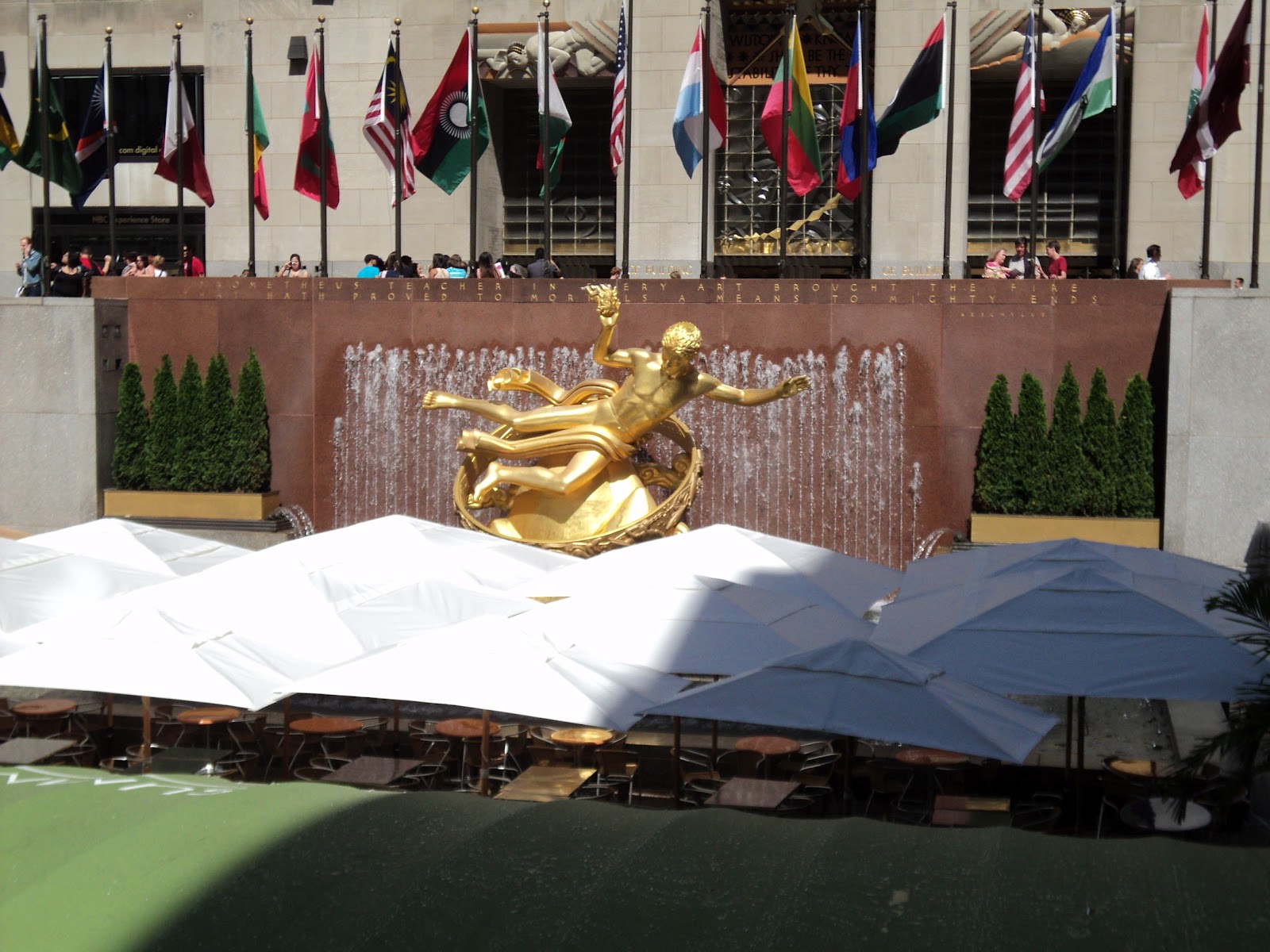
The plaza was full of locals and visitors going to and fro, or seated on stone benches in the shade. Rockefeller Center itself soared above my head. In front of me was the sunken plaza with the statue of the Greek god Prometheus, (who brought fire to mankind from heaven--so the story goes) surrounded by fountains (photo right). This is where the ice-skating rink is set up during the Christmas season, along with the huge towering Christmas tree.
Rockefeller Center, which is comprised of a series of buildings, is the home of NBC News; I could see the studio where the Today show is done every day. (NBC's HQ is in the GE Building, which is the main building in the Center.) Flags from many nations fly from poles surrounding the plaza, and it's a great place to see and be seen. I sat down on a bench in the shade and did some writing, and rested.
Close by were two cool stores: the LEGO Store and the Metropolitan Museum of Art Shop. Two more contrasting stores couldn't be found anywhere; the LEGO Store is for kids of all ages, filled with kits to build everything from London's iconic Tower Bridge to the latest Star Wars ship! Two huge walls were on the ground floor, full of colorful LEGO pieces of all sizes and shapes; a customer could fill a bag with them, and build whatever they wanted.
One side of the store held LEGO kits for buildings like royal castles, or cars and such; the other side was full of kits of Star Wars and Harry Potter stuff. And in the middle of the store was a replica of Rockefeller Center--in LEGO (photo above left). It was complete with little people, vehicles, the Prometheus sculpture and little flags--AND none other than Darth Vader from Star Wars, standing on Rockefeller Center's roof with some 'storm troopers'! (photo right) Thankfully, an NYPD helicopter was nearby, to come to the rescue...
In total contrast, the Metropolitan Museum of Art Shop was very elegant and stylish. You could buy replicas of some of 'the Met'''s artworks on items like silk scarves and stationery, to smaller-scale sculpture works by Auguste Rodin (his The Thinker was on display). There were also some really beautiful jewelry pieces based on various artworks, or artistic periods represented at the Met; for instance, necklaces and brooches inspired by the Russian Easter eggs created by the jeweler Peter Carl Faberge, for the Romanov Russian Imperial Family in the late 19th and early 20th centuries. And I think there were also posters of some of the artworks too.
Most of this stuff, however, was a bit out of my price range. Instead, I wandered over to the book tables and music CD displays. There were some lovely coffee-table sized books for sale--including one that really caught my eye: The French Dog, by a female American photographer whose name escapes me now. But the photos of dogs in rural and urban France, and the stories behind the photos, were really entertaining. In the event, I bought this book for my sister Joanne. It was too sweet to pass up!
And so, armed with my purchases, I headed south on Fifth Avenue to Madison Avenue via 40th Street, for lunch at the Pret A Manger shop on Madison. I bought another chicken Caesar salad, a chocolate brownie, red grapes and strawberry lemonade. Stupidly, I forgot to buy salad dressing--and, most important, pick up eating utensils for the salad. I didn't notice until I got back to my room to eat! Good thing I didn't get dressing, because I ended up eating lunch with my fingers. Still, it was awesomely delicious.
I halted my sight-seeing around 1 pm, and went back to my room to eat, and take a nap before the reception that evening. I left a wake-up call for 4:30 pm at the front desk. The reception would start at 6 pm at The Morgan Library & Museum, and I wanted to have plenty of time to shower and dress up. So after lunch, I settled down for a good nap. Next up: the Churchill reception!
I woke between 5 and 6 am on Thursday, 7 June 2012: the 'big day'--that is, the day of the reception at The Morgan Library & Museum, to open the exhibition Churchill: The Power of Words. It was the culmination day for so many people, who worked so hard to bring this event to pass--the staff at The Morgan, and especially for my friend Allen Packwood, and his team at the Churchill Archives Centre at Churchill College in Cambridge, England.
Before that event occurred, however, I decided to take in a few of New York City's sights (and at the same time not over-exert myself, to be 'fresh' for the evening's festivities). So after showering and dressing, I headed out to the Pret A Manger restaurant on Fifth Avenue at 40th Street for breakfast: a tomato and mozzarella cheese sandwich, and granola and yogurt. Thus fortified, I headed south on Fifth Avenue, to the Empire State Building. Despite my occasional fear of heights, I was determined to get a bird's-eye view of the New York City skyline.
It was a good thing I arrived at the Empire State Building when I did, around 8:30 am; the lines were already forming for admission to ride the elevators to the 88th floor Observation Deck. I took an escalator to the second floor, where the tour would begin. I followed the line going to the ticket window: but before one ever gets there, one has to go through a Security Check similar to that for the airport! I bet it's been in place since the September 11, 2001 World Trade Center attack.
We had to take off any handbags, backpacks, camera cases--and our belts!--and put them in a tray to go through the x-ray machine, and then walk through a metal-detector. When my turn came, I told the attendant I wasn't wearing a belt....but I really was wearing one. When I went through the metal-detector and it went off, I sheepishly went back to the attendant--who was now scowling at me. She said, "You told me you weren't wearing a belt." And I replied: "I forgot"--and I unbuckled it, and placed it in the tray. This time, I didn't set the detector off. I grabbed my backpack, camera case and belt, and put them on..and tried to find an inconspicuous way to put the belt back on. What a pain....
After purchasing my ticket, I was directed to stand in front of a blank wall and have a photo taken. It wasn't for security reasons: it was for an over-priced souvenir (more on that later)! Then, I joined the throngs waiting for the express elevator trip to the 80th floor, and I crammed inside with about 12-15 people: several Chinese and French-speaking tourists among them. My ears popped as the elevator smoothly climbed its way up. We got off at the 80th floor, and waited in yet another line for another express elevator, to go to the 86th floor, and the Observation Deck. As we emerged from the second elevator, a huge wind-gust hit our faces--which meant we were at our destination.
I have to confess: my knees initially went weak as I stepped out onto the Deck, and looked out over the scene: all of New York City appeared to be at our feet! To the south: Lower Manhattan and New York Harbor; to the west, the Hudson River. To the east: the East River and Brooklyn; to the north, Fifth Avenue and Central Park. It was windy and quite comfortable, as I wandered around the Deck and took lots of photos.
The far skyline had a little bit of smog and haze, but I could still make out the Statue of Liberty and Ellis Island in New York Harbor. And in Lower Manhattan, the 'new' World Trade Center tower (sometimes called the 'Freedom Tower') was really taking shape; most of the lower floors were already done (photo above left). I watched the ferry and tour boats making their ways along the Hudson and East Rivers, and in the Harbor. A huge cruise ship lay just beyond Lady Liberty.
On the south side of the Deck, I could make out Central Park and Fifth Avenue, and Rockefeller Center--and a wee bit of St Patrick's Cathedral (photo right). The Chrysler Building wasn't far away, either. There's a high fence between you and a 'long way down'--but I still had visions of me losing my grip on my camera, and watching it fall 86 stories to the street (or on someone's head). So I wrapped the strap around my wrist, and snapped away, like my fellow visitors. So many languages were heard: Chinese, French, Scandinavian, German and English--people from everywhere and anywhere were taking photos. I'd venture to say that over a million photos are taken atop the Empire State Building in an average day. It's amazing....
I think I stayed around an hour or so, just savoring the views. Eventually, I decided to go back in, and head back down the elevators. But not before I stopped at the 80th-floor souvenir shop: a place filled with all kinds of Empire State Building tchochkes: from ESB pencil-sharpeners and paperweights, to fridge magnets and key chains and t-shirts....and not to mention the stuffed King Kong toys. I admit it: I bought a King Kong/ESB fridge magnet, a Wish-You-Were-Here ESB fridge magnet, and a bottle of water. Later, I couldn't help but think that the bottle of water alone cost $10.... All the Chinese visitors must have felt at home here. I bet most of these tchochkes were Made In China!!!
I then left the souvenir store, and headed for the elevator back to the ground floor. I didn't leave the Empire State Building, however, without one more stop....for the 'souvenir' photo taken earlier. Turns out that 'empty wall' behind me was really a backdrop of the Empire State Building at night! When I saw how horribly ugly my photo was, I didn't buy it. Good thing too; it would have cost me $20!!!! It got shredded, thank goodness.
Outside the Empire State Building, I headed north along Fifth Avenue to Rockefeller Center (photo left). Judging from the view from the Observation Deck, I thought it would be a short walk. I should have known better: it was about six long city blocks away. The morning was a bit warmer than the day before, around 80 degrees and sunny--so I stopped about half-way, and rested in the plaza of the New York Public Library. I found a table beneath a shade tree, drank some water and got off my feet for a few minutes. Good thing there was still a little breeze. I started back up Fifth Avenue again, and turned west across from St Patrick's--and about half a block away was Rockefeller Plaza.
The plaza was full of locals and visitors going to and fro, or seated on stone benches in the shade. Rockefeller Center itself soared above my head. In front of me was the sunken plaza with the statue of the Greek god Prometheus, (who brought fire to mankind from heaven--so the story goes) surrounded by fountains (photo right). This is where the ice-skating rink is set up during the Christmas season, along with the huge towering Christmas tree.
Rockefeller Center, which is comprised of a series of buildings, is the home of NBC News; I could see the studio where the Today show is done every day. (NBC's HQ is in the GE Building, which is the main building in the Center.) Flags from many nations fly from poles surrounding the plaza, and it's a great place to see and be seen. I sat down on a bench in the shade and did some writing, and rested.
Close by were two cool stores: the LEGO Store and the Metropolitan Museum of Art Shop. Two more contrasting stores couldn't be found anywhere; the LEGO Store is for kids of all ages, filled with kits to build everything from London's iconic Tower Bridge to the latest Star Wars ship! Two huge walls were on the ground floor, full of colorful LEGO pieces of all sizes and shapes; a customer could fill a bag with them, and build whatever they wanted.
One side of the store held LEGO kits for buildings like royal castles, or cars and such; the other side was full of kits of Star Wars and Harry Potter stuff. And in the middle of the store was a replica of Rockefeller Center--in LEGO (photo above left). It was complete with little people, vehicles, the Prometheus sculpture and little flags--AND none other than Darth Vader from Star Wars, standing on Rockefeller Center's roof with some 'storm troopers'! (photo right) Thankfully, an NYPD helicopter was nearby, to come to the rescue...
In total contrast, the Metropolitan Museum of Art Shop was very elegant and stylish. You could buy replicas of some of 'the Met'''s artworks on items like silk scarves and stationery, to smaller-scale sculpture works by Auguste Rodin (his The Thinker was on display). There were also some really beautiful jewelry pieces based on various artworks, or artistic periods represented at the Met; for instance, necklaces and brooches inspired by the Russian Easter eggs created by the jeweler Peter Carl Faberge, for the Romanov Russian Imperial Family in the late 19th and early 20th centuries. And I think there were also posters of some of the artworks too.
Most of this stuff, however, was a bit out of my price range. Instead, I wandered over to the book tables and music CD displays. There were some lovely coffee-table sized books for sale--including one that really caught my eye: The French Dog, by a female American photographer whose name escapes me now. But the photos of dogs in rural and urban France, and the stories behind the photos, were really entertaining. In the event, I bought this book for my sister Joanne. It was too sweet to pass up!
And so, armed with my purchases, I headed south on Fifth Avenue to Madison Avenue via 40th Street, for lunch at the Pret A Manger shop on Madison. I bought another chicken Caesar salad, a chocolate brownie, red grapes and strawberry lemonade. Stupidly, I forgot to buy salad dressing--and, most important, pick up eating utensils for the salad. I didn't notice until I got back to my room to eat! Good thing I didn't get dressing, because I ended up eating lunch with my fingers. Still, it was awesomely delicious.
I halted my sight-seeing around 1 pm, and went back to my room to eat, and take a nap before the reception that evening. I left a wake-up call for 4:30 pm at the front desk. The reception would start at 6 pm at The Morgan Library & Museum, and I wanted to have plenty of time to shower and dress up. So after lunch, I settled down for a good nap. Next up: the Churchill reception!
Yes, I Know: It's Been Awhile....
Yep--it's been some time since I've written in this blog. I could use all kinds of reasons/excuses/rationalizations: I was too lazy, or it was too hot outside, or whatever. Enough's enough. Let's try and describe my trip to New York City, for the opening of Churchill: The Power of Words, at The Morgan Library & Museum
The Museum's entrance is the photo above left.
This journey all started back in November 2010, during my three-week visit to the UK and Europe. I spent a wonderful day in Cambridge, at the Churchill Archives Centre at Churchill College, where I met Mr Allen Packwood, the Centre's Director. I'd emailed him about my initial research into Winston Churchill's American maternal ancestors, the Jeromes--after discovering that Churchill's maternal grandfather, Leonard Jerome, was born in the village of Pompey Hill, New York: a short drive from where I live outside Syracuse. Allen was in the planning stages for this New York City exhibition about Churchill and his 'way with words', and he asked if I would like to be involved in some way. And I said, 'Certainly--in whatever way I can help'--or words to that effect.
In the event, I did some research in the Syracuse area, and found a family tree tracing back to the first Jerome to settle in the Pompey Hill area: one Timothy Jerome, who came from the Isle of Wight. I traced down through the male line, all the way to Leonard Jerome and his middle daughter Jennie, who married Lord Randolph Churchill, the second son of the 7th Duke of Marlborough. (That's Jennie's portrait on the left.) Their firstborn son was Winston Churchill. I email the information to Allen, and his team created a really great graphic design, for people to see. I subsequently received an invitation to attend the reception to open the exhibition on 7 June 2012.
I decided to stay in New York for two days, which was all I could afford. I found a hotel on Park Avenue online, and bought rail tickets from Syracuse to Penn Station in New York (I did NOT want to drive in Manhattan). The trip took about 5 1/2 hours, and made several stops along the way. The best part of the journey was the view of the Hudson River; I made sure to get a seat on the right side of the train! The Hudson was magnificent: I was able to view sites like the US Military Academy at West Point (on the west side of the river), and the wide expanse of the river as we headed south. There was a lot of wildlife to be found--including a Bald Eagle, perched in a riverside tree.
I arrived at Penn Station just after 1 pm, on Wednesday, 6 June. The station is situated underneath Madison Square Garden--aka The World's Most Famous Arena, and home to the NHL's New York Rangers and the NBA's New York Knicks. I joined the heaving throng out of the station, and into the taxi queue--which was quite orderly for New York. The driver deftly dodged his way through the midtown Manhattan traffic, and I arrived at my hotel: the 70 Park Avenue. My room faced the Empire State Building, which was pretty darned cool!
That first day was more of a 'recon' time than anything: I wanted to get my bearings as to where things were. I hadn't visited New York in many years, and I'd brought along a few Google maps to places I wanted to visit. And I did a LOT of walking that first day, north along both Madison and Fifth Avenues. Those 'sidewalks of New York' are VERY VERY long, and always full of people; I felt like a minnow trying to swim upstream!! And I especially wanted to find my way to The Morgan Library & Museum, and figure out the shortest way to go from the hotel.
My one lingering visit that day was to 'Chartwell Booksellers', at 55 East 52nd Street--and not far from Fifth Avenue (photo right). Their slogan is The World's Only Winston Churchill Bookshop--and it's as good as its word. Here, one can find almost any book about Winston Churchill: his political thought, his family--even his 'sartorial style'. One can also find First Editions of Churchill's own books plus several hardcover editions of the Official Churchill biography by Randolph Churchill (WSC's son) and Sir Martin Gilbert. One of these hardcover Official biographies was for sale for....$8000!!! After I gulped at the price, I thought: 'Sure--I've got some loose change in my pocket!"
Alongside the Churchill books, there were volumes about Britain in the Second World War; general British history; general Second World War history, and books on Architecture and Gardening. I found a number of books by Sir Martin that were not Churchill-related (I have several of them in my home library). And it was tempting to buy something at Chartwell Booksellers. But I managed to resist..although I did take some photos of the shop's window displays; mostly having to do with Churchill Style: a new book about Churchill's clothes and his sartorial style!
I took some time off my feet nearby, before braving the crowds again along Fifth Avenue. I passed many upscale shops as I headed south, back towards the hotel: Saks Fifth Avenue, Lord and Taylor, Louis Vuitton, Gucci, Tiffany & Co.: well, you get the idea. One could do a whole day's worth of 'window shopping', gazing at high fashion for women or expensive jewelry and leather goods.
I made a brief stop at St Patrick's Cathedral, which was covered in exterior scaffolding for a major restoration project. Inside, it was a bit of a madhouse: tourists snapping photos and lighting candles at various shrines flanking the nave, along with a high school graduation ceremony in full swing at the foot of the High Altar. I don't know how anyone managed to pray in the cathedral, with all the chaos going on; a few people were making a valiant effort to do just that. And I nearly got run over by a mother pushing her toddler in a stroller!
This day, at least, St Patrick's was more of a tourist attraction, than a 'house of prayer'. YIKES....! And I admit it: I acted like a tourist myself, by snapping photos of some of the stained-glass windows.... (photo right).
Later on, I couldn't stop thinking about the 'houses of Mammon' that lined Fifth Avenue, in contrast to St Patrick's.
Upon leaving St Patrick's, I noticed a really imposing building on the opposite side of the street: the New York Public Library, with its imposing lion sculptures flanking its entrance (photo left). The story goes that the sculptures were originally named "Leo Astor' and "Leo Lenox" after the Library's founders John Jacob Astor and James Lenox. But in the 1930s, during the Great Depression, New York City Mayor Fiorello LaGuardia nicknamed them 'Patience' (on the left as the viewer looks) and 'Fortitude' (on the right); LaGuardia believed those were two attributes that would give New Yorkers the strength and courage to get through those dark days.
There is a little plaza of sorts out front with tables, where one can sit, eat and drink, and just watch the people go by. And there were a lot of people hanging about, on a very lovely late-spring day. I took several photos of the Library, and the lion sculptures.
By this time, it was after 3 pm, and I thought I would go look for The Morgan, and see how to get inside for the next evening's reception. I left Fifth Avenue at 40th Street, turned onto Madison Avenue and there it was. The Morgan is one of New York's small treasures: part of the Museum comprises the former home of financier J. Pierpont Morgan: one of the richest men in the world. It is also a world-class art museum, with changing exhibits of paintings, drawings and sculpture. One of their current exhibitions was one on Renaissance drawing.
As I entered the Museum's modern lobby, I spotted a familiar face: my friend Allen Packwood from Cambridge, who was in a small group of people. I thought he glanced my way, before disappearing into an exhibit hall on the right with his small group. While standing around looking lost, I was approached by a museum staffer, who asked what I was doing; I replied it was my first visit to The Morgan, and that I would be attending the next evening's Churchill exhibition reception. The staffer then allowed me to wander around the 'free' area off the lobby--normally, one would pay $15 to visit the main exhibit areas.
And that's what I did: I wandered about, and looked at some medieval and Renaissance-era sculptures, religious implements, reliquaries and such, that were part of The Morgan's permanent collection. There was also a plaster sculpture in a display case of the original 1902 entrance to J. Pierpont Morgan's home, which is on 37th Street.
I was sweating profusely from all the outdoors walking, and hoped I didn't look like a total wet rag. Soon, Allen emerged from the nearby exhibit hall and came over to me, and greeted me warmly. We had a few moments to chat, and he told me some writers from The New York Times were in the Churchill exhibition, to write an advanced review. Allen told me he left them alone because the Times staffers wished to work in peace. I thought, that makes sense.
During our conversation, Allen told me there would be just over three hundred people in attendance at the reception. And there would be several 'special guests' invited: London Mayor Boris Johnson, Churchill's granddaughters Edwina and Celia Sandys (daughters of Churchill's eldest child Diana)--and Caroline Kennedy and her husband Edwin Schlossberg. At that point, Allen wasn't certain Ms. Kennedy would be attending...but at the same time, my mouth literally flew open. And I thought, what in the WORLD was 'little old me' doing at this reception with so many 'real' V.I.P.'s?!?
Poor Allen: he'd been dashing about New York City ever since his arrival the previous Sunday, making sure everything (and everyone) was in place for this event. Not just the reception: the whole exhibition, which runs through 23 September 2012. I don't know how he managed to keep his head together, with all the details and things to take care of. If it were me, I'd probably be tearing my hair out.....! So I decided to let him go back to see what the Times people were doing; I bid him 'Good Evening', and said I'd see him at the reception. I left The Morgan, and headed back to my hotel
By now, it was close to 4:30 or so, and I was VERY hungry. While planning my trip, I discovered there were several stores of my favorite UK restaurant chain--Pret A Manger--in close proximity to the hotel. This restaurant makes freshly-prepared food all day: sandwiches, salads, soups, and desserts. It's all local food and/or organic; and I found 'Pret' by accident in London in November 2010. I bought an awesome chicken Caesar salad with raspberry vinaigrette dressing; an organic fruit drink; some crunchy red grapes and a chocolate and granola bar, and took it all back to my room.
As I crashed for the night--with somewhat sore feet--I savored my supper, and reflected on where I'd been, and what I'd seen so far. And I also tried to get some decent sleep--all the while trying not to get nervous about the upcoming reception at The Morgan.....
The Museum's entrance is the photo above left.
This journey all started back in November 2010, during my three-week visit to the UK and Europe. I spent a wonderful day in Cambridge, at the Churchill Archives Centre at Churchill College, where I met Mr Allen Packwood, the Centre's Director. I'd emailed him about my initial research into Winston Churchill's American maternal ancestors, the Jeromes--after discovering that Churchill's maternal grandfather, Leonard Jerome, was born in the village of Pompey Hill, New York: a short drive from where I live outside Syracuse. Allen was in the planning stages for this New York City exhibition about Churchill and his 'way with words', and he asked if I would like to be involved in some way. And I said, 'Certainly--in whatever way I can help'--or words to that effect.
In the event, I did some research in the Syracuse area, and found a family tree tracing back to the first Jerome to settle in the Pompey Hill area: one Timothy Jerome, who came from the Isle of Wight. I traced down through the male line, all the way to Leonard Jerome and his middle daughter Jennie, who married Lord Randolph Churchill, the second son of the 7th Duke of Marlborough. (That's Jennie's portrait on the left.) Their firstborn son was Winston Churchill. I email the information to Allen, and his team created a really great graphic design, for people to see. I subsequently received an invitation to attend the reception to open the exhibition on 7 June 2012.
I decided to stay in New York for two days, which was all I could afford. I found a hotel on Park Avenue online, and bought rail tickets from Syracuse to Penn Station in New York (I did NOT want to drive in Manhattan). The trip took about 5 1/2 hours, and made several stops along the way. The best part of the journey was the view of the Hudson River; I made sure to get a seat on the right side of the train! The Hudson was magnificent: I was able to view sites like the US Military Academy at West Point (on the west side of the river), and the wide expanse of the river as we headed south. There was a lot of wildlife to be found--including a Bald Eagle, perched in a riverside tree.
I arrived at Penn Station just after 1 pm, on Wednesday, 6 June. The station is situated underneath Madison Square Garden--aka The World's Most Famous Arena, and home to the NHL's New York Rangers and the NBA's New York Knicks. I joined the heaving throng out of the station, and into the taxi queue--which was quite orderly for New York. The driver deftly dodged his way through the midtown Manhattan traffic, and I arrived at my hotel: the 70 Park Avenue. My room faced the Empire State Building, which was pretty darned cool!
That first day was more of a 'recon' time than anything: I wanted to get my bearings as to where things were. I hadn't visited New York in many years, and I'd brought along a few Google maps to places I wanted to visit. And I did a LOT of walking that first day, north along both Madison and Fifth Avenues. Those 'sidewalks of New York' are VERY VERY long, and always full of people; I felt like a minnow trying to swim upstream!! And I especially wanted to find my way to The Morgan Library & Museum, and figure out the shortest way to go from the hotel.
My one lingering visit that day was to 'Chartwell Booksellers', at 55 East 52nd Street--and not far from Fifth Avenue (photo right). Their slogan is The World's Only Winston Churchill Bookshop--and it's as good as its word. Here, one can find almost any book about Winston Churchill: his political thought, his family--even his 'sartorial style'. One can also find First Editions of Churchill's own books plus several hardcover editions of the Official Churchill biography by Randolph Churchill (WSC's son) and Sir Martin Gilbert. One of these hardcover Official biographies was for sale for....$8000!!! After I gulped at the price, I thought: 'Sure--I've got some loose change in my pocket!"
Alongside the Churchill books, there were volumes about Britain in the Second World War; general British history; general Second World War history, and books on Architecture and Gardening. I found a number of books by Sir Martin that were not Churchill-related (I have several of them in my home library). And it was tempting to buy something at Chartwell Booksellers. But I managed to resist..although I did take some photos of the shop's window displays; mostly having to do with Churchill Style: a new book about Churchill's clothes and his sartorial style!
I took some time off my feet nearby, before braving the crowds again along Fifth Avenue. I passed many upscale shops as I headed south, back towards the hotel: Saks Fifth Avenue, Lord and Taylor, Louis Vuitton, Gucci, Tiffany & Co.: well, you get the idea. One could do a whole day's worth of 'window shopping', gazing at high fashion for women or expensive jewelry and leather goods.
I made a brief stop at St Patrick's Cathedral, which was covered in exterior scaffolding for a major restoration project. Inside, it was a bit of a madhouse: tourists snapping photos and lighting candles at various shrines flanking the nave, along with a high school graduation ceremony in full swing at the foot of the High Altar. I don't know how anyone managed to pray in the cathedral, with all the chaos going on; a few people were making a valiant effort to do just that. And I nearly got run over by a mother pushing her toddler in a stroller!
This day, at least, St Patrick's was more of a tourist attraction, than a 'house of prayer'. YIKES....! And I admit it: I acted like a tourist myself, by snapping photos of some of the stained-glass windows.... (photo right).
Later on, I couldn't stop thinking about the 'houses of Mammon' that lined Fifth Avenue, in contrast to St Patrick's.
Upon leaving St Patrick's, I noticed a really imposing building on the opposite side of the street: the New York Public Library, with its imposing lion sculptures flanking its entrance (photo left). The story goes that the sculptures were originally named "Leo Astor' and "Leo Lenox" after the Library's founders John Jacob Astor and James Lenox. But in the 1930s, during the Great Depression, New York City Mayor Fiorello LaGuardia nicknamed them 'Patience' (on the left as the viewer looks) and 'Fortitude' (on the right); LaGuardia believed those were two attributes that would give New Yorkers the strength and courage to get through those dark days.
There is a little plaza of sorts out front with tables, where one can sit, eat and drink, and just watch the people go by. And there were a lot of people hanging about, on a very lovely late-spring day. I took several photos of the Library, and the lion sculptures.
By this time, it was after 3 pm, and I thought I would go look for The Morgan, and see how to get inside for the next evening's reception. I left Fifth Avenue at 40th Street, turned onto Madison Avenue and there it was. The Morgan is one of New York's small treasures: part of the Museum comprises the former home of financier J. Pierpont Morgan: one of the richest men in the world. It is also a world-class art museum, with changing exhibits of paintings, drawings and sculpture. One of their current exhibitions was one on Renaissance drawing.
As I entered the Museum's modern lobby, I spotted a familiar face: my friend Allen Packwood from Cambridge, who was in a small group of people. I thought he glanced my way, before disappearing into an exhibit hall on the right with his small group. While standing around looking lost, I was approached by a museum staffer, who asked what I was doing; I replied it was my first visit to The Morgan, and that I would be attending the next evening's Churchill exhibition reception. The staffer then allowed me to wander around the 'free' area off the lobby--normally, one would pay $15 to visit the main exhibit areas.
And that's what I did: I wandered about, and looked at some medieval and Renaissance-era sculptures, religious implements, reliquaries and such, that were part of The Morgan's permanent collection. There was also a plaster sculpture in a display case of the original 1902 entrance to J. Pierpont Morgan's home, which is on 37th Street.
I was sweating profusely from all the outdoors walking, and hoped I didn't look like a total wet rag. Soon, Allen emerged from the nearby exhibit hall and came over to me, and greeted me warmly. We had a few moments to chat, and he told me some writers from The New York Times were in the Churchill exhibition, to write an advanced review. Allen told me he left them alone because the Times staffers wished to work in peace. I thought, that makes sense.
During our conversation, Allen told me there would be just over three hundred people in attendance at the reception. And there would be several 'special guests' invited: London Mayor Boris Johnson, Churchill's granddaughters Edwina and Celia Sandys (daughters of Churchill's eldest child Diana)--and Caroline Kennedy and her husband Edwin Schlossberg. At that point, Allen wasn't certain Ms. Kennedy would be attending...but at the same time, my mouth literally flew open. And I thought, what in the WORLD was 'little old me' doing at this reception with so many 'real' V.I.P.'s?!?
Poor Allen: he'd been dashing about New York City ever since his arrival the previous Sunday, making sure everything (and everyone) was in place for this event. Not just the reception: the whole exhibition, which runs through 23 September 2012. I don't know how he managed to keep his head together, with all the details and things to take care of. If it were me, I'd probably be tearing my hair out.....! So I decided to let him go back to see what the Times people were doing; I bid him 'Good Evening', and said I'd see him at the reception. I left The Morgan, and headed back to my hotel
By now, it was close to 4:30 or so, and I was VERY hungry. While planning my trip, I discovered there were several stores of my favorite UK restaurant chain--Pret A Manger--in close proximity to the hotel. This restaurant makes freshly-prepared food all day: sandwiches, salads, soups, and desserts. It's all local food and/or organic; and I found 'Pret' by accident in London in November 2010. I bought an awesome chicken Caesar salad with raspberry vinaigrette dressing; an organic fruit drink; some crunchy red grapes and a chocolate and granola bar, and took it all back to my room.
As I crashed for the night--with somewhat sore feet--I savored my supper, and reflected on where I'd been, and what I'd seen so far. And I also tried to get some decent sleep--all the while trying not to get nervous about the upcoming reception at The Morgan.....
Wednesday, December 14, 2011
Better Late Than Never: Day Three of My Hyde Park Adventure
I do apologize for the 'late' entry here: procrastination got the better of me for the last month, and I haven't concluded recounting my 'excellent' adventure in Hyde Park, New York, in November 2011. But I'm doing that right now...
Day Three, 10 November 2011, dawned bright with unseasonable warmth. I slept OK overnight, except for a case of 'twitchy legs'. I hate those....! I waited to finish packing up until I had breakfast at the Roosevelt Inn: more bagels and cream cheese, with a banana and orange juice. After I completed packing, and loaded my things into the car, I went to the office to pay my bill. As I approached the office door, I noticed a Welsh Corgi on the other side, barking at me. This was "Minna", the canine 'desk clerk': the Inn's manager, a lovely lady from Finland, encouraged me to come in.
Minna, as it turned out, loves the Inn's guests. She let me pet her, and got very excited when I made a fuss over her (photo left). Minna's mistress has run the Roosevelt Inn for over thirty years: she told me her German-born husband had recently passed away: he had been born in East Prussia--the part of Germany that was given to Poland after Germany's defeat in the Second World War. I mentioned that my mother's family was also from Germany, but in the western part of the country.
Minna, for her part, was so excited by all the attention, she wouldn't look at me, while I tried to take her photo. The one at the left is one of the best.
Before I left, I assured Minna's mistress that I would be back in Hyde Park again, and staying at the Roosevelt Inn: I enjoyed the hospitality, and said I would recommend the Inn to others. After giving Minna one last scratch on the head, I was on my way.
The night before, I had decided to take the more 'scenic route' home. I decided against going back on the New York State Thruway because it is an incredibly boring drive at high-speed. I decided to take US Route 9 north to near Albany, and then go US Route 20 west. It would take a longer time, yes--but there's a change in road speeds, along with changes of scenery.
Before leaving Hyde Park, I returned to the Franklin D. Roosevelt National Historic Site, and retrace the path that Allen Packwood and I had trod the day before--but at a more leisurely pace. The ground was damp from overnight dew--but there were few people about, except staff working on the restoration project at the FDR Presidential Library building.
Behind the Library, I noticed three large sculpture busts standing all alone: two were of President Roosevelt--and one was of British Prime Minister Winston Churchill (photo right). Normally, they would be standing within the Library building. But during the restoration work, they were moved outside, a few feet from the rear entrance. Needless to say, I was surprised to see these: I wish Allen and I had found them the day before!
Doing some research after the trip, I discovered this bust was created by the same sculptor who did a similar Churchill bust at Churchill College in Cambridge, England. I saw that particular sculpture in November 2010, when I first met Allen at his office at the Churchill Archives Centre. This Hyde Park bust shows both Churchill's strength and determination.
Retracing my steps to the nearby Rose Garden, I took a couple more photos of the Franklin and Eleanor Roosevelt graves--and the grave of Roosevelt's Scottie, 'Fala'. On a nearby National Park Service marker, I found an interesting and sad photo of Eleanor Roosevelt accompanying Churchill on a visit to Franklin Roosevelt's grave in March 1946 (photo left). Churchill looks utterly sad, as he gazes at the grave of his wartime colleague. He must have been devastated, when he first received the news of Roosevelt's untimely death in April 1945.
Near the Rose Garden is the main house, Springwood, where Franklin Roosevelt was born. During his presidency, he used this house as a summer home, and a retreat from wartime stress. Just before the Second World War broke out, the Roosevelts invited Britain's King George VI and Queen Elizabeth, to a picnic at nearby Top Cottage. It was here that the King and Queen tried American hot dogs for the first time!
Springwood itself is also undergoing some restoration work. Most of it appears to be happening at the rear of the house. The view from the sweeping front drive is beautiful: it must have been a hive of activity when the Roosevelts and their children were in residence. And poor Eleanor had to deal with her husband's overprotective and domineering mother, Sara Delano Roosevelt.
The views of the Hudson River Valley, behind Springwood, are spectacular. And even though the leaves were mostly off the trees, it was still a beautiful thing to behold.
I made my way slowly back to the Wallace Educational Center, next door to the Library. I wanted to see if the gift shop was open--but, alas, I was too early. It didn't open until 10 am, and it was just after 9 am when I arrived. I did, however, do some wandering about outside, and got some photos of a really nice dual sculpture of Eleanor and Franklin Roosevelt, seated on a terrace outside the Center (photo right).
There's even a spot for visitors to sit next to the President, to have their photos taken. On the Roosevelt Inn's Web site, little Minna had her chance to sit next to Franklin Roosevelt!
Going back inside the Center, I found the sculpture of "Fala" that sits next to the Visitor Information desk. Allen had pointed it out to me the day before, but I was unable to get a photo of it then. So I took the opportunity to get one this time around (photo left).
If there was a poll asking people who the most famous White House pet was (or is), I am sure many people would pick "Fala". His master spoke of him often enough!
Right after I took this photo, I left the park. But before I left Hyde Park itself, I made a couple more photo stops. One was at The Eveready Diner, where Allen and I had lunch the day before. I'll never forget their very filling dinners from Tuesday and Wednesday evening! A must-stop for any future Hyde Park visit.
My final Hyde Park stop was at the St James Episcopal Church (photo left), where the Roosevelts worshiped during their stays at Springwood. It was consecrated in October 1811, as the only Protestant Episcopal congregation north of Poughkeepsie, and south of Hudson, New York. The first congregational meeting was held in March 1812. Many of the prominent families in the Hyde Park area were members of St James' congregation--including the Livingston and Lewis families. Many members of these families were buried in the cemetery behind the church--including one Robert Livingston, who was a drafter (but not a signer) of the Declaration of Independence.
My main reason for stopping at the St James Church cemetery was to see if Sara Delano Roosevelt was buried there. She died in Hyde Park in September 1941, and her funeral was held at St James. Sadly, I could not find her grave, if it was there. I did see some rather impressive mausoleums of the 'local gentry', however--including that of the above-mentioned Robert Livingston.
I also saw a very poignant memorial marker (photo left), for Paul E. Tegtmaier, a former member of the Hyde Park Fire Department. He had moved to New York City and joined the FDNY--only to perish in the World Trade Center's North Tower, on 11 September 2001. No trace of this young man was ever found.
The cemetery itself was very quiet, except for lawn-mowing being done by a groundskeeper. The leaves beneath my feet crunched, as I walked along the graveyard's paths. Then: lo and behold, I saw something moving between two of the mausoleums: it was a large deer: it looked like a buck, but I couldn't be sure. We looked at each other for a long time, and I stepped forward, one step at a time, to try and get a good photo. The deer snorted a little, but made no initial attempt to run away. Eventually, it scampered off to my left, amongst the gravestones, and towards busy US Route 9.
I hope the creature was able to cross the road safely. I didn't see it again once I left the church grounds.
Soon, it was time to get back on the road. I had a wonderful drive through some beautiful and historic Hudson Valley towns, like Rhinebeck. I love seeing the farmland, and all the wonderful old buildings. And it was hard to leave such a wonderful area like the Hudson Valley. Especially when I reached Albany, the state capital of New York. Driving through that city's not for the faint of heart, or the 'directionally-challenged'!
After i crossed the Hudson River, I found myself at the foot of one of Albany's more monstrous building sites: the Empire State Plaza, where many state Government offices are located. I was looking for the way to US Route 20, and had to drive through some congested streets to get there. I followed a set of signs to Route 20--only to have them disappear from sight, on a narrow side street lined with restored old town-houses. Good thing I decided not to get off this particular street, because eventually I found my way out of Albany proper--and right onto US Route 20.
The sun stayed out all during my drive north on US Route 9. Until I left the Albany city limits, that is. Then, the skies darkened, and the rain came pouring down--all while I'm literally driving up-hill-and-down-dale on Route 20. I must confess it is a very scenic roadway, full of historic towns and villages, and incredible scenery. But it was probably not a good choice, for driving in the rain, and the darkening skies!
Eventually, the rain ended as I reached the village of Manlius, just outside Syracuse. It was dry as I arrived home around 4 pm....but no sooner did I get the car unloaded and my baggage brought inside, but the heavens opened with another heavy downpour!
All in all: my Hyde Park visit was a great success. It was a pleasure to see Allen again, nearly a year since our visit in Cambridge. And he was happy with what I had found about Leonard Jerome, for use in next year's Churchill exhibition at the Morgan Library in New York City. That alone made it all worthwhile.
Day Three, 10 November 2011, dawned bright with unseasonable warmth. I slept OK overnight, except for a case of 'twitchy legs'. I hate those....! I waited to finish packing up until I had breakfast at the Roosevelt Inn: more bagels and cream cheese, with a banana and orange juice. After I completed packing, and loaded my things into the car, I went to the office to pay my bill. As I approached the office door, I noticed a Welsh Corgi on the other side, barking at me. This was "Minna", the canine 'desk clerk': the Inn's manager, a lovely lady from Finland, encouraged me to come in.
Minna, as it turned out, loves the Inn's guests. She let me pet her, and got very excited when I made a fuss over her (photo left). Minna's mistress has run the Roosevelt Inn for over thirty years: she told me her German-born husband had recently passed away: he had been born in East Prussia--the part of Germany that was given to Poland after Germany's defeat in the Second World War. I mentioned that my mother's family was also from Germany, but in the western part of the country.
Minna, for her part, was so excited by all the attention, she wouldn't look at me, while I tried to take her photo. The one at the left is one of the best.
Before I left, I assured Minna's mistress that I would be back in Hyde Park again, and staying at the Roosevelt Inn: I enjoyed the hospitality, and said I would recommend the Inn to others. After giving Minna one last scratch on the head, I was on my way.
The night before, I had decided to take the more 'scenic route' home. I decided against going back on the New York State Thruway because it is an incredibly boring drive at high-speed. I decided to take US Route 9 north to near Albany, and then go US Route 20 west. It would take a longer time, yes--but there's a change in road speeds, along with changes of scenery.
Before leaving Hyde Park, I returned to the Franklin D. Roosevelt National Historic Site, and retrace the path that Allen Packwood and I had trod the day before--but at a more leisurely pace. The ground was damp from overnight dew--but there were few people about, except staff working on the restoration project at the FDR Presidential Library building.
Behind the Library, I noticed three large sculpture busts standing all alone: two were of President Roosevelt--and one was of British Prime Minister Winston Churchill (photo right). Normally, they would be standing within the Library building. But during the restoration work, they were moved outside, a few feet from the rear entrance. Needless to say, I was surprised to see these: I wish Allen and I had found them the day before!
Doing some research after the trip, I discovered this bust was created by the same sculptor who did a similar Churchill bust at Churchill College in Cambridge, England. I saw that particular sculpture in November 2010, when I first met Allen at his office at the Churchill Archives Centre. This Hyde Park bust shows both Churchill's strength and determination.
Retracing my steps to the nearby Rose Garden, I took a couple more photos of the Franklin and Eleanor Roosevelt graves--and the grave of Roosevelt's Scottie, 'Fala'. On a nearby National Park Service marker, I found an interesting and sad photo of Eleanor Roosevelt accompanying Churchill on a visit to Franklin Roosevelt's grave in March 1946 (photo left). Churchill looks utterly sad, as he gazes at the grave of his wartime colleague. He must have been devastated, when he first received the news of Roosevelt's untimely death in April 1945.
Near the Rose Garden is the main house, Springwood, where Franklin Roosevelt was born. During his presidency, he used this house as a summer home, and a retreat from wartime stress. Just before the Second World War broke out, the Roosevelts invited Britain's King George VI and Queen Elizabeth, to a picnic at nearby Top Cottage. It was here that the King and Queen tried American hot dogs for the first time!
Springwood itself is also undergoing some restoration work. Most of it appears to be happening at the rear of the house. The view from the sweeping front drive is beautiful: it must have been a hive of activity when the Roosevelts and their children were in residence. And poor Eleanor had to deal with her husband's overprotective and domineering mother, Sara Delano Roosevelt.
The views of the Hudson River Valley, behind Springwood, are spectacular. And even though the leaves were mostly off the trees, it was still a beautiful thing to behold.
I made my way slowly back to the Wallace Educational Center, next door to the Library. I wanted to see if the gift shop was open--but, alas, I was too early. It didn't open until 10 am, and it was just after 9 am when I arrived. I did, however, do some wandering about outside, and got some photos of a really nice dual sculpture of Eleanor and Franklin Roosevelt, seated on a terrace outside the Center (photo right).
There's even a spot for visitors to sit next to the President, to have their photos taken. On the Roosevelt Inn's Web site, little Minna had her chance to sit next to Franklin Roosevelt!
Going back inside the Center, I found the sculpture of "Fala" that sits next to the Visitor Information desk. Allen had pointed it out to me the day before, but I was unable to get a photo of it then. So I took the opportunity to get one this time around (photo left).
If there was a poll asking people who the most famous White House pet was (or is), I am sure many people would pick "Fala". His master spoke of him often enough!
Right after I took this photo, I left the park. But before I left Hyde Park itself, I made a couple more photo stops. One was at The Eveready Diner, where Allen and I had lunch the day before. I'll never forget their very filling dinners from Tuesday and Wednesday evening! A must-stop for any future Hyde Park visit.
My final Hyde Park stop was at the St James Episcopal Church (photo left), where the Roosevelts worshiped during their stays at Springwood. It was consecrated in October 1811, as the only Protestant Episcopal congregation north of Poughkeepsie, and south of Hudson, New York. The first congregational meeting was held in March 1812. Many of the prominent families in the Hyde Park area were members of St James' congregation--including the Livingston and Lewis families. Many members of these families were buried in the cemetery behind the church--including one Robert Livingston, who was a drafter (but not a signer) of the Declaration of Independence.
My main reason for stopping at the St James Church cemetery was to see if Sara Delano Roosevelt was buried there. She died in Hyde Park in September 1941, and her funeral was held at St James. Sadly, I could not find her grave, if it was there. I did see some rather impressive mausoleums of the 'local gentry', however--including that of the above-mentioned Robert Livingston.
I also saw a very poignant memorial marker (photo left), for Paul E. Tegtmaier, a former member of the Hyde Park Fire Department. He had moved to New York City and joined the FDNY--only to perish in the World Trade Center's North Tower, on 11 September 2001. No trace of this young man was ever found.
The cemetery itself was very quiet, except for lawn-mowing being done by a groundskeeper. The leaves beneath my feet crunched, as I walked along the graveyard's paths. Then: lo and behold, I saw something moving between two of the mausoleums: it was a large deer: it looked like a buck, but I couldn't be sure. We looked at each other for a long time, and I stepped forward, one step at a time, to try and get a good photo. The deer snorted a little, but made no initial attempt to run away. Eventually, it scampered off to my left, amongst the gravestones, and towards busy US Route 9.
I hope the creature was able to cross the road safely. I didn't see it again once I left the church grounds.
Soon, it was time to get back on the road. I had a wonderful drive through some beautiful and historic Hudson Valley towns, like Rhinebeck. I love seeing the farmland, and all the wonderful old buildings. And it was hard to leave such a wonderful area like the Hudson Valley. Especially when I reached Albany, the state capital of New York. Driving through that city's not for the faint of heart, or the 'directionally-challenged'!
After i crossed the Hudson River, I found myself at the foot of one of Albany's more monstrous building sites: the Empire State Plaza, where many state Government offices are located. I was looking for the way to US Route 20, and had to drive through some congested streets to get there. I followed a set of signs to Route 20--only to have them disappear from sight, on a narrow side street lined with restored old town-houses. Good thing I decided not to get off this particular street, because eventually I found my way out of Albany proper--and right onto US Route 20.
The sun stayed out all during my drive north on US Route 9. Until I left the Albany city limits, that is. Then, the skies darkened, and the rain came pouring down--all while I'm literally driving up-hill-and-down-dale on Route 20. I must confess it is a very scenic roadway, full of historic towns and villages, and incredible scenery. But it was probably not a good choice, for driving in the rain, and the darkening skies!
Eventually, the rain ended as I reached the village of Manlius, just outside Syracuse. It was dry as I arrived home around 4 pm....but no sooner did I get the car unloaded and my baggage brought inside, but the heavens opened with another heavy downpour!
All in all: my Hyde Park visit was a great success. It was a pleasure to see Allen again, nearly a year since our visit in Cambridge. And he was happy with what I had found about Leonard Jerome, for use in next year's Churchill exhibition at the Morgan Library in New York City. That alone made it all worthwhile.
Tuesday, November 15, 2011
Day Two of My Excellent Hyde Park Adventure
Wednesday, 9 November 2011, was another unseasonably warm and sunny day. The middle day of my short stay in Hyde Park, New York, would be the busiest one yet. I would be spending most of the day with my British friend Mr. Allen Packwood, the Director of the Churchill Archives Centre at Churchill College in Cambridge, England. He was on a six-day visit to New York, discussing the details of the upcoming Winston Churchill-themed exhibition at The Morgan Library--and meeting with schoolteachers to go over ways to include learning about Winston Churchill, in their various educational institutions. Allen was taking the train from New York, to spend a few hours in Hyde Park going over my part in the exhibition, and meeting staff members at the Franklin D. Roosevelt Library, to see how they, too, could assist in his work.
I slept fairly well overnight, with the windows open: an odd thing to do in mid-November. But the room was initially a bit warm for my liking. As the night wore on, I felt much more comfortable. When morning came, I was up and going around 6:30 am. After a shower, I changed into some 'dressed-up' clothes: a black vest, white shirt, and khaki trousers--and pinned my red "Flanders Fields" poppy pin on the vest's lapel, so Allen would recognize me at the train station in nearby Poughkeepsie. This is usually about the dressiest I get.
I stopped at the inn's coffee shop, for their complimentary breakfast. I helped myself to a toasted bagel with cream cheese, a banana, and orange juice. As the first one in the coffee shop, I felt a little bit alone as I sat to eat, and read a copy of The New York Times. But I was soon joined by another guest: a gentleman from Florida named Mike, who was on his way to Cooperstown, New York, to visit the National Baseball Hall of Fame and Museum. He told me he was a fan of the St Louis Cardinals, who had just won the 2011 World Series in late October. It was also his first visit to the Hudson River Valley, and he said he enjoyed it very much. I wished Mike a safe trip to Cooperstown.
After breakfast, I returned to my room and went on my computer for a few minutes. I also decided to try and call Allen one more time, to tell him how to recognize me at the train station. Happily, we finally made telephone contact, and I said he could recognize me by the black vest with a red poppy pin. He said he'd be on the lookout, so I wished him a safe journey, and rang off. I then washed my face again and put on fresh makeup, and left for the train station. It was around 9:30 am.
As I got closer to Poughkeepsie, the traffic became busier--especially after I passed Marist College. It grew even heavier--and faster!--as I approached what I thought was the correct exit to the station. When it turned out to be the wrong exit, I panicked ever so slightly, thinking I'd have to go all the way into the city of Poughkeepsie itself, and then backtrack to Route 9. After making a U-turn at one light, I got back onto Route 9 going back to Hyde Park; I turned around in a store parking lot across from Marist College, went back to Poughkeepsie, and eventually made the correct exit for the train station. Thank heaven I'd left Hyde Park with about an hour to spare; if I'd left any later, I would certainly have panicked!
Then came the next challenge: finding a spot to park the car at the station! Now this was an adventure.... First, I tried an outside car park near the station. But it was full, and one could park there by 'permit only'. Next, I entered the parking garage adjacent to the station itself. But I could not find a way to get to the garage's second or third levels, so I exited the garage, and went back to the adjoining street, thinking there would be 'public parking' in another car park. When I found out the car park was for a local elder-care home, I started to get a bit frustrated. But eventually, I did find on-the-street parking near the station: four hours of 'free' parking! I pulled into the spot and parked, and walked to the station.
Inside the waiting area, it was fairly quiet. Only a few staffers and passengers were about. I can only imagine what this station looks like at morning and evening rush-hours. Allen's train from New York was scheduled to arrive around 11:30 am. It was about 10 am when I got into the station, so I had time to write, and wait. I looked out the waiting area's north window, at the pedestrian-only Poughkeepsie Bridge, sitting high above the Hudson River (photo left). It was once a railroad trestle, that spanned the east and west sides of the river. It's a bit too high for my taste, especially over the water....
During the wait, I chatted with a couple of ladies from Texas, who were taking a train to New York. We talked about things like horses, and the terrible drought that ravaged parts of Texas this past summer.
Right around 11:30, Allen's train pulled into the station. I waited by the staircase leading from the platform--and then I saw him. He smiled as he recognized me, and came over and greeted me warmly. It had been nearly a year since I'd met Allen, in his office at the Churchill Archives in Cambridge. On my visit last November, he'd given me a tour of the Archives, and treated me to lunch in the Fellows' Dining Hall at the College.
We chatted about his train trip, and his week of activity in New York, while walking back to my car. Allen had to remember that the passenger side on US cars is on the right, instead of the other-way-round in the UK. Soon, we were back on US Route 9, and on our way to lunch at The Eveready Diner. We talked about many subjects on the drive, including travel. I'd discovered that Allen had visited Israel in the early 1990s. My own multiple visits to Israel occurred in the 1970s and 1980s.
Not only is Allen the Churchill Archives Director. He is also the Executive Director of the Churchill Centre, UK branch. I honestly don't know how he juggles all these responsibilities, and still manage to keep his head about things!
At the Eveready Diner, we ordered lunch: we both ordered salads (he, Santa Fe salad; me, Chicken Caesar Salad). I warned Allen the portions at this diner are huge--and they sure were! He was eating light, as he told me he had a dinner to attend later that evening back in New York.
While we ate, Allen showed me the floor plans for the Churchill exhibition at The Morgan Library. It's called Churchill: The Power of Words, and will have displays of various artifacts related to Churchill: one of his paintings, copies of various speeches, some personal effects, etc..
There will also be some interactive touch-screen spots in the exhibition--and this is where my efforts will come in: in the touch-screen kiosks will be seen Churchill's American family tree, focusing on the paternal line of his mother, Jennie Jerome. Her father, Leonard Jerome (photo left) was born in Pompey Hill, New York, in 1817: an area in Upstate New York not far from where I live, outside Syracuse. I've found some photos of Leonard Jerome and his wife, Clara Hall Jerome, and Leonard's parents Samuel and Aurora Murray Jerome. Allen wants to digitize these photos, and use them in conjunction with the family tree--which I just happened to bring with me, courtesy of the Palmyra, New York, Historical Society. (Clara Hall Jerome was born in Palmyra.)
When I showed the written family tree to Allen, he said it was 'perfect'. I gave him this copy, and told him to use it as long as he needed to, and then send it back to me. Using my computer, I also showed him several photos and portraits of Leonard Jerome and his family I'd found myself, or had been emailed from different sources. I've sent most of those to Allen. He was pleased with what I'd found.
Allen also had a couple of things for me: a small book on the history of Churchill College (written for its 50th anniversary last year)--and a check, to cover my research efforts. It was in an envelope, so I didn't know then how much it was for....but later that afternoon, he told me it was for four hundred dollars. I felt it was almost too generous, but Allen wanted to be sure I was compensated for my part in the exhibition. He also told me the exhibition's Opening Night was by invitation only--and he said to me: "And you'll be receiving an invitation!" I stopped and thought, "WHAT--ME?? I'll be amongst V.I.P.'s like Sir Martin Gilbert, and members of Churchill's family?!?" It still boggles my mind, even a week later....!! I hope I won't feel like a tiny minnow, in a very large sea.....
Allen had another surprise for me at our lunch: he encouraged me to think about writing an article about the life of Leonard Jerome for the Churchill Centre's publication Finest Hour! It comes out four times a year. He said he'd be happy to proof my written draft--and would also include our mutual friend Sir Martin Gilbert in that task. He'd also help with any photos and such from the Churchill Archives.
Needless to say, I was flabbergasted at such an idea. But then, I thought about it: why not use all this information I've found for good, and educate people? Eventually, I want to create a Web site about Leonard's life--but an article, in such a respected publication, would be a great start. Allen also says he was sure there'd be a lot of Churchill-related Web sites who'd want to link to a Leonard Jerome Web site--including the Archives, and the Churchill Centre.
We soon finished our lunch, and I drove Allen to the nearby Franklin D. Roosevelt National Historic Site. While here, he would have a meeting with staffers from the FDR Presidential Library, and go over with them the plans for the Churchill exhibition, and get their input as to how the FDR Library could be part of it--with Churchill-related documents from the Library. The meeting was scheduled for around 2:30 pm--but we had about an hour or so to wait beforehand. During that time, Allen and I watched a short film about Roosevelt's presidency, in the Henry Wallace Educational Center. Afterwards, we took a short walk around the grounds near Roosevelt's home, Springwood (photo right).
During our walk, we visited the large Rose Garden, where the graves of both Franklin and Eleanor Roosevelt--and the Roosevelts' famous Scottish Terrier, 'Fala', are located (photo left). The roses were all cut-back for the autumn, but the garden itself is a wonderful place to stand and contemplate.
Franklin Roosevelt is the only Democratic president I admire: he led the US through the Great Depression of the 1930s, and most of the Second World War. He pretty much created the Federal Government the way we in the US know it today, with programs like Social Security (begun in 1935), and agencies like the Securities and Exchange Commission (founded 1934)--to name just two!
We didn't visit the inside of Springwood, which is a lovely 'manor' house of solid stone. We walked around to the side that faces the Hudson River, and took photos of each other. Normally, I don't like having my picture taken for any reason. But it was such a beautiful day, so I consented. I took this photo of Allen (photo right). I hope he won't mind my including it on my blog.
On the way back to the Wallace Center, Allen shared a little about his academic background, and how he became an Archivist. He's been a staff member at Churchill College for over ten years. He also said he was happy to get out of New York City, if only for a few hours. I told him it was a great day to be out of the Big Apple: a lovely autumn day in the Mid-Hudson Valley!
Soon, it was time for Allen's meeting with the Roosevelt Library staffers. While we waited for everyone to gather, I said to Allen that Churchill and I shared one thing in common: we both battled depression--which Churchill called his 'black dog'. Allen asked me: "I trust that he (the dog) is now chained up?" And I said, "For the most part". I sure hope the 'black dog' is.
Soon after, two young men walked over and introduced themselves. I only got first names, and they were Cliff and Todd. They both shook hands with me firmly. I trailed the three men (another man, David, would be joining us shortly), thinking I would wait for them outside their meeting room. But they kindly let me sit in on the conversation, which was a lovely surprise. When the four of us were seated, David finally came in, and Allen introduced me to him.
When they were all seated, the discussion began in earnest. Allen showed the three men the exhibition floor plan he'd shown me at lunch, and went over what roles the Roosevelt Library might play. The four of them discussed educational opportunities for teachers and schoolchildren through the exhibition, and plans for activities for the Opening Night V.I.P.s--including renting a coach for a day-trip to Hyde Park, and a panel discussion on Churchill. There was also talk of Web-streaming the panel discussion, or a presentation via C-Span2, the public service channel. The ideas were flying thick and fast.
As for myself, I said little, if anything. It was fun to watch and listen to the discussion. I scribbled a few reminders to myself in my notepad about research deadlines. The Library team was very impressed with what Allen's team has done so far--and there's still about six months to go, before the exhibition opens. It'll run from 7 June to 23 September, at The Morgan Library. It was really nice of these four gentlemen to let me sit in on their discussion. I could have just as easily sat outside the meeting room, and waited for them to finish.
All too soon, the meeting was over, and it was time to take Allen back to Poughkeepsie. I said farewell to Cliff, Todd and David, and led Allen back to the car park, and my car. During the drive, I thanked Allen again for taking the time to come to Hyde Park. And, unfortunately, I couldn't stop a lot of nervous chatter on my part. I still kick myself, even a week later, for being so idiotic.
We didn't park on the street, when we arrived at the station. Allen just asked me to drop him off at the main door, near the taxi stands. Which is just what I did: I parked the car, and Allen stepped out, and he warmly said good-bye. I wished him a safe trip home to England, and waved as he entered the station. He waved back with a smile, as I drove off, and back to Hyde Park. Traffic was crazy, as I neared Marist College again.
Back at the Roosevelt Inn, I changed clothes and went to supper at The Eveready Diner. I ordered the most awesome Chicken Pot Pie: the 'pie' was actually a puff-pastry, covered with chicken, gravy and vegetables, with a side-scoop of mashed potatoes. I was stuffed again, like usual! But it was so good.
It was dark, by the time I left the diner. I went back to my room at the inn, and watched TV and went on the computer. I made sure to write a thank-you email to Allen, and tell him how much I enjoyed our visit--and to thank him for letting me play a small role in this Churchill exhibition. It was one of the best days I've had in a very long time: probably since my UK trip last November. And now, it was almost over: both the day itself, and my Hyde Park visit.
I slept fairly well overnight, with the windows open: an odd thing to do in mid-November. But the room was initially a bit warm for my liking. As the night wore on, I felt much more comfortable. When morning came, I was up and going around 6:30 am. After a shower, I changed into some 'dressed-up' clothes: a black vest, white shirt, and khaki trousers--and pinned my red "Flanders Fields" poppy pin on the vest's lapel, so Allen would recognize me at the train station in nearby Poughkeepsie. This is usually about the dressiest I get.
I stopped at the inn's coffee shop, for their complimentary breakfast. I helped myself to a toasted bagel with cream cheese, a banana, and orange juice. As the first one in the coffee shop, I felt a little bit alone as I sat to eat, and read a copy of The New York Times. But I was soon joined by another guest: a gentleman from Florida named Mike, who was on his way to Cooperstown, New York, to visit the National Baseball Hall of Fame and Museum. He told me he was a fan of the St Louis Cardinals, who had just won the 2011 World Series in late October. It was also his first visit to the Hudson River Valley, and he said he enjoyed it very much. I wished Mike a safe trip to Cooperstown.
After breakfast, I returned to my room and went on my computer for a few minutes. I also decided to try and call Allen one more time, to tell him how to recognize me at the train station. Happily, we finally made telephone contact, and I said he could recognize me by the black vest with a red poppy pin. He said he'd be on the lookout, so I wished him a safe journey, and rang off. I then washed my face again and put on fresh makeup, and left for the train station. It was around 9:30 am.
As I got closer to Poughkeepsie, the traffic became busier--especially after I passed Marist College. It grew even heavier--and faster!--as I approached what I thought was the correct exit to the station. When it turned out to be the wrong exit, I panicked ever so slightly, thinking I'd have to go all the way into the city of Poughkeepsie itself, and then backtrack to Route 9. After making a U-turn at one light, I got back onto Route 9 going back to Hyde Park; I turned around in a store parking lot across from Marist College, went back to Poughkeepsie, and eventually made the correct exit for the train station. Thank heaven I'd left Hyde Park with about an hour to spare; if I'd left any later, I would certainly have panicked!
Then came the next challenge: finding a spot to park the car at the station! Now this was an adventure.... First, I tried an outside car park near the station. But it was full, and one could park there by 'permit only'. Next, I entered the parking garage adjacent to the station itself. But I could not find a way to get to the garage's second or third levels, so I exited the garage, and went back to the adjoining street, thinking there would be 'public parking' in another car park. When I found out the car park was for a local elder-care home, I started to get a bit frustrated. But eventually, I did find on-the-street parking near the station: four hours of 'free' parking! I pulled into the spot and parked, and walked to the station.
Inside the waiting area, it was fairly quiet. Only a few staffers and passengers were about. I can only imagine what this station looks like at morning and evening rush-hours. Allen's train from New York was scheduled to arrive around 11:30 am. It was about 10 am when I got into the station, so I had time to write, and wait. I looked out the waiting area's north window, at the pedestrian-only Poughkeepsie Bridge, sitting high above the Hudson River (photo left). It was once a railroad trestle, that spanned the east and west sides of the river. It's a bit too high for my taste, especially over the water....
During the wait, I chatted with a couple of ladies from Texas, who were taking a train to New York. We talked about things like horses, and the terrible drought that ravaged parts of Texas this past summer.
Right around 11:30, Allen's train pulled into the station. I waited by the staircase leading from the platform--and then I saw him. He smiled as he recognized me, and came over and greeted me warmly. It had been nearly a year since I'd met Allen, in his office at the Churchill Archives in Cambridge. On my visit last November, he'd given me a tour of the Archives, and treated me to lunch in the Fellows' Dining Hall at the College.
We chatted about his train trip, and his week of activity in New York, while walking back to my car. Allen had to remember that the passenger side on US cars is on the right, instead of the other-way-round in the UK. Soon, we were back on US Route 9, and on our way to lunch at The Eveready Diner. We talked about many subjects on the drive, including travel. I'd discovered that Allen had visited Israel in the early 1990s. My own multiple visits to Israel occurred in the 1970s and 1980s.
Not only is Allen the Churchill Archives Director. He is also the Executive Director of the Churchill Centre, UK branch. I honestly don't know how he juggles all these responsibilities, and still manage to keep his head about things!
At the Eveready Diner, we ordered lunch: we both ordered salads (he, Santa Fe salad; me, Chicken Caesar Salad). I warned Allen the portions at this diner are huge--and they sure were! He was eating light, as he told me he had a dinner to attend later that evening back in New York.
While we ate, Allen showed me the floor plans for the Churchill exhibition at The Morgan Library. It's called Churchill: The Power of Words, and will have displays of various artifacts related to Churchill: one of his paintings, copies of various speeches, some personal effects, etc..
There will also be some interactive touch-screen spots in the exhibition--and this is where my efforts will come in: in the touch-screen kiosks will be seen Churchill's American family tree, focusing on the paternal line of his mother, Jennie Jerome. Her father, Leonard Jerome (photo left) was born in Pompey Hill, New York, in 1817: an area in Upstate New York not far from where I live, outside Syracuse. I've found some photos of Leonard Jerome and his wife, Clara Hall Jerome, and Leonard's parents Samuel and Aurora Murray Jerome. Allen wants to digitize these photos, and use them in conjunction with the family tree--which I just happened to bring with me, courtesy of the Palmyra, New York, Historical Society. (Clara Hall Jerome was born in Palmyra.)
When I showed the written family tree to Allen, he said it was 'perfect'. I gave him this copy, and told him to use it as long as he needed to, and then send it back to me. Using my computer, I also showed him several photos and portraits of Leonard Jerome and his family I'd found myself, or had been emailed from different sources. I've sent most of those to Allen. He was pleased with what I'd found.
Allen also had a couple of things for me: a small book on the history of Churchill College (written for its 50th anniversary last year)--and a check, to cover my research efforts. It was in an envelope, so I didn't know then how much it was for....but later that afternoon, he told me it was for four hundred dollars. I felt it was almost too generous, but Allen wanted to be sure I was compensated for my part in the exhibition. He also told me the exhibition's Opening Night was by invitation only--and he said to me: "And you'll be receiving an invitation!" I stopped and thought, "WHAT--ME?? I'll be amongst V.I.P.'s like Sir Martin Gilbert, and members of Churchill's family?!?" It still boggles my mind, even a week later....!! I hope I won't feel like a tiny minnow, in a very large sea.....
Allen had another surprise for me at our lunch: he encouraged me to think about writing an article about the life of Leonard Jerome for the Churchill Centre's publication Finest Hour! It comes out four times a year. He said he'd be happy to proof my written draft--and would also include our mutual friend Sir Martin Gilbert in that task. He'd also help with any photos and such from the Churchill Archives.
Needless to say, I was flabbergasted at such an idea. But then, I thought about it: why not use all this information I've found for good, and educate people? Eventually, I want to create a Web site about Leonard's life--but an article, in such a respected publication, would be a great start. Allen also says he was sure there'd be a lot of Churchill-related Web sites who'd want to link to a Leonard Jerome Web site--including the Archives, and the Churchill Centre.
We soon finished our lunch, and I drove Allen to the nearby Franklin D. Roosevelt National Historic Site. While here, he would have a meeting with staffers from the FDR Presidential Library, and go over with them the plans for the Churchill exhibition, and get their input as to how the FDR Library could be part of it--with Churchill-related documents from the Library. The meeting was scheduled for around 2:30 pm--but we had about an hour or so to wait beforehand. During that time, Allen and I watched a short film about Roosevelt's presidency, in the Henry Wallace Educational Center. Afterwards, we took a short walk around the grounds near Roosevelt's home, Springwood (photo right).
During our walk, we visited the large Rose Garden, where the graves of both Franklin and Eleanor Roosevelt--and the Roosevelts' famous Scottish Terrier, 'Fala', are located (photo left). The roses were all cut-back for the autumn, but the garden itself is a wonderful place to stand and contemplate.
Franklin Roosevelt is the only Democratic president I admire: he led the US through the Great Depression of the 1930s, and most of the Second World War. He pretty much created the Federal Government the way we in the US know it today, with programs like Social Security (begun in 1935), and agencies like the Securities and Exchange Commission (founded 1934)--to name just two!
We didn't visit the inside of Springwood, which is a lovely 'manor' house of solid stone. We walked around to the side that faces the Hudson River, and took photos of each other. Normally, I don't like having my picture taken for any reason. But it was such a beautiful day, so I consented. I took this photo of Allen (photo right). I hope he won't mind my including it on my blog.
On the way back to the Wallace Center, Allen shared a little about his academic background, and how he became an Archivist. He's been a staff member at Churchill College for over ten years. He also said he was happy to get out of New York City, if only for a few hours. I told him it was a great day to be out of the Big Apple: a lovely autumn day in the Mid-Hudson Valley!
Soon, it was time for Allen's meeting with the Roosevelt Library staffers. While we waited for everyone to gather, I said to Allen that Churchill and I shared one thing in common: we both battled depression--which Churchill called his 'black dog'. Allen asked me: "I trust that he (the dog) is now chained up?" And I said, "For the most part". I sure hope the 'black dog' is.
Soon after, two young men walked over and introduced themselves. I only got first names, and they were Cliff and Todd. They both shook hands with me firmly. I trailed the three men (another man, David, would be joining us shortly), thinking I would wait for them outside their meeting room. But they kindly let me sit in on the conversation, which was a lovely surprise. When the four of us were seated, David finally came in, and Allen introduced me to him.
When they were all seated, the discussion began in earnest. Allen showed the three men the exhibition floor plan he'd shown me at lunch, and went over what roles the Roosevelt Library might play. The four of them discussed educational opportunities for teachers and schoolchildren through the exhibition, and plans for activities for the Opening Night V.I.P.s--including renting a coach for a day-trip to Hyde Park, and a panel discussion on Churchill. There was also talk of Web-streaming the panel discussion, or a presentation via C-Span2, the public service channel. The ideas were flying thick and fast.
As for myself, I said little, if anything. It was fun to watch and listen to the discussion. I scribbled a few reminders to myself in my notepad about research deadlines. The Library team was very impressed with what Allen's team has done so far--and there's still about six months to go, before the exhibition opens. It'll run from 7 June to 23 September, at The Morgan Library. It was really nice of these four gentlemen to let me sit in on their discussion. I could have just as easily sat outside the meeting room, and waited for them to finish.
All too soon, the meeting was over, and it was time to take Allen back to Poughkeepsie. I said farewell to Cliff, Todd and David, and led Allen back to the car park, and my car. During the drive, I thanked Allen again for taking the time to come to Hyde Park. And, unfortunately, I couldn't stop a lot of nervous chatter on my part. I still kick myself, even a week later, for being so idiotic.
We didn't park on the street, when we arrived at the station. Allen just asked me to drop him off at the main door, near the taxi stands. Which is just what I did: I parked the car, and Allen stepped out, and he warmly said good-bye. I wished him a safe trip home to England, and waved as he entered the station. He waved back with a smile, as I drove off, and back to Hyde Park. Traffic was crazy, as I neared Marist College again.
Back at the Roosevelt Inn, I changed clothes and went to supper at The Eveready Diner. I ordered the most awesome Chicken Pot Pie: the 'pie' was actually a puff-pastry, covered with chicken, gravy and vegetables, with a side-scoop of mashed potatoes. I was stuffed again, like usual! But it was so good.
It was dark, by the time I left the diner. I went back to my room at the inn, and watched TV and went on the computer. I made sure to write a thank-you email to Allen, and tell him how much I enjoyed our visit--and to thank him for letting me play a small role in this Churchill exhibition. It was one of the best days I've had in a very long time: probably since my UK trip last November. And now, it was almost over: both the day itself, and my Hyde Park visit.
Subscribe to:
Posts (Atom)