Friday, January 28, 2011

Day Fifteen, Part Two: Monday, 15 November 2010

To continue on, to Part Two of my memorable visit to Cambridge....

On this beautiful November day, as I left Churchill College, I decided to take a leisurely walk back to the city of Cambridge along Queen's Road, and look into visiting King's College Chapel.  The area I was in was very leafy: there were old houses situated along the road, and students walking or bicycling along.  Traffic on Queen's Road was busy too.

The walk must have taken twenty minutes or so.   I tried to remember the cab ride earlier, to find the shortest route to King's College.   I found an open gateway, where others were also walking or bicycling through (and it wasn't marked "Private"), so I followed along and crossed a stone bridge over the River Cam--which isn't a very wide river at all.   It led to an almost-medieval maze of ancient buildings, which revealed little courtyards within, like the one below.

Only students in the particular College could enter the courtyard, or their guests (photo left).  I imagine if that weren't the case, there would be hordes of tourists crashing about, snapping photos left and right.   It's not real conducive to a learning environment.   But I'm glad visitors can have at least a tiny glimpse within, through the gates.

The walk across the River Cam bridge leads visitors into what's called The Backs--that is, the river faces the 'backs' of several Cambridge Colleges.   It is really a lovely setting--pastoral, even on the edges of a city.   In the summer, visitors picnic along the shoreline, or take a ride in a little boat called a punt.   It's a flat-bottomed rowboat, and it's steered by sticking a long pole into the river bottom.   It is a favorite pastime for both students and visitors.

I probably could have snapped a boatload of photos just of The Backs: they were peaceful and so beautiful (photo right).   I could see why: it was absolutely magical.   It looks so much like a pastoral English painting from past centuries.   And I was so glad the sun was out, and not a drop of rain to be found anywhere.  I could walk about to my heart's desire!

Eventually, I reached my destination: the awesomely beautiful King's College Chapel (photo below left), founded by the ill-starred King Henry VI.  The Chapel's first Foundation Stone was laid in 1441, by the-then 19-year-old King.   But it took five English kings, four master masons, and an army of craftsmen over a century to finish building the Chapel.
King Henry VI was a scholarly and devout man.   The only child of the warlike King Henry V (of the Battle of Agincourt fame), he founded both King's College in Cambridge, and Eton College, the famous public school near London.   He originally intended King's to have one Provost and twelve impoverished students, but later decided on a much grander plan: there would be seventy scholars (to represent the original 70 evangelists chosen by Jesus in the New Testament), who would be drawn exclusively from Eton College.  Today, King's College students come from not just Eton, but other schools too.

 In both Colleges, Henry's first concern was the chapel, and he wanted King's College's chapel to be without equal in size and beauty.   And I think he succeeded in his goal, brilliantly.

The Chapel's foundation stone was laid on 25 July 1446.  It was the first step in Henry's plan to build a great court, of which the Chapel would make up the north side.   But in 1455, the Wars of the Roses broke out, when Richard Plantagenet, Duke of York challenged Henry's right to the throne.  Building work on the Chapel was irregular at best for about eleven years: the annual grant of 1000 pounds from the King's family estates in the Duchy of Cornwall came at various intervals.   In 1461, King Henry was taken prisoner by the Yorkists, and building on the Chapel ceased.   Only the foundation stone had been laid, and the walls rose irregularly from east to west.   

Sadly, King Henry VI was murdered in the Tower of London on 21 May 1471.   He had inherited two great kingdoms (England and France) from his father, and lost them both.   But at the same time, however, he founded two of England's greatest Colleges, at Cambridge and at Eton.

King's College Chapel is also the home of the world-famous "Festival of Nine Lessons and Carols", broadcast live on Christmas Eve on the BBC.  The Festival was conceived by a former British Army chaplain called Eric Milner-White--who was also the Dean of King's College.  His experiences as an army chaplain led him to believe that more imaginitive worship services were needed in the Church of England.   

This service has been sung every Christmas Eve since its beginning after the First World War in 1918--even during the Second World War, when the Chapel's stained-glass windows were removed for their protection from potential bomb damage (and thereby losing all the interior heat).   I've heard this service on my local PBS radio station the last several Christmas Eves, and it is magnificent.

Upon paying my admission fee, I entered the Chapel, and before my eyes stood a most magnificent sight indeed.   The organist in the Loft, above the Nave, was practicing softly, and I joined a few other visitors in wandering around the Nave, gazing at the stone fan-vaulted ceiling above (photo left), and the sunlight streaming through the lovely stained-glass windows.

The fan-vaulting's color was grayish in the afternoon light: not as blindingly-bright as the similar ceiling I saw in the Henry VII Chapel at Westminster Abbey in London.  But it was awesome nevertheless.

The Organ Screen (photo right) divides the Chapel into two sections: the Antechapel (where I was standing when the above photo was taken) and the Choir, on the other side.  It is made of dark oak, and was a gift from King Henry VIII.  It is a marvelous example of Tudor woodwork.  Among the carved flowers, portcullises, fleur-de-lys and monsters, one can see the King's initials "HR", or Henricius Rex, those of his second queen, Anne Boleyn ("RA" or Regina Anna), and the falcon badge of the Boleyn family.   

It is surprising that Anne's initials are still found here, because Henry had her executed in 1436!   Perhaps those responsible for eradicating all physical reminders of Anne missed the Chapel?

I went into the Antechapel and sat for a bit in the Choir, and spent a few moments just looking around.  In front of me above the high altar was a massive painting by Peter Paul Rubens, The Adoration of the Magi (photo left).   It was painted in 1634 for the Convent of the White Nuns in Louvain, Belgium--but was acquired by the Marquess of Lansdowne when the Convent was suppressed in 1783.   It then came into possession of the Grosvenor family, and was sold at auction in 1959 to a Major A.E. Allnatt--who then presented it to King's College in 1961; it was the Major's wish that the painting would again be an altarpiece in a great church.   

I wished I'd taken a good photo of it; instead, it was something of a blur; the photo of the painting is from the Internet.   By the way: one could take photos inside the Chapel, provided one didn't use flash.

But I did get a few photos of the stained-glass windows (photo right); there are 26 in all, and date from the time of King Henry VIII, between 1517 and around 1547.   

The lower windows begin and end with scenes from The Golden Legend: a story of the life of Mary, Jesus' mother, who is the patroness of both the College and Chapel.   In between these windows are scenes from the New Testament story of the life, death and resurrection of Christ, the coming of the Holy Spirit, and the history of the Early Church.   

The upper set of windows show scenes from the Old Testament, foreshadowing the events shown below.  In one of these windows, King Henry VIII himself is seen in the guise of King Solomon, receiving the Queen of Sheba.

The West Window (photo left)  depicts The Last Judgement.   King Henry VIII's successor, King Edward VI, was a very staunch Protestant, and did not like 'graven images', so this huge space was filled with plain glass until 1879, when the current window was put in place.  

The East Window, (photo below right) above the altar, shows six scenes from the Passion of Jesus, ending with the Deposition from the Cross.

There was so much more to explore in the Chapel: there were doors on either side of the Choir, leading into smaller chapels where one could pray privately, and rooms displaying the history and building stages of the Chapel over the centuries.  

I entered the door on the south side first, and found myself inside a lovely small Memorial Chapel.   It was once a chantry chapel of John Argentein, Provost of King's College from 1501-1507, and physician to King Edward IV and Edward's young son, King Edward V and his brother, Richard of Shrewsbury, Duke of York: these young boys were the two "Princes in the Tower", who were murdered in the Tower of London.

This chapel was converted in 1920-1921 and renamed All Souls' Chapel, and commemorates College members who died in both World Wars, including the poet Rupert Brooke.   Below are a few photos from this lovely Chapel.

I loved the way the afternoon sun streamed through the stained-glass windows (two photos below left) onto the altar.   There was laid a single poppy wreath on the altar; no doubt that was done the 
day before, on Remembrance Sunday (photo left).   Seeing that single poppy wreath was a moving moment for me.

And then, one had a look at the massive number of names on the opposite wall (photo below): there must have been at least a couple thousand of those listed, just for the First World War!   A smaller number of names of College members who died in the Second World War was nearby.  But I could not get over how many names were on that First World War list.   Truly, an entire generation was lost in that terrible conflict.

The poet Rupert Brooke was a Fellow, or Faculty member, of King's College when the First World War broke out.   He first served in the Royal Naval Volunteer Reserve as a temporary Sub-Lieutenant, and saw action with the Royal Naval Division at Antwerp in October 1914.   He sailed with the British Mediterranean Expeditionary Force to Turkey in February 1915, but came down with sepsis after being bitten by an infected mosquito.   Brooke died on a French hospital ship on 23 April 1915, aged just 27 years old, and was buried in an olive grove on the island of Skyros, Greece.  He still lies there today.

One of Brooke's most famous poems is called The Soldier.  And it reads like this:

"If I should die, think only this of me,
That there's some corner of a foreign field that is forever England.   There shall be In that rich earth a richer dust concealed;
A dust whom England bore, shaped, made aware,
 Gave, once, her flowers to love, her ways to roam,
A body of England's, breathing English air,
 Washed by the rivers, blest by suns of home.
And think, this heart, all evil shed away,
 A pulse in the eternal mind, no less Gives somewhere back the thoughts by England given; Her sights and sounds; dreams happy as her day; And laughter, learnt of friends; and gentleness; 
In hearts at peace, under an English heaven."

This Memorial Chapel is a beautiful place just to sit for awhile, and remember the young UK men who died in both World Wars.   And to also remember the young men and women, who were dying today, in Afghanistan.


I left this Chapel and crossed the corridor into a second chapel, which was reserved for private prayer.  I took a few minutes to sit and pray a little, thanking God for the opportunity to visit King's College Chapel.   I filled out a prayer request card and dropped it in a small box before leaving.


From here, I walked across the Choir, to visit an exhibit on the creation of the Chapel.   It was quite impressive: it included prayer books from Henry VI's time and other similar artefacts, and a cutaway view of the creation of the fan-vaulted ceiling.   


There was also a geneaological chart (photo right), showing Henry VIII's ancestry, with both Plantagenet (Yorkist) and Tudor forebears.
                                                         
In the same display area, I found this really beautiful stained-glass portrait of King Henry VI (photo left below).   
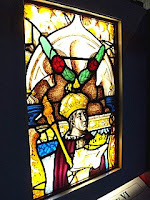

In a way, I felt very sad for Henry VI: he was not of a war-like temper like his father, King Henry V.   He was much more inclined to learning, and to prayer.   He also suffered from periods of insanity, becoming totally unaware of what was going on.   His unpopular French Queen, Margaret of Anjou, virtually ruled England during those periods.   He was in prison, in the Tower of London, when he learned of the death of his only son and heir, Edward of Westminster, Prince of Wales, at the Battle of Tewkesbury in May 1471.   
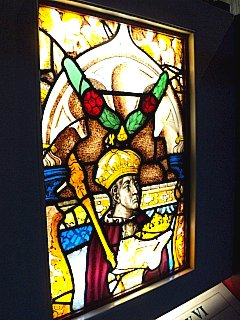
Tradition says his Yorkist enemies murdered him in the Tower of London's Wakefield Tower, while Henry knelt in prayer.  To this day, on the anniversary of Henry's death, the Provosts of the Colleges he founded--King's College and Eton College--lay roses and white lilies at the place where Henry died.   While Henry may not have been the warlike King his father was, his own legacy is much more long-lasting, when one visits King's College, and its gorgeous Chapel.


I stopped briefly in the Choir, for a few more photos.   It was really difficult to leave such a beautiful and historic place as King's College Chapel.   But the afternoon was slipping away, and I wanted to get a few more outdoor photos of the Chapel, before the sun set altogether.   I made my way again to The Backs, where I noticed a few people taking advantage of the lovely day to go punting.   


If it hadn't been November, and I wasn't alone, I might have taken advantage of the opportunity.   It looked like great fun!   But alas, it wasn't to be.   I contented myself with taking photos of the punters on the River Cam.
I think there's a student-run company, that does the punting 'work'; from experience, they probably know how far to stick the pole into the bottom of the Cam, and not tip the punt over.   

The bridge in the photo (left) reminds me a little of Venice, and the punter is the gondolier!  But I don't expect an English punter to suddenly burst out into song: methinks they are a bit more reserved.    But it sure is a beautiful way to go.

I lingered quite awhile on The Backs, taking photos and just absorbing the atmosphere.   I didn't want to leave right away.   The day had been so magical, at the Churchill Archives and then at King's College Chapel.   But I knew I had to get back to London soon, before it got dark.   So I mentally waved 'au revoir' to King's College, and The Backs, and returned to Queen's Road.

When I returned to Queen's Road, I looked around for a taxi stand, but found none.   The traffic was getting heavier, and the daylight lesser, and I was nowhere near the city center.   I asked directions of a couple of people, and I also followed a few road signs (of course, like a fool, I was sure I'd remember my way around, and didn't consult Allen's map!).   

Eventually, I found my way to a busy street near Corpus Christi College: the sidewalks were full of people going to and fro.   I approached a young couple, and asked where I could find a taxi.  The young woman gave me a cell phone number to call, and I wrote it down and dialed--and she gave me a description of the area, to give to the taxi dispatcher.  I thanked her and her companion for their help, and waited for the taxi to arrive.   By this time, my poor feet were screaming in pain, from all the walking in the wrong shoes.   I wanted to curse myself, for not having the right walking shoes....

I waited for the taxi across the road, in front of this rather bizarre-looking thing: it's the "Corpus Clock"--a sculpture clock, it appears.   It's a well-known local landmark (left).   The thing on the top--although it's hard to see it in the photo--is a grasshopper!   Does it symbolize time slipping away?

Here's an interesting bit of trivia: the "Corpus Clock" was unveiled on 19 September 2008, by the world-famous Cambridge physicist Stephen Hawking!

Very soon, the taxi arrived: a big passenger van.   I got in and closed the door, and off we went--straight into Cambridge's rush-hour traffic!   Thankfully, the jam didn't last long, and soon I arrived at the train station.  I paid the driver, and dashed into the station just in time, as the train to London's Kings Cross station was just about to arrive.   By the time the train pulled into Cambridge station, it was just about dark.

Unlike the morning train from London to Cambridge, this one was not an Express train: it stopped at several small stations along the way.   Most of the passengers in my carriage were school kids, and mainly teenagers.   Many of them were a bit loud and very chatty.   But most of them got off at these small stations, to go home.   I pulled a book out of my backpack and tried to read, but all the noise wasn't real conducive to concentration.

After an hour or so, the train pulled into Kings Cross station, and I joined the throng getting off.  Instead of using the Kings Cross Underground station, I went next door to use St Pancras' Tube stop; it's much brighter and newer-looking.   I managed to squeeze into a full train for Victoria Station, and stood for the entire six stops between St Pancras and Victoria.   London's rush hour was going full-tilt, and I joined the heaving throng on the escalator, and heading out onto Victoria Street.   I stopped at the Pret A Manger shop near the station and bought my evening meal, and headed back to the hotel, hoping for a restful night in.   But it didn't quite begin that way!

When I got to my room and tried to open the door with my card-key, it didn't work.   The door wouldn't unlock.   So I backtracked to the Spa at 51 reception desk, where I described my problem to Nabeelah, a very helpful staff member.   She told me the card needed to be 'recharged': evidently, the magnets or whatever weren't working.   She directed me to go to the Front Desk, where I met Patricia, the young Spanish girl who checked me in Saturday evening.   I described the situation again, and she kindly fixed the problem, and the key worked fine afterwards.   Then I was finally able to crash--and get off my sore feet!--and enjoy supper.

It was the end of yet another amazing, and memorable, day in the UK.   I love Cambridge very much!

Thursday, January 27, 2011

Day Fifteen, Part One: Monday, 15 November 2010

A new week has begun--and today, I am off to Cambridge, to a meeting with Mr. Allen Packwood, the Chief Archivist, to see the Winston Churchill Archives at Churchill College.   I was really looking forward to meeting Mr. Packwood, and viewing some of Mr. Churchill's letters, photos and other documents.

It was a bright and sunny November morning: a far cry from the damp and chill of Remembrance Sunday.   I had a round-trip ticket to Cambridge, and would leave around 10 am, so I had a little time to walk about and see some London sights.

I slept like a baby overnight (after all the walking about I did on Sunday), and woke up around 7 am.   After showering and dressing, I decided to walk to the 'other end' of Buckingham Gate, which led me to the front of Buckingham Palace.

The walk was really interesting: I noticed a number of the older buildings had been converted into small businesses--but kept the lovely exteriors.   The area directly in front of the Palace, around the Queen Victoria Memorial, is closed to vehicular traffic--probably for security reasons.   But it's great that one doesn't have to dodge cars around the Memorial any longer.   A few tourists were about, snapping photos.  But most of the foot traffic was made up of commuters walking to work in London.

After I took a few photos of the Palace, I crossed St James's Park to Birdcage Walk, where I heard and saw a military band playing and marching about behind a tall metal fence (photo left).   The bandsmen wore bearskin hats and camouflage uniforms (an interesting combination!).

I also saw soldiers in camouflage, and wearing military berets, near them--and took photos of both through the fence.
I am not entirely sure what unit these soldiers are serving in, but I believe it's the Life Guards (photo right).  

The building behind them is their London HQ, and it holds an excellent Guards Museum.   All these men are serving British military personnel.   I wonder if these fellows were deploying to, or returning from, Afghanistan....

By now, I was feeling very hungry, as I'd not eaten breakfast at the hotel.   I made my way back to Victoria Street, and to Victoria Station, where I'd catch the Underground to Kings Cross Station, and the train to Cambridge.   Near Victoria Station, I found a natural-foods shop called "Pret A Manger" (more about them later!), and went in and ordered a tomato-mozzarella-basil sandwich with tea.   The shop was full of morning commuters, but I did find a place to sit and eat.   The sandwich was excellent!!   And the tea hit the spot, too: enough to take the edge off my hunger.   I then went back outside, and into the heaving mass leaving Victoria Station and heading into central London.

I found the Underground station at Victoria, and arrived at the platform in time to catch the next Tube to Kings Cross.   I stood the whole time, for the short trip to Kings Cross; most of the British passengers were quietly reading the newspaper, or lost in their own thoughts--but two young American women were seated nearby, and they would not stop talking!   I assumed they were probably university students on a semester-long International Studies stay.   And they didn't stop talking when they left the Tube, either!

The Tube finally arrived at Kings Cross, and I got off and walked yet another long corridor out of the Tube station (thank heaven I was only carrying the backpack this day).    In the train station at Kings Cross, I noticed the Express train for Cambridge, and what platform it was leaving from, and made a dash for it--only to discover it was really leaving from a different platform some ways away!   So my fellow passengers and I dashed to the other side of the platform, and got on the right train.   I was out of breath from the dash, and I collapsed into my window seat.

This train had only one stop to make: at Cambridge.   It took around an hour or so, I figured.   The sun shone brightly on the scenery: bare fields and small hills, mostly.   Not as many animals, as I saw on the way to Worcester, however: just a few horses, and the usual 'puffy' sheep.

Before we knew it, the train was rolling into the Cambridge train station.   I was surprised at how small the station was, for such an important city as Cambridge: home to one of Britain's oldest, and best-known, universities.

I hailed a cab outside the station, and asked to be driven to the Provost's House at Churchill College.   The cab driver was a really nice fellow; he told me he'd been a Cambridge cab driver for over 30 years, and never tired of showing his passengers the sights: the various historic colleges that make up the University of Cambridge.   He said that Peterhouse College, for instance, is the oldest Cambridge college, founded in the year 1284.

As we rode along Queen's Road, the cab driver told me to look to my right.   And when I did, I saw the most gorgeous sight: the King's College Chapel, where the Festival of Nine Lessons and Carols has been held every Christmas Eve since 1918.   I've seen many photos of the Chapel, but nothing compares to seeing it 'in the flesh', right before your eyes.   I made a mental note to go visit the Chapel afterwards.

It was around 11 am or so, and my appointment with Mr. Packwood wouldn't be until 12 noon--so I had a little time to wander about and explore the main building at the College.  I didn't go too far afield, however, as I didn't want to get lost.   Just after noon, I went to the Provost's Office (photo left), and asked to see Mr. Packwood.   The gentleman in the Office rang up Mr. Packwood's assistant, and she gave him directions as to where I should go.   I then went into Jock Colville Hall, which houses the Churchill Archives, and almost literally crashed into Mr. Packwood's assistant, who showed me into his office.   And there he was.   He warmly shook my hand, and invited me to sit down.

After the introductions, Mr. Packwood (he invited me to call him Allen) inquired about my UK/Europe travels so far, so I described my wreath-laying 'duty' in Ypres on Armistice Day, and my breakfast meeting in London with Sir Martin Gilbert.   Turns out Allen knows Sir Martin well, and I noticed one of Sir Martin's books on Churchill on a shelf in his office.

Allen then asked me about my research on Leonard Jerome, Winston Churchill's maternal grandfather, and what I had planned to do with what I found.  I said that I was planning to create a Web site about Leonard Jerome's life, and its connections in Upstate New York.

Allen took a few notes, and then said something extraordinary: he'd told me in our pre-visit correspondence that the Archives was sponsoring a major Exhibition on Churchill and his American ancestry, to be held at the Morgan Library in New York City in 2012.   He asked if I would be interested in being a contributor in some way, in assisting the Churchill Archives with any information I might find in historical societies near me (Leonard Jerome was born in the hamlet of Pompey Hill, New York, in the hill country south of Syracuse, and also lived for a time in the Western New York village of Palmyra, and in Rochester, before moving to New York City).   Allen also said he would like to link the Archives site with my Leonard Jerome Web site.

Of course, I was absolutely gobsmacked!   I said it would be an honor, and would do whatever I could to assist the Archives' efforts.   I am still working on the basic Leonard Jerome biography.   Thankfully, the Exhibition is not until 2012, so I still have time....but it'll certainly go by fast!

After this chat, Allen took me on a short tour.   As we left the Archives, we came to an open area between campus buildings, and he pointed out a very large oak tree.   But it's not just any oak tree: it was planted by Sir Winston himself in 1957, as the College was getting on its feet.   It's absolutely huge now (photo left).

To the left of this tree, and close to the building, is a row of more-recently planted younger trees.  And one of them was planted by Sir Winston's youngest--and sole surviving--daughter, Lady Mary Soames, who is an Honorary Fellow (or Faculty member) of the College.   Allen said she wanted to plant it here, so it would stand in the shadow of her father's tree.

On the way back to the Provost's Lodge, Allen told me he had been interviewed for a Canadian documentary, in reference to Sir Martin Gilbert's book Churchill and the Jews.   Allen said he'd been interviewed for quite some time.   But, as things in television usually go, the interview will probably be cut down to a 30-second sound bite!

Allen then led the way into the building behind the tree: the main Administrative building of Churchill College, where staff offices and the Dining Halls are located.   On a stairway near the Dining Halls is a very good sculpted bust of Sir Winston, and Allen asked if I'd like my picture taken next to it.   I agreed, so he took my camera and did so.   I must say it's not a bad photo--more so for the Churchill bust than for me!

Doesn't it look like Sir Winston is pensively getting ready to listen to me (photo left)?

Then, it was up the stairs we went to the Dining Halls, as it was almost lunchtime.   There are a couple of Dining Halls in this building: one for the students, and one for more formal meetings of College officials and their guests.   The students' Dining Hall was quite spacious, and didn't feel like a school cafeteria.  I think the brickwork on the walls, and the extensive woodwork, made it feel much warmer and inviting.

Before we went into the main Dining Hall for lunch, Allen showed me something really exciting: a chair once owned, and sat upon, by Sir Winston himself!   It was nicely padded, with some interesting woodwork on the arms and legs; above it stood a bust of Churchill by the celebrated British sculptor Sir Jacob Epstein.   Allen asked if I'd like to sit in it myself--and, after some hesitation, I agreed!   He asked me to look 'lost in important thought' as I sat down, and he took my photo.   So I can say that I sat my bum on the very same chair that Sir Winston sat upon!   Never thought I'd ever get to do THAT...!

And the proof is the photo at right!  

On the opposite wall from the "Churchill Chair" was a wonderful painting of a younger Winston Churchill done around 1915--the time of the Dardanelles/Gallipoli fiasco in Turkey, during the First World War.  Allen told me it was one of Clementine Churchill's favorite portraits of her husband.   I wish I had gotten the artist's name, and a photo of the painting.

We then arrived back at the Dining Hall for lunch.   Allen graciously paid for the meal: everything looked quite delicious!  I chose lamb with Yorkshire pudding (never had the latter before), zucchini in tomato sauce, and two small desserts: fruit crumble, and one with custard on top.   We found places at the Fellows' Table: the one the Faculty uses!   We sat down and had a wonderful chat about many topics.  One would never have guessed we'd only just met that day.

After lunch, Allen then took me to visit the Archives itself.   As we climbed one staircase, I noticed a large portrait on the wall; Allen told me it was of none other than Professor Barnes Wallace, of The Dam Busters fame.  He is the scientist who created the 'bouncing bombs' which 617 Squadron of the RAF (thereafter known as 'The Dam Busters Squadron') used to destroy several hydroelectric dams in Germany's Ruhr Valley, in May 1942.   Allen told me Barnes Wallace became a Fellow of Churchill College after the war.   And the Barnes Wallace family coat-of-arms includes a picture of the 'bouncing bomb'.

Allen told me the College is doing much work to make the Churchill Archives more accessible to researchers; it has contracted with a company to digitize the documents for online research.   Much of what the Archives currently holds is on microfilm.   And the room where researchers can work was also being renovated.   Eventually, it'll be turned into two huge rooms, where visiting researchers can bring their laptops to work.   Of course, there will also be a whole lot of security measures in place.

The Churchill Archives themselves are stored in a climate-controlled and very secure area.   There is low humidity within, and it was a bit chilly to boot.   Right now, the documents and photos are kept in boxes stored in closed, safe-like shelves--and Allen knows what's in every one of those boxes!   He had brought a few of them out, to show me specific items.

First of all, he showed me several of young Winston's first letters from his boarding school, which were written in huge, well-formed script.   Most of these were written to his mother, Lady Randolph Churchill  (the former Jennie Jerome), but there was also one written to his father, Lord Randolph Churchill.   As Winston got a bit older, he wrote letters from Harrow School that were virtually pleading for his parents to come visit.   In one of those, he pleaded with his parents to send instead his nanny, Mrs. Elizabeth Anne Everest (whom young Winston called "Old Woom")--and she eventually did come to visit.   It is sad that Winston's parents didn't come to see him while in school.  He had to have been a very lonely child.

In another box, Allen showed me letters to Jennie, from Winston as a young man.   There was one written from New York City, where Winston was staying with an American friend, Bourke Cochran; from Cuba in 1895, where Winston was covering the country's rebellion against Spain for a British newspaper; and from South Africa in 1899, where Winston was a journalist covering the Second Boer War.   At this time, his handwriting was much smaller, and not quite as easy to read.

Next, Allen got out of another box a typed copy of now-Prime Minister Winston Churchill's 1941 Christmas Eve broadcast to the American people.   At that time, he was visiting President Franklin D. Roosevelt and staying at the White House.   The copy was double-spaced, with corrections written in Churchill's own hand.   In the same box was a copy of the speech Churchill gave to a joint session of the US Congress, where he refers to Jennie's American birth.   Accompanying this speech was a handwritten insert from Churchill, which said he felt that Jennie would have been proud of what he had accomplished in his life!

Allen told me that Churchill would normally have had dictated these particular speeches to one of his female secretaries.   But on this American visit, he brought along a male shorthand writer, Patrick Kinna, because he felt that crossing the Atlantic with the Nazi U-boat menace in place was much too risky for the women.   Mr. Kinna, by the way, passed away in March of 2009, aged 95.

One of the other US-related documents Allen showed me was a letter from President Roosevelt in 1942, in which FDR quoted a line by the American poet Henry Wadsworth Longfellow: 'Sail on, O Ship of State....'  Churchill had this letter framed, and placed it on the wall at Chartwell, his country house in Kent.   He even saved the envelope, in which FDR addressed Churchill as a 'certain Naval person'--referring to Churchill's service as First Lord of the British Admiralty during the First World War.   Churchill and Roosevelt had actually met once before: in London in the 1920s, when FDR was US Secretary of the Navy. At the time, Roosevelt didn't think much of Churchill as a person.

The next box Allen got out was huge, and it contained something really special: one of Churchill's personal photo albums.   In this one I found several photos of Churchill as a child, that I'd seen in several other books: one of him with his mother and his younger brother, Jack.   And there were the original formal photos of Lord Randolph and Jennie I'd also seen in books.

Also in this album were photos of Winston in military uniform in India and South Africa; on the political stump after the Boer War; and with his wife Clementine.   I noticed some empty spaces, with tear-marks: Allen said it was most likely done by Clementine, who often didn't like her own photos.   (I can relate to her on that!)   Allen didn't show all the photos in this album, as the binding was showing some signs of wear.   He didn't want to put extra stress on it, especially the album's spine.

The Churchill College Archives not only contain Winston Churchill's public and private papers.  It now also holds the papers of Second World War Field Marshal William Slim (who mainly served in the South-East Asia and Burma campaigns), and former UK Prime Minister Margaret Thatcher.   The latter were the most recent donations to the Archives, and can't be revealed yet for some time.   But Allen did show me something interesting: the handbag that Mrs. Thatcher used while Prime Minister!   It had a note with it, in her own hand.   And I was able to touch the bag with my own hands!   I think it was made of alligator skin.

There was also another fascinating Thatcher-related display: two British flags and an Argentinian flag, from the Falkland Islands.   One British flag was rather battered: it was from the islands' capital, Stanley, and had seen hard service during the Falklands War between the UK and Argentina, from April to June 1982.   The other British flag was from the Royal Navy ship leading the Task Force that liberated the Falklands from the Argentinians; the widow of the ship's commander donated the flag to Mrs. Thatcher.   I suppose the Argie flag was a war trophy....?

By now, it was early afternoon, and Allen led me back out of the Archives, and back to his office.   He gave me a signed copy of the brochure done for a Churchill exhibit in Washington DC (and it was one of only a handful of brochures left!), and a map of Cambridge itself, in case I wanted to go see any of the other historic Colleges.   He led me out to the entrance of the Provost's Office and shook my hand and thanked me for coming.   In turn, I thanked him profusely for his time, and for lunch and the awesome visit to the Churchill Archives.

I had such a memorable time here!   I hope I can make a return visit soon.

It was a beautiful day for a walk, so I decided not to hail a taxi or take a bus back into Cambridge.   My next destination: King's College Chapel, which will be the subject of Part Two!

Thursday, January 20, 2011

Day Fourteen: Remembrance Sunday, 14 November 2010

"At the Going Down of the Sun, and In the Morning,
We Will Remember Them".

This day was unlike other Sundays in the UK.   It was Remembrance Sunday, where the British once again paused to remember their war dead, in churches large and small, and in civic services.  

For me personally, it was another unforgettable day in London.

It started out gray and chilly, but rain-free, as I walked from my hotel, up Victoria Street to Westminster Abbey, in hopes of attending its special Remembrance Sunday Service.   I didn't have time to eat breakfast beforehand, as I wanted to be sure to get to the Abbey in time before the 10:30 am service.   When I arrived, I spent time in the Field of Remembrance, taking lots of photos of the various 'fields' placed by regiments, Service support units, and veterans' organizations.

But before that, I had a chance to chat with two UK Second World War veterans, who were waiting to attend the Abbey service (photo left).   The fellow on the right was a Scot who served in Italy with an English unit; I think he lied about his age in order to enlist.

I wished I'd gotten their names.   But before I left them, I took their hands in mine and thanked them for their service.   They were pleased with that.  And I have the feeling the Scot was trying to flirt with me....!

Off I went to the Field of Remembrance.   There were lots of photo opportunities here.  And there were a lot of people about, pausing to look at the names on the Memorial crosses, and also waiting to be admitted to the Abbey service.   I saw both elderly veterans wearing their Service medals, and young current Service personnel, including some rather dashing (and boyish-looking!) Royal Navy sailors.

Memorial Wreath In Honour
of the British Army.
Field of Remembrance, Westminster Abbey.
It was absolutely staggering, how many 'Fields' there were, 'planted' on the Abbey green.   One saw memorials for all sorts of units in the British Armed Services: historic regiments, Support Services, units made up of Second World War or Korean War veterans.   There were 'Fields' for Dragoon Guards and Dragoons, Life Guards and Household Cavalry Regiments, the Hussars, the Lancers, London Regiments, and various Royal British Legion plots.   

Some of the names were rather whimsical, and so totally British: the Memorable Order of  Tin Hats is just one; another is the Old Contemptibles: the original British Expeditionary Force in the First World War; these men were the survivors of the pre-war British Army, which was made up of career professionals.  

The name "Old Contemptibles' comes from a comment made by Germany's Kaiser Wilhelm II, who was dismissive of the small British Army sent to fight German forces in Belgium and France.  In 1914, he supposedly issued an order to '....exterminate the treacherous English...and walk over General {John} French's contemptible little army'.   Hence, The Old Contemptibles.

The UK Services Personnel 'Field' was quite large.   Many of the poppy crosses displayed photos of men and women who were killed in both Afghanistan since 2001, and in Iraq after 2003 (photo left).   

Other UK Service Personnel "Fields" included those 'Unknown Soldiers' who were probably killed in both World Wars, whose remains were never found, and have no known grave.   I imagine they represented many of the names I saw on the Menin Gate Memorial in Ypres.   Those were located on the Green on the Abbey's North side.

I also saw 'Fields' for several other countries: Australia, Canada, New Zealand--and even the United States.  The 'Field' for Canada (photo right) was almost as large as the one for UK Service Personnel killed in Afghanistan.   Many of the poppy crosses had photos of the Canadian Forces personnel who've died in Afghanistan since 2001.

There were also poppy crosses for Canadian Forces members who died in both World Wars, and in Korea.

I lost count as to how many photos of the Field I took that morning.   I couldn't take enough of them, they were all so poignant.

Memorial Wreath for the Royal Air Force.
Field of Remembrance, Westminster Abbey.

 I noticed a lot of uniformed Armed Services personnel around the Abbey, and I was afraid I would need a ticket to attend the service there.   For a few moments, I almost decided to attend the same service at St Margaret's Church next door.

But I took a chance, and went to the Abbey's West Door, and inquired whether I did need a ticket to attend.   Thankfully, it was not the case!   I was escorted to a few rows of 'non-reserved' seating right beside the Choir Screen, on the right side.   I found a seat in the very last row, and sat down to wait, and observe the scene around me.

The Abbey slowly began to fill up, while I watched.   I saw many Armed Services personnel in their dress uniforms, and veterans of past wars with their chests full of medals.   I also noticed many of the women were dressed up, and wearing very fancy hats (although nothing that could be considered 'over-the-top').   I must admit I felt a bit under dressed, even in my best black trousers and black dress shirt!

Soon, a middle-aged British couple sat down next to me, and introduced themselves; their names were Jenny and Adrian.   Adrian was a Second World War veteran; he told me he served in Italy, and he wore several Service medals.   I chatted with them quietly before the service began; I shared with them about my wreath-laying 'duty' in Ypres, and my breakfast with Sir Martin Gilbert.   I must admit they were impressed by that.  When I thought about our encounter afterwards, I felt like a shameless name-dropper....

The service itself began promptly at 10:30 am.   It started with the Lord Mayor of Westminster, Judith Warner, being conducted to her seat in the Choir, and was soon followed by the clergy and choir of Westminster Abbey  in procession from the West Door.   The congregation stood and sang O God Our Help In Ages Past--all the verses.  And it was sung robustly by all present.

After a Bidding prayer by the Dean of Westminster, John Robert Hall, the Abbey Choir chanted Psalm 46: "God is our hope and strength; a very present help in trouble....".   This was followed by a reading from Isaiah, Chapter 65, by the Lord Mayor of Westminster:

"For I am about to create new heavens and a new earth; the former shall not be remembered, nor come into mind.  I will rejoice in Jerusalem, and delight in My people: no more shall the sound of weeping be heard in it, or the cry of distress.  No more shall there be in it an infant that lives but a few days, or an old person who does not live out a lifetime; for one who dies at a hundred years will be considered a youth, and one who falls short of a hundred will be considered accursed.  They shall build houses and inhabit them; they shall plant vineyards and eat their fruit.  They shall not build and another inhabit: they shall not plant and another eat; for like the days of a tree shall the days of My people be, and My chosen shall long enjoy the work of their hands.   Before they call I will answer, while they are yet speaking I will hear.  The wolf and the lamb shall feed together, and the lion shall eat straw like the ox; but the serpent--its food shall be dust!   They shall not hurt nor destroy on all My holy mountain, says the Lord".


The next hymn, "Thy Kingdom Come, O God", was the first unfamiliar (to me) hymn in the service.  I listened to the melody of the first verse, and then sang the subsequent verses.  This was followed by the next Lesson, read by Rev. Dr. Nicholas Sagovsky, Canon in Residence, from Romans Chapter 8:

"What then are we to say about these things?  If God is for us, who is against us?  He who did not withhold His own Son, but gave Him up for all of us, will He not with Him also give us everything else? Who will bring any charge against God's elect?  It is God Who justifies.   Who is to condemn?  It is Christ Jesus, Who died, yes, Who was raised, Who is at the right hand of God, Who indeed intercedes for us.  Who will separate us from the love of Christ?  Will hardship, or distress, or persecution, or famine, or nakedness, or peril, or sword?  No, in all these things we are more than conquerors through Him Who loved us.  For I am convinced that neither death, nor life, nor angels, nor rules, nor things present, nor things to come, nor powers, nor height, nor depth, nor anything else in creation, will be able to separate us from the love of God in Christ Jesus our Lord".


As the congregation remained seated, the Abbey Choir sang the Anthem, its text taken from Revelation 21: 1-4.   It is one of the most moving sections of the Bible, and was particularly so on this day:

"And I saw a new heaven and a new earth: for the first heaven and the first earth were passed away; and there was no more sea.  And I, John, saw the Holy City, the New Jerusalem, coming down from God out of heaven, prepared as a bride adorned for her husband.  And I heard a great voice out of heaven, saying, Behold, the tabernacle of God is with men, and He will dwell with them, and they shall be His people, and God Himself shall be with them, and be their God.  And God shall wipe away all tears from their eyes, and there shall be no more death, neither sorrow, nor crying, neither shall there be any more pain; for the former things are passed away".


I hope that last verse brought some consolation to those in the congregation, who might have lost a family member in Afghanistan during the year.


Then followed the Intercessions, led by the Rev. Michael Macey, Minor Canon.   After that came another unfamiliar hymn, "Judge Eternal, Throned in Splendour".  The words were beautiful, indeed.  Then the clerical and lay Procession--including Official Representatives of the Merchant Air Service, The Merchant Navy, the Commissioner of the Metropolitan Police, the Royal Air Force, the Royal Navy and the Army--moved to the Tomb of the Unknown Warrior, located just inside the West Door (photo left).   The congregation all stood, as the Dean read this prayer:

"O Lord our God, Whose Name only is excellent and Thy praise above heaven and earth: we remember in Thy Presence those who laid down their lives in war.  May they find fulfillment in Thy eternal Kingdom; and grant that we may dedicate our lives to the causes of justice and freedom, for which they died: through Jesus Christ our Lord.  Amen".


The Abbey Choir then sang one of the most moving pieces of music I've ever heard: The Kontakion For the Dead, which sounded very much like a Russian Orthodox chant:

"Give rest, O Christ, to Thy servants with Thy saints: where sorrow and pain are no more; neither sighing, but life everlasting.  Thou only art immortal, the Creator and Maker of man: and we are mortal, formed of the earth, and unto earth shall we return, for so Thou didst ordain, when Thou createdst me, saying, Dust thou art, and unto dust shalt thou return.  All we go down to the dust; and weeping o'er the grave, we make our song: alleluia, alleluia, alleluia!  Give rest, O Christ, to Thy servants with Thy saints: where sorrow and pain are no more: neither sighing, but life everlasting".


By now, it was 11 am.   From the outside, we could hear Big Ben sounding the hour, followed by a loud blast which shook the Abbey: it was an artillery piece fired from Hyde Park, to signal the start of the Two-Minute Silence.   I heard a couple of scattered coughs; but otherwise, it was total silence in the Abbey.   And the same Silence was taking place not far away, in Whitehall at The Cenotaph.  That was where HM The Queen, the senior Royals, the Prime Minister, other Government and Military leaders, and members of the public were participating in their own Service of Remembrance.

When the Silence ended, the Abbey Choir sang the famous verse from First World War poet Laurence Binyon's poem For the Fallen:


"They shall grow not old as we that are left grow old
age shall not weary them nor the years condemn.
At the going down of the sun, and in the morning,
We will remember them".

And everyone present, including myself, repeated: "We will remember them".

We all stood, as the first notes of The Last Post sounded through the Abbey.   Tears rolled down my cheeks--and then Jenny gently touched my shoulder, and pointed to the Choir Screen above me.   As I looked up, I could just see the front edge of the bugle sticking out above the wall.   The Bugler was right above me!   As the final note slowly died away, the Bugler suddenly sounded Reveille, which rang throughout the Abbey.


Here's a YouTube video of
the Remembrance Sunday Service at
The Cenotaph in Whitehall.
The Last Post is included in the video.

Next, the congregation sat back down, and the Choir sang, in Latin, a Renaissance chant by English composer William Byrd (one of my favorite composers), with words from the Apochryphal book of Wisdom: "The souls of the righteous are in the hand of God, and there shall no torment touch them.  In the sight of the unwise they seemed to die: but they are at peace".   This was followed by the Dean leading the congregation in reciting the first half of Francis of Assisi's prayer, Lord, make us instruments of Thy Peace, followed by The Lord's Prayer.   

After the prayers came the last unfamiliar hymn sung by the Abbey Choir and the congregation: Christ Is the World's True Light, sung to the more-familiar tune of Now Thank We All Our God.   Again, I semi-sang the first verse, and then felt more confident in joining in with the last two verses.

The service ended with The Blessing, followed by the singing of God Save the Queen.   I sang along, as, I suppose, an 'honorary Brit' for the day.   As the Processions left the Abbey, the congregation remained standing, and then after bidding farewell to Jenny and Adrian (with whom I shook hands, and I gave Adrian a kiss, in thanks for his military service), I followed the crowd out towards the West Door.   On the way, I briefly stopped before two young Army men dressed in splendid formal uniform and thanked them for their service.

As the congregation passed round the Tomb of the Unknown Warrior, many placed poppy pins on the grave in respect.   I found one at the outside edge of the Tomb and bent to pick it up and place it--and, in regaining my balance, accidentally grasped one of the flanking candlesticks by the Tomb, and almost knocked it over--and it was a lit candle to boot!   What an embarrassment that moment would have been!!!

As I left the Abbey precincts, my original plan was to walk up Whitehall to Trafalgar Square, where I would meet my British friend Myles and his daughter Megan, and together we would pay a visit to London's National Gallery.   But I soon noticed that would be impossible: there were metal crowd-control barriers up on both sides of Whitehall: not for any public demonstrations, but instead for the Royal British Legion's Remembrance Sunday March-Past, consisting of Legion members and veterans--all marching up from the service at The Cenotaph.

I joined the crowds lined up along Parliament Square, who awaited the arrival of the March-Past.   Of course, there was a band to start the march off, in great British style.  I wasn't sure if these men in the photo (photo left) were from the Life Guards or Coldstream Guards.  But I've always loved the huge bearskin hats they wear.   How in the world do they see where they're going?
I recognized the red coats of the Chelsea Pensioners: (photo right) the residents of the Royal Hospital Chelsea, a retirement and nursing home for British soldiers located in Chelsea, central London.   The Hospital was founded by King Charles II, by Royal Warrant, in 1681, to make provision for injured and disabled soldiers.  

The main building of the Hospital was designed by Sir Christopher Wren, the architect of St Paul's Cathedral in London.
I also recognized the veterans of the Parachute Regiment by their distinctive red berets (photo left).   I wondered how many of the veterans might have served in the Second World War's major airborne campaigns, such as Operation Market Garden in The Netherlands, in September 1944?  Or maybe on D-Day, 6 June 1944?  How many of their deceased comrades were they thinking about at that moment?

There were both young men and elderly veterans marching smartly past; one of the younger officers would march alongside the veterans and shout out 'left-right-left-right'', and the veterans did everything possible to stay in step.   Some were infirm enough to be in wheelchairs, but it didn't keep them from obeying the young officer!

I took quite a few photos during the March-Past (photo left).   It was so wonderful to see the crowds come out to applaud both the veterans, and current Service Members, and show their support.   The applause was both warm and enthusiastic, but never over-the-top.  It's definitely the British way of doing special days like this.

I couldn't leave Parliament Square without taking a photo of the statue of Sir Winston Churchill, as he looks over towards the Houses of Parliament (below, left).

All that week, there were fence barriers in front of the statue--there were demonstrators around the edges of the square, protesting the UK's military involvements in Afghanistan and Iraq.   Several of them had put up tents, and appeared to be wanting to stay for awhile.  But they were not allowed in the Square proper.  I suppose the fences were put up in order to protect the grass from being trampled upon over much, by the demonstrators and curious visitors.

The demonstrators were peaceful; they didn't harass passers-by like me.   And I didn't make any eye contact with them.   I wonder what Mr. Churchill would have thought of them?   I would imagine he would have let them say their peace, so long as it was 'peaceful'.   If they weren't, I'm sure he would have done whatever was needed to keep the peace.   And maybe he would have let the demonstrators feel the full force of his oratorical skills!   Now that I would have loved to have seen and heard!

It was now raining a bit more steadily.   And try as I might, I could not find a way out of the crowds to get on my way to Trafalgar Square.   Eventually, I followed a few people with the same idea in mind (at least in finding a way out).   I found myself on a narrow side-street with beautiful Queen Anne-style townhouses with shiny-painted doors and brass knockers.   The windows hung out over the street, which was a bit crooked too.

I wish I'd gotten a few photos of these buildings.   It was as if the Second World War had never touched this area of Westminster!

When I came out of the street, I found myself in St James's Park.  I asked a nearby female Bobby how to get to Trafalgar Square; she said to 'follow the red brick road'--a red gravel path actually--to The Mall.  I thanked her, and crossed a bridge over a lake--and noticed, to my left, Buckingham Palace (photo left) and the Queen Victoria Memorial.

The Park has become one of my favorite places to be in London.   Walking along its paths is the best way to relax, after a long day's worth of walking and sightseeing.

Walking along the lakeshore, where ducks, geese and swans congregated, I noticed a most  interesting marker in the path (photo below). This portion of the path through St James's Park was dedicated to the memory of the late Diana, Princess of Wales.  


I think she would have liked this walk, through such a beautiful green area of London.

Soon, I found The Mall: the great ceremonial road between Admiralty Arch (photo right) and Buckingham Palace.  Admiralty Arch was dedicated in 1910 by King Edward VII, as a memorial to his mother, Queen Victoria. 

There were no cars on The Mall this Remembrance Sunday, which was really nice.

 As I looked up over the buildings to my left, I found Lord Nelson's Column towering above all.   I was very close to Trafalgar Square!   I walked up The Mall and through Admiralty Arch, and then up a short flight of steps to the Square.

Soon, I would be standing in one of London's most famous gathering places: Trafalgar Square, dedicated to the memory of Admiral Horatio, Lord Nelson--one of Britain's most famous military heroes.   He fought against the navy of the French Emperor, Napoleon Bonaparte, in the early years of the 19th century; the Square is named for one of Lord Nelson's greatest victories, the Battle of Trafalgar, fought off the coast of Spain, on 21 October 1805.

Sadly, it was the Admiral's final victory: he was mortally wounded during the battle, and died the same day.   He was brought back to the UK and given a State funeral, and was buried in London's St Paul's Cathedral.

Trafalgar Square's focal point is the Lord Nelson Column, in the center (left photo).   It displays friezes of four of Nelson's most notable victories: Cape St Vincent, The Nile, Copenhagen and Trafalgar.   At the very top is a statue of the Admiral himself, looking out over Whitehall.  The Column itself was built between 1840 and 1843, to commemorate Lord Nelson's death at Trafalgar. 

The Column is 'guarded' on four sides by fierce-looking British lions (right).   These 'beasts' have been photographed and climbed upon by tourists and Londoners alike, since they were put in place in 1867.     The lions were designed by Sir Edwin Landseer, and sculpted by Baron Marochetti.

For myself, I think these lions look quite magnificent!

Trafalgar Square has been the site of moments of national rejoicing, and national sorrow, in Britain.   It was the site of joyous V-E Day celebrations during the Second World War, and on 6 July 2005, when London was awarded the 2012 Summer Olympic Games.   And it also held a mournful gathering a few days later, after the 7 July terrorist transit bombings in London.   So it's seen its share of laughter and tears.

One thing I just discovered: if the Nazis had successfully invaded Britain in Operation Sealion in 1940, Adolf Hitler would have dismantled Lord Nelson's Column, and moved it to Berlin, as a war trophy!   Good thing that didn't happen.   It would have made the British people even more eager to defy the Nazis.

There are so many sights to see around Trafalgar Square: there is the National Gallery of London, the Church of St Martin-in-the-Fields, its two fountains--and the 'Fourth Plinth".   About the last-named sight: there are four statues on plinths flanking the Square.   Three of them are currently 'occupied': one is an equestrian statue of King George IV.   But this 'Fourth" was supposed to hold an equestrian statue of its own, but that didn't happen.   So in 1998, the Royal Society of Arts came up with "The Fourth Plinth Project", where local artists would display their works on the empty plinth for a period of time.

And at this time, there was placed a most appropriate 'work of art' for the Square (photo left): it is Lord Nelson's Trafalgar flagship HMS Victory--and she's encased in a glass bottle, like a model ship!   She's got one little detail that Lord Nelson could never have foreseen: her sails are made of African-patterned cloth.

I had to laugh, and wonder what Lord Nelson would think of this.  I would hope he wouldn't have let loose a barrage of naval oaths....

The church of St Martin-in-the-Fields (photo right) is an Anglican church that is on the northeast corner of Trafalgar Square.   A church by that name (named for its patron saint, St Martin of Tours, in France) has been on this site since at least 1222.   The current building was designed by James Gibbs, and erected in 1721.

It is also home to the world-famous Academy of St Martin-in-the-Fields chamber orchestra, founded in 1959 by conductor and violinist Sir Neville Marriner.

The National Gallery of London is located on the back side of Trafalgar Square, and overlooks the Square, and Whitehall.  It is home to a collection of over 2300 works of art, from the mid-13th century to 1900.   Its current building was designed by architect William Willkins, and was constructed between 1832 and 1838.  The front facade has pretty much stayed the same since then.   But its interior gallery space has been expanded in various stages throughout its history.

This Remembrance Sunday, I would be visiting the National Gallery (photo left) in the company of my British friend Myles and his young daughter Megan.   They were coming from Surrey, the southern county closest to London.

It was now close to 1 pm, and the rain was still coming down.  The wind also began to pick up a little, and I was becoming chilled to the bone, as I stood close to Lord Nelson's Column.   I did receive a text-message from Myles, stating that he and Megan would be arriving at Waterloo Station shortly.

 I decided to get out of the rain, if only for a few minutes, so I ducked into a nearby bookshop: Weatherstone's, which faced Trafalgar Square.   I'm glad I did stop in: it was a paradise for the book-lover in me!   I immediately went to the History section downstairs, and found a copy of Sir Martin Gilbert's The Holocaust: the Jewish Tragedy.   I bought that, and The Wicked Wit of Winston Churchill, a collection of some of Churchill's most famous humorous stories and quotes.  

I also bought two more books in British author Susan Howatch's Church of England/St Benet's series of novels: Glittering Images and The High Flyer, respectively.   These two series of novels are among my favorites; I've read all of them, though not in the order in which they were written!

Carrying my purchases, I popped out of Weatherstone's, and went back over to Lord Nelson's Column to wait for Myles and Megan.    Sure enough: just after 2 pm, they arrived: Myles hugged me in greeting, and introduced me to his young daughter Megan, and I introduced myself to her.   Myles and I have been email correspondents for just over ten years, and I was so glad to finally meet him in person!   The three of us then walked across the wet Square to our destination: the National Gallery of London.

The National Gallery is home to some of Britain's greatest art treasures, and we were going to see as many of them as we could, in a short time.  

The Gallery is laid out in some of the most gorgeous rooms I've ever seen: high ceilings, beautiful woodwork round the doors, and perfect lighting effects.   We found works by masters such as Leonardo da Vinci, Vincent Van Gogh, Titian, Peter Paul Rubens, Rembrandt, and most of the French Impressionists, such as Claude Monet and Edouard Manet.   We also saw English works by John Constable, Turner, and Sir Thomas Gainsborough--and King Henry VIII's favorite painter, Hans Holbein the Younger.

One of Holbein's works was of the teenage Princess Christina of Denmark, (photo left) painted in 1538, during the time Henry was looking for his fourth wife.   She turned the King down, saying "If I had two heads, one would be at the King of England's disposal"!   Christina was definitely a smart girl!!

The Princess was quite lovely, dressed in a long black gown, with a black cap covering her head.

One of the most moving works we saw was one by the 18th-century French artist Hippolyte (Paul) Delaroche, depicting the moment before the execution of Lady Jane Grey at the Tower of London on 12 February 1554 (photo right): Lady Jane is blindfolded, and is searching frantically for the block, on which she is to lay her head; a sorrowful clergyman is guiding her gently there, as the sad Executioner and Lady Jane's grieving ladies look on.   It is a massive work, and there was quite a crowd looking at it.

The two photos of the aforementioned works are not my own.  Visitors could not take photographs inside the National Gallery, so I have to be content with photos from the Internet.

 One of the British works I particularly liked was one painted by Constable of Salisbury Cathedral: somehow, the artist managed to depict a perfect rainbow above the cathedral.   Whomever put these displays together knew how to delight and overwhelm the visitor at the same time!

We were there about a half-hour, when Megan said she was hungry, so we trooped downstairs to the self-service Cafeteria for a little lunch.  Myles bought Megan a nut-less cake and fruit cup for himself, and I selected a tomato-mozzarella-basil sandwich.   Myles graciously paid for all three of us.  

We managed to find a place in the very-crowded eating area, and had an opportunity to chat.   Myles gave me a copy of the program from the Guildford Opera Company's production of Gaetano Donizetti's Lucia di Lammermoor, in which he played the role of Normano, the Captain of the Guard.   Myles is a very talented singer and actor; he's performed in local repertory productions of musicals like Guys and Dolls and the rock opera Jesus Christ Superstar.   

All too soon, we were finished with lunch, and we made our way back to the galleries, to see more paintings.   On the way upstairs, Myles told me his father was pleased I knew of Gonville & Caius, one of the colleges at the University of Cambridge.   It seems the elder Mr. Harfield is a Gonville & Caius man.   This college figures prominently in one of my favorite films, Chariots of Fire; one of the main characters, Olympic champion Harold Abrahams, is a Gonville & Caius man.

We didn't see many more paintings, alas, as it was getting late in the afternoon, and Myles and Megan had to get back to their hometown of Farnham.   When we got back outside, I asked them if I could take their photo, to remember our time together.   Myles said yes, and that's what we did (left).

When we got back into Trafalgar Square at Lord Nelson's Column, I hugged Megan goodbye, and wished her a good week at school; I then hugged Myles, and thanked him for lunch, and for the company at the National Gallery.   And then they were off, back to Waterloo Station, and home.

It was around 4 or so, and the rain had finally stopped--mercifully.   But the streets of London were still full of people, as I made my way back along Whitehall, to Westminster.   Whitehall was now open to vehicular traffic; it had been closed during the ceremony at The Cenotaph, and the Royal British Legion March-Past earlier in the day.

I walked the entire length of Whitehall, passing Horse Guards (the horses and their riders were not 'on duty' outside overnight), and stopped at The Cenotaph (photo left), to look at the floral tributes left by The Queen, senior Royals, the Prime Minister and his Government, regimental organizations, veterans' groups, and many others.   I also took photos of both sides of The Cenotaph.

Many passers-by stopped along the metal fence surrounding The Cenotaph, to read the inscriptions on the cards on the wreaths, or to look for a specific wreath.   The crowd was quiet and dignified: no shouting or even laughing.   It was a very moving thing to see.

I was really amazed at the number of passers-by, at this time of the evening.   I suppose that a major city like London never really 'sleeps'.   There is always something going on.

But on this particular evening, there was still a solemnity in the air: that this was not supposed to be 'just any Sunday' evening in London.   It was a day to reflect, and to remember, all those Britons who had given their lives in war; or, as President Lincoln said so perfectly in the Gettysburg Address: 'the last full measure of devotion.'

I left The Cenotaph, and arrived at Parliament Square, and took some photos of the illuminated Houses of Parliament.   One came out particularly well.   I was quite surprised to see this photo (photo right) : a moonrise behind the floodlit St Stephen's Tower.

I then turned near Westminster Abbey, up an equally busy Victoria Street into a quieter Buckingham Gate, and the hotel.  I soon 'crashed' for the evening, and slept like a rock: a perfect ending to a really memorable, and very moving, Remembrance Sunday.